 Watch on YouTube ↗
Hardware Unboxed ·
Graphics cards / Review roundup
Desktop GPU; not the non-XT RX 9070
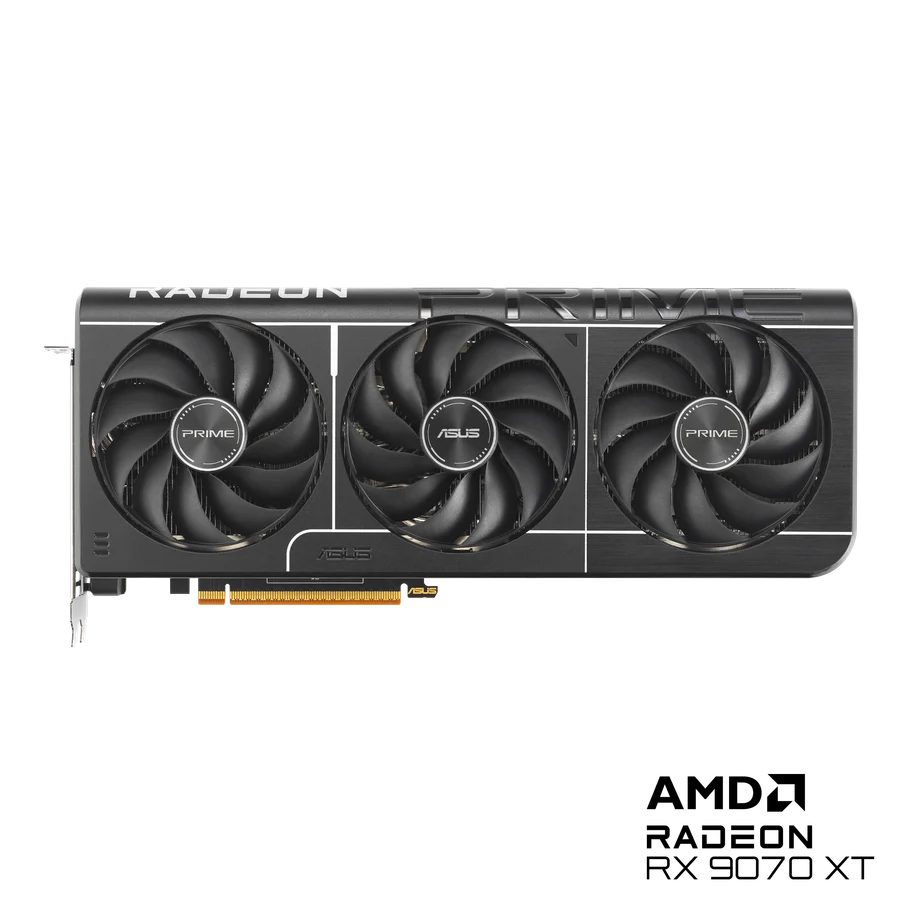
The Radeon RX 9070 XT is the card AMD needed to build: a high-efficiency RDNA 4 powerhouse that directly challenges Nvidia's upper midrange without the usual heavy ray tracing penalty. It trades blows with the GeForce RTX 5070 Ti in traditional rasterization and finally narrows the RT gap thanks to overhauled hardware traversal and machine-learning-driven FSR 4. You still miss out on DLSS's wider adoption and superior productivity/CUDA compute, but at a typical street price around $600 to $650, it is the best pure raster gaming value in its class.
We may earn a commission from purchases or qualifying sign-ups through our links. Affiliate links explained
Across broad multi-game suites, the RX 9070 XT positions itself firmly between the RTX 5070 and RTX 5070 Ti, frequently edging ahead in pure raster titles. In TechSpot's 52-game testing suite, the 9070 XT averaged 88 fps in Marvel Rivals at 1440p and 51 fps at 4K. In God of War Ragnarök, it traded blows with the RTX 5070 Ti, while easily crushing older-generation favorites. Tom's Hardware highlighted the card as the sweet spot for 1440p ultra settings while acting as a reliable, cost-effective entry point for 4K 60 fps gaming. Interestingly, TechSpot also revealed that under very high refresh rates (200+ fps at 1080p/1440p), AMD's lighter driver overhead lets the 9070 XT push fewer CPU-bound frame drops than Nvidia's top silicon, making it exceptionally nimble for esports.
Historically AMD's Achilles' heel, ray tracing sees its largest generational leap yet with RDNA 4's overhauled BVH traversal logic and 64 second-gen ray accelerators. In hardware-accelerated games like Metro Exodus Enhanced and Alan Wake 2, Tom's Hardware and TechSpot observed that the RX 9070 XT now comfortably matches previous-gen GeForce RTX 4080-class ray tracing speeds. While extreme path-traced overhauls like Cyberpunk 2077's Overdrive mode still heavily favor Nvidia GPUs, the card remains fully playable with AMD's updated FSR 4 upscaler. Reviewers at Tom's Guide noted that FSR 4's machine-learning-based reconstruction substantially narrows the visual quality gap with DLSS, delivering crisp edges and minimal shimmer.
AMD equipped the RX 9070 XT with 16GB of GDDR6 memory across a wide 256-bit bus, producing 640 GB/s of raw bandwidth. Both PC Gamer and TechSpot praised this configuration, noting that 16GB provides comfortable breathing room against modern VRAM-guzzling titles running maxed-out texture packs at 1440p and 4K. Unlike competitors who have released 12GB or sub-256-bit variants at similar pricing tiers, reviewers agree that 16GB ensures the 9070 XT will not encounter sudden 1% low frame-time crashes due to local video memory spills over the next several years.
Built on TSMC's 4nm process (N4P), the Navi 48 die is rated for 304 watts Total Board Power (TBP). TechSpot's 14-card roundup showed that partner designs handle this thermal envelope gracefully. Custom triple-fan cards like the Sapphire Nitro+ and ASRock Steel Legend routinely stabilized GPU core temperatures between 62°C and 67°C under sustained load with near-silent fan profiles hovering below 34 dBA. Factory-overclocked variants pull closer to 330W when boosting past 3.1 GHz, but heat dissipation remains well within standard ATX case airflow tolerances.
Because AMD opted not to produce an official Made-by-AMD reference card for retail, sizing depends entirely on add-in-board (AIB) partners. Most partner models measure roughly 295 mm to 320 mm in length and occupy 2.5 to 3 expansion slots. A major plus highlighted by reviewers is power delivery: virtually all standard retail cards use two tried-and-true 8-pin PCIe power cables rather than the controversial 16-pin 12V-2x6/12VHPWR connector. Outlets recommend a solid 750W to 850W power supply, allowing existing system owners to drop the card in without buying new modular cables or power supplies.
AMD announced an official MSRP of $599, though initial retail availability saw board partner cards floating between $650 and $739 due to high demand and lack of reference models. However, retail pricing has since stabilized near the $599 to $629 mark. When stacked against the RTX 5070 Ti (which frequently sells north of $750) and the RTX 5070, reviewers consistently find the RX 9070 XT delivering superior cost-per-frame metrics across raster titles and unmatched value in high-resolution gaming.
Early board partner markups briefly inflated prices past $700, but regular retail inventory has settled near MSRP, making it significantly cheaper than its primary competitor, the RTX 5070 Ti.
PERFORMANCE
GeForce RTX 5070 Ti scores 2% higher average frame rate than Radeon RX 9070 XT in this test.
Tom’s Hardware · full test results ↗ · Original chart ↗Published March 5, 2025 · checked 2026-10-06
March 2025 launch review; Ryzen 7 9800X3D, 32GB DDR5-6000. PowerColor Reaper RX 9070 XT and RX 9070, Asus Prime RTX 5070 Ti, RTX 5070 Founders Edition. Launch-era drivers apply; see the review’s test setup. Native rendering, no upscaling or generated frames; geometric mean.
Historical review snapshot. Tests use this publication’s common system and suite; game patches and drivers can differ between the included cards. Results are kept separate from other review suites.
| Product | Result | Against first measured model |
|---|---|---|
| Radeon RX 9070 XT | 60 | 0% |
| GeForce RTX 5070 Ti | 61.2 | 2% |
| GeForce RTX 5070 | 46.7 | -22.2% |
| Radeon RX 9070 | 52.2 | -13% |
Bars start at zero. Results apply to the tested configuration and settings. Percentage differences use the first measured model as the baseline; they are not a combined rating. A suite average is not the frame rate of every game. 1% lows describe the slowest portion of frames and help expose uneven delivery. Missing products are never assigned zero.
Help choosing
Key differences, review evidence and who should buy each model.
Watch on YouTube ↗Hardware Unboxed ·
 Watch on YouTube ↗
Hardware Unboxed ·
Offers slightly faster ray tracing, broader DLSS 4 support, and superior productivity/CUDA compute, though at a $100 to $150 price premium.
A binned variant running at lower wattage that saves around $50, but sacrifices roughly 10-14% performance compared to the XT.
Matches the sub-$600 price point, but trails the 9070 XT significantly in raw rasterization framerates and memory bandwidth.
This roundup summarizes professional reviews and published specifications; Next Interrupt did not test the product. Roundup updated October 15, 2026. How we work