 Watch on YouTube ↗
Hardware Unboxed ·
Graphics cards / Review roundup
Desktop GPU, 12GB; not RTX 5070 Ti
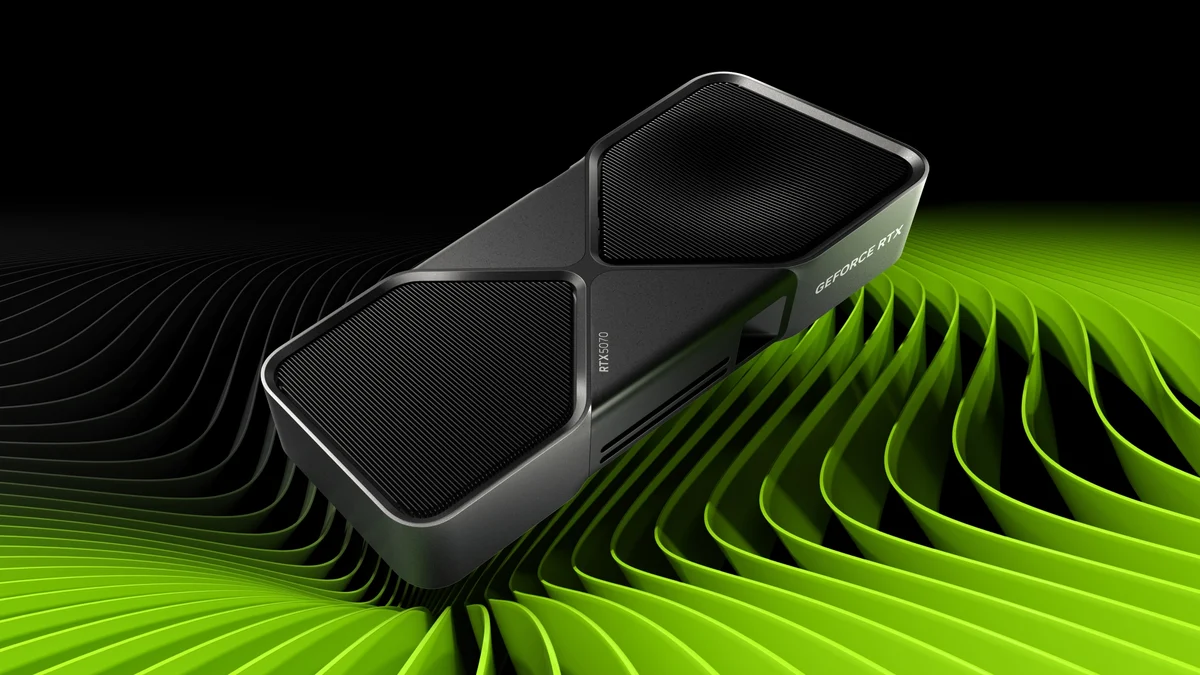
The GeForce RTX 5070 delivers capable 1440p gaming performance, refined upscaling through DLSS, and strong ray tracing efficiency in a compact dual-slot form factor. Its biggest asset is modern feature support and modest power consumption that fits easily into existing 650W setups. However, raw rasterization speed barely improves over the older RTX 4070 Super, and its 12GB memory buffer raises legitimate concerns for longevity at max settings. Upgraders moving from an RTX 3070 will notice a substantial boost, but shoppers eyeing AMD's Radeon RX 9070 will find faster traditional rendering and more memory headroom for similar money.
We may earn a commission from purchases or qualifying sign-ups through our links. Affiliate links explained
Reviewers found the RTX 5070 designed squarely around max-settings 1440p gaming. In TechSpot's 16-game testing, the card averaged just 1% faster than the older RTX 4070 Super and 20% ahead of the standard RTX 4070 at 1440p. Gamers Nexus recorded an 89 fps average at 1440p across its benchmark suite, trailing the RTX 5070 Ti by roughly 21%. At native 4K, TweakTown measured a 63 fps average across its test titles, which climbed to 84 fps when engaging DLSS Quality mode. At 1080p, the card easily pushes over 100 fps in heavy titles like Cyberpunk 2077 and several hundred fps in competitive esports games, though Tom's Hardware pointed out that 1080p testing is frequently CPU-limited. For native 4K gaming, demanding rasterized games hover around 45 to 60 fps natively, meaning 4K gamers will rely on upscaling.
Ray tracing remains Nvidia's primary architectural advantage. Tom's Hardware recorded Cyberpunk 2077 at 1080p Medium ray tracing reaching 61.3 fps on the 5070, compared to 48.2 fps on the RTX 4070 and 23.8 fps on the RTX 3070. In heavier path tracing workloads, raw native frame rates drop steeply, requiring upscaling to achieve fluidity. Tom's Hardware demonstrated that DLSS with multi-frame generation can push demanding ray-traced scenes past 100 fps with manageable input latency. However, outlets including Gamers Nexus and TechSpot voiced strong criticism over Nvidia's marketing, which claimed the 5070 offered 'RTX 4090-class performance' by relying on multi-frame generation rather than actual rendering speed.
Nvidia increased the total board power rating of the RTX 5070 to 250W, up from 200W on the RTX 4070 and 220W on the 4070 Super. In actual gaming measurements, TechPowerUp recorded the Founders Edition drawing an average of 229W. The compact dual-slot cooler kept temperatures around 77°C on the GPU edge and 78°C on the memory under full load, but fan noise reached 37.7 dBA. Tom's Hardware found the Founders Edition reached 50 dBA during stress testing, making it noticeably audible compared to larger cards. By contrast, custom partner designs like the Asus TUF OC tested by TechPowerUp ran much cooler at 61°C and dropped noise down to 26.2 dBA.
The 12GB VRAM allocation on a 192-bit bus was universally identified as the card's biggest compromise. While switching to 28 Gbps GDDR7 memory boosts total bandwidth to 672 GB/s (a 33% increase over the 4070 Super), the capacity itself remains unchanged. Outlets such as TechSpot, Engadget, and Tom's Hardware highlighted that 12GB leaves minimal headroom for upcoming titles running maxed-out ray tracing, frame generation buffers, and uncompressed texture packs. At a $550 price point, reviewers consistently argued that 16GB should have been the baseline for this tier.
The Founders Edition card measures 245 mm long, 115 mm wide, and 40 mm thick, occupying exactly two expansion slots. This compact footprint meets Nvidia's SFF-Ready guidelines, fitting comfortably into tight Mini-ITX cases without compatibility headaches. Power delivery relies on a single 16-pin 12V-2x6 connector, with a dual 8-pin PCIe adapter included in the box. Nvidia recommends a 650W power supply, allowing most PC builders to install the card into an existing setup without needing a power supply upgrade.
At its $549 launch price, the RTX 5070 struggled to convince reviewers because the older RTX 4070 Super offered nearly identical performance for roughly the same price. However, pricing shifts in late 2025 and 2026 brought retail street prices between $490 and $560, noticeably improving its value proposition. AMD's competing Radeon RX 9070 delivers roughly 6% to 11% faster raw rasterization and more VRAM for similar money, but falls behind in path tracing stability, power efficiency, and upscaler image quality.
The card faced criticism at its $549 launch for matching the RTX 4070 Super's performance rather than providing a clear generational leap. As retail discounts frequently pushed it near the $500 mark, its value against AMD's RX 9070 series became much more competitive.
PERFORMANCE
GeForce RTX 5060 Ti 16GB scores 19.7% lower average frame rate than GeForce RTX 5070 in this test.
Tom’s Hardware · full test results ↗ · Original chart ↗Published June 10, 2025 · checked 2026-10-06
June 2025 review; Ryzen 7 9800X3D, 32GB DDR5-6000, Windows 11 24H2. PowerColor RX 9060 XT 16GB Reaper, PNY RTX 5060 Ti 16GB OC, Asus RTX 5060 Dual, RTX 5070 Founders Edition, PowerColor RX 9070 Reaper. Native rendering; no upscaling or generated frames.
Historical review snapshot. Tests use this publication’s common system and suite; game patches and drivers can differ between the included cards. Results are kept separate from other review suites.
| Product | Result | Against first measured model |
|---|---|---|
| GeForce RTX 5070 | 148.8 | 0% |
| GeForce RTX 5060 Ti 16GB | 119.5 | -19.7% |
| Radeon RX 9060 XT 16GB | 116.5 | -21.7% |
| GeForce RTX 5060 | 102.2 | -31.3% |
| Radeon RX 9070 | 159.1 | 6.9% |
Bars start at zero. Results apply to the tested configuration and settings. Percentage differences use the first measured model as the baseline; they are not a combined rating. A suite average is not the frame rate of every game. 1% lows describe the slowest portion of frames and help expose uneven delivery. Missing products are never assigned zero.
Help choosing
Key differences, review evidence and who should buy each model.
Watch on YouTube ↗Hardware Unboxed ·
Provides faster traditional rasterization performance and more memory headroom around the same price point, though DLSS and ray tracing fidelity remain inferior.
Offers 16GB of GDDR7 on a wider 256-bit bus and around 20% faster gaming speeds, solving the base model's future-proofing concerns.
Delivers virtually identical raster performance and the same 12GB memory buffer, making it an excellent value if found discounted on clearance or secondhand.
This roundup summarizes professional reviews and published specifications; Next Interrupt did not test the product. Roundup updated November 10, 2026. How we work