Keyboards & peripherals / Review roundup
SteelSeries Rival Pro
Rival Pro
- 89%PC Gamer
- 4.5 / 5TechRadar
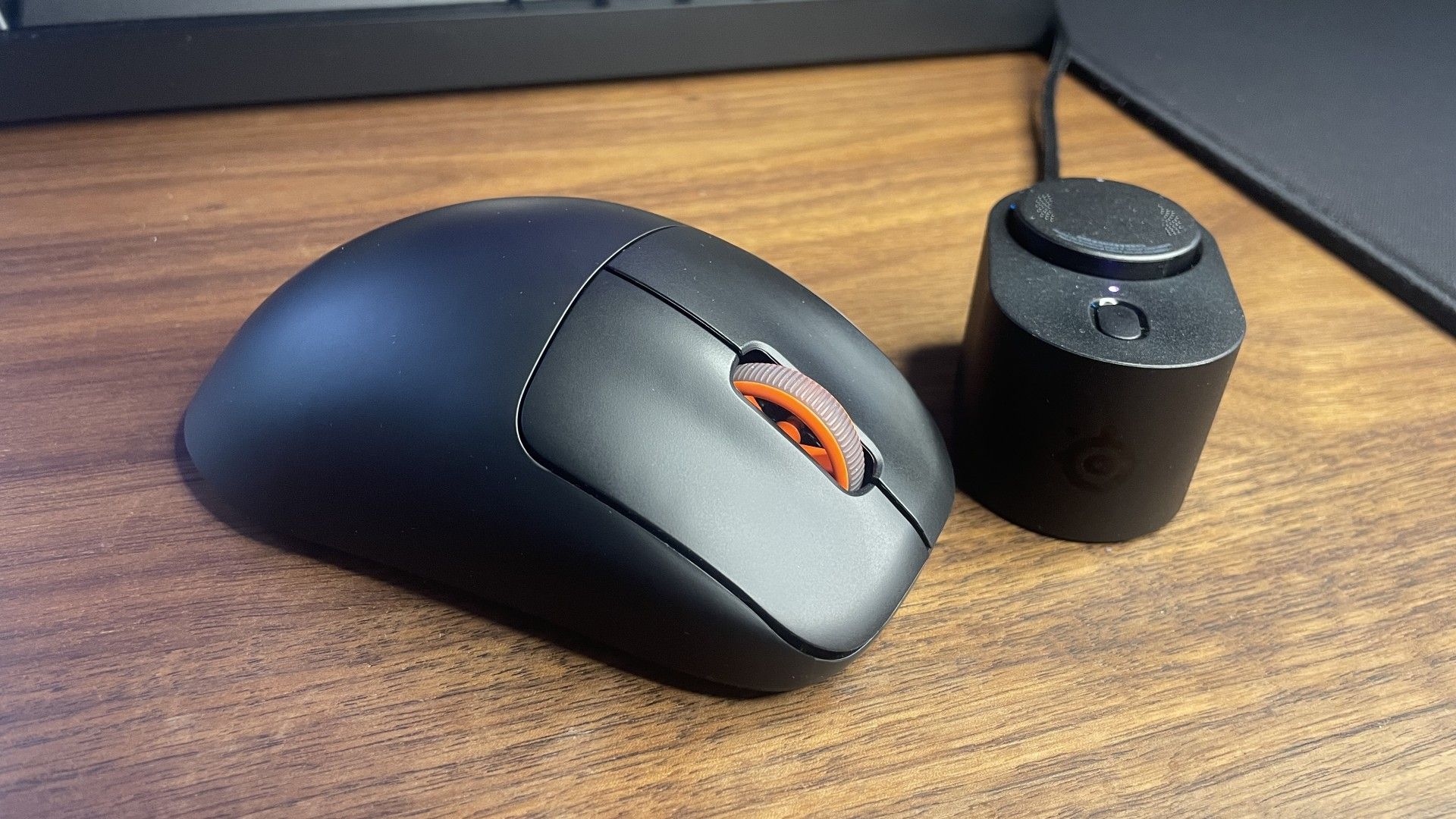
A superb 53-gram ergonomic esports mouse with infinite swappable battery life, but zero wired connectivity
The SteelSeries Rival Pro is ideal for competitive first-person shooter players who prefer an ergonomic palm grip and dread plugging in cables to recharge. Its standout feature is the swappable dual-battery dock, which completely eliminates battery anxiety alongside reliable 8,000 Hz polling over ultra-wideband wireless. The biggest compromise is the complete absence of a USB port on the mouse itself, meaning there is no wired fallback mode if wireless fails. While the Logitech G Pro X3 Superstrike offers adjustable analog triggers, the Rival Pro delivers a lighter 53-gram chassis and uninterrupted play without ever tethering your hand.
Buy it if
- Right-handed gamers using palm or relaxed claw grips seeking a featherlight ergonomic shell
- Competitive players who want true 8,000 Hz wireless polling without cable drag during recharging
- Anyone tired of battery degradation or remembering to plug in their mouse between gaming sessions
Skip it if
- Gamers who require a wired fallback connection or travel without the proprietary base station
- Left-handed or fingertip grip players who would be better served by the symmetrical Sensei Pro
- Players seeking customizable analog or rapid-trigger click actuation points
Where to buy
We may earn a commission from purchases or qualifying sign-ups through our links. Affiliate links explained
What reviewers liked
- Hot-swappable dual battery system and charging dock ensure zero recharging downtime
- Ultra-light 53-gram solid chassis with no honeycomb cutouts or structural flex
- Interference-free Ultra-Wideband wireless delivers reliable 8,000 Hz polling
- Precise TrueMove 42K Pro sensor with independent SuperSync polling rate adjustment
- Generous bundle includes charging dock, extra PTFE feet, and grip tape
What they didn’t
- No USB port on the mouse body eliminates any possibility of wired play
- Steep $179.99 asking price matches the most expensive flagships
- Smooth matte finish readily attracts fingerprints and skin oils
- Optical switches lack analog actuation customization seen on top rivals
Key specs
- Launch price
- $179.99
- Reported price
- $179.99
- Weight
- 53 grams (Black), 54 grams (White)
- Sensor
- SteelSeries TrueMove 42K Pro optical (up to 42,000 DPI, 800 IPS, 70G)
- Switches
- SteelSeries Optical switches rated for 100 million clicks
- Polling rate
- Up to 8,000 Hz (8K) over Ultra-Wideband wireless
- Connectivity
- Ultra-Wideband (UWB) wireless (no wired USB mode)
- Battery life
- 60 hours per battery at 1,000 Hz (120 hours total); 16 hours at 8,000 Hz
- Battery system
- Infinite Power System with 2 hot-swappable battery pucks
- Shape
- Right-handed ergonomic
- Buttons
- 6 programmable buttons
In depth
Feel and build quality
Reviewers universally praised the engineering of the Rival Pro's chassis. Despite including an internal quick-release battery compartment, the mouse weighs just 53 grams (54 grams in the white colorway) without resorting to exterior honeycomb perforations. Digital Foundry and TechRadar noted that the unibody shell exhibits exceptional rigidity with zero squeaking, creaking, or flexing when squeezed firmly during intense matches. The underside features generous pure PTFE skates curved cleanly around the battery hatch, which Tom's Guide found offered effortless glide across both cloth and glass pads. The main critique regarding exterior finish came from TechRadar and Tom's Guide, both noting that the smooth matte finish rapidly collects skin oils and fingerprint smudges. SteelSeries mitigates grip concerns by including a pre-cut set of adhesive grip tape along with a replacement set of PTFE skates in the box.
Performance (sensor, switches, latency)
Performance in competitive shooters met the high expectations set by top-tier esports rodents. The TrueMove 42K Pro optical sensor tracks up to 42,000 DPI, 800 IPS, and 70G of acceleration. Tom's Guide reported pinpoint cursor tracking and micro-adjustments during rapid flick shots in Counter-Strike 2, with no smoothing or jitter observed across various surfaces. The mouse uses optical switches rated for 100 million clicks with a rated click latency of 0.35 ms. Jacob Fox at PC Gamer and testers at Digital Foundry noted that clicks are crisp, well-tensioned, and have slightly heavier actuation force than competitors like the Razer DeathAdder V3 Pro. This stiffness helps prevent accidental misclicks, though TechRadar observed it can feel slightly firm during prolonged rapid-click spamming. Tom's Guide also pointed out that while these optical switches are durable, they lack the adjustable analog magnetic actuation points found on Logitech's G Pro X3 Superstrike.
Battery life and connectivity
The Rival Pro introduces two bold wireless innovations. First, SteelSeries abandoned standard 2.4 GHz RF in favor of Ultra-Wideband (UWB) wireless operating in higher frequency spectrums between 6.4 GHz and 9.056 GHz. Digital Foundry found that UWB proved virtually immune to local wireless interference and maintained a stable 8,000 Hz polling rate bolstered by SteelSeries' 9K over-polling protocol. Second, it borrows the Infinite Power System from SteelSeries' flagship headsets. The mouse comes with two hot-swappable battery pucks: one powers the mouse while the second charges inside the desktop base station. Digital Foundry and PC Gamer measured roughly 60 hours per battery at a standard 1,000 Hz polling rate (120 hours total) and about 16 hours per battery when pushed to 8,000 Hz (32 hours total). Swapping batteries takes about five seconds, creating continuous play. However, PC Gamer highlighted the glaring tradeoff: the mouse has no USB port whatsoever. If you misplace the desktop transmitter or travel without it, there is no wired cable option to plug in.
Software and customization
Customization is managed through either the SteelSeries GG desktop software suite or a newly launched web-based utility. Tom's Guide praised the software experience for running smoothly without the heavy background resource draw associated with software like Razer Synapse. A key setting is SuperSync, which allows users to decouple click reporting from sensor polling. Gamers can run sensor tracking at a conservative 1,000 Hz or 2,000 Hz while keeping click latency locked at 8,000 Hz, preserving PC processor overhead and extending battery endurance. The software also provides five onboard DPI profiles, lift-off distance calibration, angle snapping, and acceleration and deceleration curving. An underside button lets players cycle through stored DPI and polling presets directly on hardware when away from software.
Comfort for long use
The Rival Pro features an asymmetric ergonomic contour tailored strictly for right-handed players. It sports a medium-high central hump with a flare on the left side to support the thumb, sloping down gently to accommodate palm and relaxed claw grips. TechRadar found the ergonomics exceptionally natural, remarking that its featherweight 53-gram build eliminated wrist and forearm fatigue during gaming sessions exceeding six hours. Tom's Guide noted that the ergonomic shape filled the hand comfortably without feeling overly bulky. However, reviewers stressed that this ergonomic sculpting makes the Rival Pro unsuitable for left-handed gamers and less than ideal for aggressive fingertip grips. Shooters with smaller hands or ambidextrous preferences were directed toward the symmetrical Sensei Pro or the 49-gram Rival Pro Mini.
Price
The SteelSeries Rival Pro launched at $179.99 (£169.99 in the UK, €199.99 in Europe) and typically retails at that full price across major retailers including Best Buy and Amazon. Reviewers universally agreed that $180 represents a substantial investment that places the Rival Pro at the highest tier of the gaming mouse market, level with flagships like Razer's Viper V4 Pro and Logitech's G Pro X3 Superstrike. Nonetheless, TechRadar and Shacknews argued that the price is fair given what is included in the package: while rivals often charge extra for an 8K-capable wireless charging dock, SteelSeries includes the UWB base station, two hot-swappable batteries, grip tape, and spare PTFE skates in the base box.
Is it worth the money?
At $179.99, it sits at the high end of premium esports mice, but the price includes two hot-swap batteries, a wireless charging dock, grip tape, and extra PTFE skates.
Also consider
- Logitech G Pro X3 Superstrike
Features customizable magnetic analog switches with adjustable actuation points, but lacks hot-swappable batteries.
- Razer DeathAdder V3 Pro
A proven ergonomic right-handed favorite with lighter click actuation and standard USB-C wired charging fallback.
- SteelSeries Sensei Pro
Delivers identical UWB performance and dual swappable batteries in an ambidextrous, symmetrical claw-grip shell.
Reviews we read
This roundup summarizes professional reviews and published specifications; Next Interrupt did not test the product. Roundup updated November 9, 2026. How we work