 Watch on YouTube ↗
Monitors Unboxed ·
Consoles & handhelds / Review roundup
512GB glossy OLED; some cited tests use 1TB etched-glass model
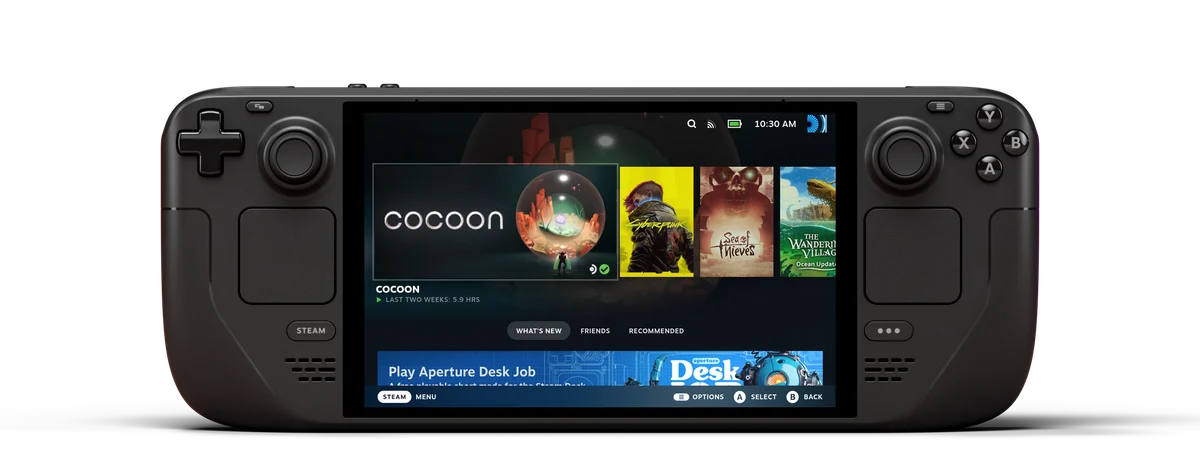
The Steam Deck OLED 512GB remains the premier handheld for PC players who value console-grade software polish and vivid screen quality over raw graphical muscle. Its 7.4-inch 90Hz OLED panel, whisper-quiet cooling, and intuitive SteamOS environment provide unmatched handheld comfort for indie games and older backlogs. However, the 6nm APU offers essentially no performance uplift over the original model, leaving demanding AAA blockbusters struggling to maintain steady frame rates without aggressive upscaling. While rivals like the Asus ROG Ally X boast superior raw horsepower and full Windows compatibility, Valve still delivers the most seamless, controller-friendly gaming experience.
We may earn a commission from purchases or qualifying sign-ups through our links. Affiliate links explained
The Steam Deck OLED is powered by AMD's 6nm 'Sephiroth' APU, a die shrink of the original 7nm chip paired with slightly faster 6400 MT/s LPDDR5 memory. Reviewers across Tom's Hardware, PC Gamer, and Digital Foundry emphasize that this is a hardware refinement rather than a generational upgrade. Frame rate improvements range between 2% and 9%, primarily stemming from improved memory bandwidth and thermal headroom rather than higher compute targets. For older releases, independent games, and emulation, performance is superb, effortlessly sustaining 60 to 90 fps at the native 800p resolution. Demanding modern AAA games, however, show the limits of the hardware. TechRadar noted that titles like Cyberpunk 2077 require setting FSR scaling to performance mode and locking the frame rate to 30 or 40 fps to avoid severe frame drops. Furthermore, competitive titles utilizing kernel-level anti-cheat (such as Destiny 2 or Call of Duty) remain unplayable on SteamOS.
The centerpiece upgrade is the 7.4-inch OLED panel, which replaces the washed-out 7-inch LCD of the original. The Verge and Digital Foundry recorded a peak HDR brightness of 1,000 nits and full 110% DCI-P3 color coverage, delivering true infinite contrast and inky blacks. The boost from 60Hz to a 90Hz refresh rate notably cuts input lag and permits smooth 45 fps frame pacing. Note that this 512GB configuration uses standard glossy glass; Tom's Hardware and PCMag pointed out that it produces prominent reflections in direct light, whereas the premium anti-glare etched finish is reserved for the 1TB edition. Control ergonomics remain a benchmark: the thumbsticks have deeper dish grips and better textured borders, the dual haptic trackpads track mouse movements with sharper fidelity, and the capacitive touchscreen polling rate was increased to 180Hz for far crisper gesture inputs.
Valve enlarged the internal battery pack from 40 Whr to 50 Whr, which couples with the 6nm APU and efficient OLED panel to produce roughly 30% to 50% longer play sessions. In demanding AAA benchmarks like Shadow of the Tomb Raider or God of War, Tom's Hardware and The Verge reported battery life increasing from roughly 90 minutes on the original Deck to around 2 hours and 15 minutes on the OLED. For moderately demanding titles like Hades, Eurogamer and user battery runs demonstrated runtimes between 4 and 6 hours, while lightweight 2D indies like Dead Cells or retro emulation routinely exceed 8 to 10 hours on a single charge. Valve also addressed charging convenience by including a longer 2.5-meter cable with the standard 45W USB-C wall charger, allowing comfortable play while plugged into distant wall outlets.
At 640 grams, the OLED model sheds approximately 29 grams compared to the original LCD version (669g). While that difference appears subtle on paper, The Verge and PCMag found that it significantly reduces wrist fatigue during multi-hour handheld sessions. Thermal management and noise levels are vastly improved: The Verge recorded internal temperatures running up to 10 degrees Celsius cooler, while a redesigned, thicker fan profile eliminates the high-pitched whine of early Deck iterations. However, porting it around remains a commitment. Measuring 298mm (11.7 inches) across, TechRadar emphasized that the Steam Deck OLED is too bulky for small slings and demands a substantial portion of backpack volume, particularly when housed in its included hardshell case.
SteamOS remains the standard against which all handheld PC operating systems are judged. Unlike Windows-powered competitors that struggle with fiddly desktop dialogs and inconsistent sleep states, the Deck features instant, reliable sleep-and-resume functionality mid-game. Valve's Deck Verified badge indicates playability out of the box, though TechRadar noted that Verified status does not guarantee stutter-free 60 fps gameplay without tweaking. The 512GB NVMe SSD is fast and spacious enough for an active rotation of games, and load times from the integrated UHS-I microSD card slot remain almost indistinguishable from internal storage. Networking speeds also saw a dramatic jump: testing by PCMag and The Verge showed that the new tri-band Wi-Fi 6E radio consistently downloads large titles two to three times faster than the Wi-Fi 5 chip on the original Deck.
The Steam Deck OLED 512GB originally launched in November 2023 at an aggressive $549 price point, earning universal praise for delivering high-end handheld value. However, in May 2026, Valve instituted an industry-wide price hike in response to steep semiconductor memory and storage costs, raising the official MSRP to $789 in the US. At its original price, it was an indisputable bargain; at $789, buyers must weigh its superior software experience and screen against more powerful Windows competitors that sit in the same pricing tier. Standard ownership costs remain modest: a 512GB or 1TB UHS-I microSD card costs between $35 and $85, while Valve includes both a quality hard-shell carrying case and a 45W charger in the box.
Launched at $549, the 512GB OLED was long considered the best value in handheld gaming. Valve implemented a major price adjustment to $789 in May 2026 due to escalating memory and component costs, which narrows its competitive pricing lead over Windows rivals.
Help choosing
Key differences, review evidence and who should buy each model.
Watch on YouTube ↗Monitors Unboxed ·
Provides substantially faster graphics with the AMD Ryzen Z1 Extreme, 24GB of RAM, and a massive 80Wh battery, though it relies on Windows 11.
Features an 8.8-inch 144Hz QHD+ display and detachable controllers for players who want a larger screen and tabletop kickstand gaming.
Much lighter, far more compact, and significantly cheaper, with access to Nintendo exclusives, but limited strictly to the Switch library.
This roundup summarizes professional reviews and published specifications; Next Interrupt did not test the product. Roundup updated October 17, 2026. How we work