Consoles & handhelds / Review roundup
Nintendo Switch 2
Reviews cover this model; exact sample configurations can differ or be unspecified
- 4.5 / 5Tom's Guide
- 4.5 / 5TechRadar
- 7 / 10IGN
A sharper, far more capable hybrid console whose ambition is tempered by battery life and an LCD panel
The Nintendo Switch 2 is an easy recommendation for anyone upgrading from the original 2017 console or seeking access to Nintendo's newest first-party releases. Its strongest asset is its custom Nvidia silicon, which brings steady 1080p portable play, 4K docked output, and broad backwards compatibility to a familiar form factor. The most noticeable compromise is endurance: battery life routinely drops to between 2 and 2.5 hours during demanding 3D gaming, and the display steps back to LCD tech rather than OLED. While PC handhelds like the Steam Deck OLED provide richer black levels and cheaper game sales, the Switch 2 remains the premier hybrid device for seamless TV docking and exclusive franchises.
Buy it if
- Original Switch owners wanting smoother frame rates, 4K TV output, and access to new generation exclusives
- Shoppers looking for a true hybrid handheld that docks effortlessly to a television for local multiplayer
- Players with large existing digital or physical Switch 1 libraries seeking backward compatibility
Skip it if
- You prioritize 5-plus hours of battery life on long flights without carrying an external power bank
- You cannot tolerate LCD motion blur or give up the pure blacks of the Nintendo Switch OLED
- You want an open handheld PC ecosystem with access to Steam and PC storefront pricing
Where to buy
We may earn a commission from purchases or qualifying sign-ups through our links. Affiliate links explained
What reviewers liked
- Massive visual leap with up to 4K docked output and DLSS upscaling
- Smooth 7.9-inch 1080p display supporting up to 120 Hz and variable refresh rates
- Substantial backwards compatibility that stabilizes frame rates for older Switch games
- Upgraded 256 GB base storage and sturdier magnetic Joy-Con attachments
What they didn’t
- Short 2 to 2.5 hour battery life during intensive 3D games
- LCD panel exhibits noticeable pixel response ghosting compared to OLED competitors
- Requires costlier microSD Express cards rather than standard legacy microSD cards
Key specs
- Launch price
- $449.99 (Standalone) / $499.99 (Mario Kart World Bundle)
- Reported price
- $449.99 to $499.99
- Launch Price
- $449.99 (Console) / $499.99 (Mario Kart World Bundle)
- Chipset
- Custom Nvidia Tegra T239 octa-core processor
- Memory
- 12 GB LPDDR5X RAM
- Display
- 7.9-inch 1080p LCD, 120 Hz, VRR, HDR10
- Docked Resolution
- Up to 4K at 60 fps; 1080p/1440p up to 120 fps via HDMI
- Internal Storage
- 256 GB UFS 3.1 (expandable via microSD Express up to 2 TB)
- Battery Capacity
- 5,220 mAh lithium-ion
- Weight
- 401 g (tablet only), 535 g / 1.18 lbs (with Joy-Con 2 attached)
- Dimensions
- 10.7 x 4.5 x 0.55 inches with Joy-Con 2 attached
In depth
Performance and game compatibility
The internal architecture marks a generational leap over the 2017 predecessor. Built around a custom Nvidia processor with 12 GB of LPDDR5X RAM, the Switch 2 incorporates Nvidia DLSS upscaling. In docked mode, reviewers at TechRadar and Tom's Guide noted games output at up to 4K resolution at 60 fps on compatible displays, with select titles achieving 120 fps at 1080p or 1440p. Demanding modern releases like Cyberpunk 2077 and Donkey Kong Bananza maintain steady performance that was impossible on previous hardware. Backwards compatibility covers the Switch 1 catalog, with testing showing faster loading speeds, steadier frame pacing, and optional handheld boost profiles on older titles.
Display and controls
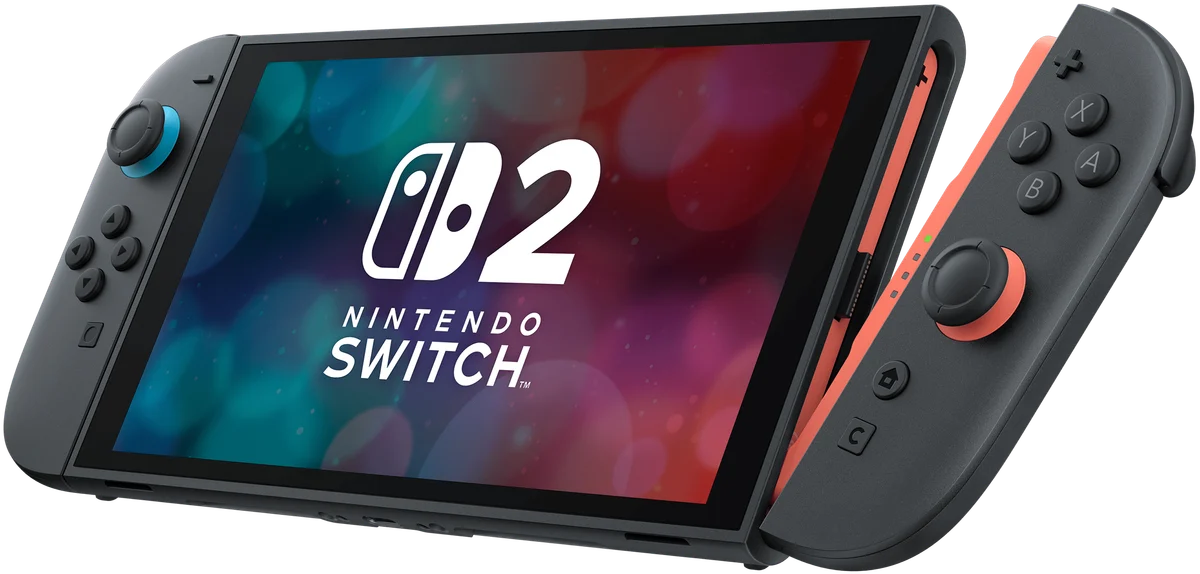
The Switch 2 upgrades to a 7.9-inch 1080p panel featuring HDR10 and variable refresh rates up to 120 Hz. The step up from 720p provides noticeable text clarity and detail, but the decision to use an LCD panel drew criticism from reviewers accustomed to the Switch OLED. In motion testing cited by Tom's Guide, pixel response times averaged around 33 ms at 60 Hz, resulting in visible ghosting behind fast-moving objects. For controls, the Joy-Con 2 attachments abandon sliding rails for secure magnetic locks. The right controller incorporates an optical sensor enabling a tabletop mouse mode, though IGN found this control scheme caused wrist fatigue during longer play sessions.
Battery life
Battery endurance represents the clearest downgrade relative to the refined Switch OLED. While Nintendo rates the 5,220 mAh internal battery for 2 to 6.5 hours of operation, real-world tests show that demanding games sit firmly at the bottom of that window. In testing conducted by outlets including Nintendo Life and independent reviewers, visually intensive 3D games depleted a full charge in roughly 2 hours to 2 hours and 33 minutes at moderate-to-high brightness. Less demanding indie titles push battery longevity past 4 hours, but gamers traveling without an outlet or high-wattage USB-PD power bank will need to manage expectations.
Comfort and portability
With Joy-Con 2 attached, the console measures 10.7 inches wide and weighs 535 grams (1.18 lbs). While significantly lighter than full PC handhelds like the 678-gram Asus ROG Ally X or 640-gram Steam Deck, it is roughly 115 grams heavier than the Switch OLED. Tom's Guide praised the revised, fuller grips for reducing cramping during two-handed play, but noted the extra width makes the console less pocket-friendly and slightly unwieldy for prolonged one-handed menu navigation. The kickstand remains wide and sturdy, providing stable tabletop gaming on trains and plane trays.
Library, storage and software
Nintendo expanded internal storage to 256 GB of UFS 3.1 flash memory, addressing the severe 32 GB bottleneck of the original model. For expansion, the slot requires microSD Express cards; while these deliver rapid load times, they are costlier than older standard microSD cards. The operating system offers snappy menu navigation, though GamingTrend pointed out that Nintendo's eShop still lacks basic multi-item cart purchases. Tom's Guide also documented slow initial download speeds over Wi-Fi when handling 20-plus gigabyte game installs during busy periods.
Price and total cost
The Switch 2 debuted at $449.99 for the standalone console and $499.99 for the launch bundle including Mario Kart World. Following component adjustments in late 2026, standard retail pricing settled around $499.99, though promotional events have discounted units back toward $400 to $450. Beyond the base console, first-party software has climbed to $69.99 and $79.99, while official accessories such as the Switch 2 Pro Controller ($84.99) and a 256 GB microSD Express card ($59.99) push the total cost of ownership past $650.
Is it worth the money?
The base package includes the dock, power supply, and HDMI cable, but steeper game pricing ($70 to $80) and mandatory microSD Express storage add noticeable long-term costs.
Help choosing
Compare before you buy
Key differences, review evidence and who should buy each model.
Also consider
- Valve Steam Deck OLED
Offers an authentic 90 Hz HDR OLED panel, superior ergonomic grips, and cheaper PC games, but cannot play native Nintendo exclusives.
- Nintendo Switch OLED
Provides deeper black levels and twice the real-world battery life at a lower price point, though it cannot run next-generation Switch 2 software.
- Asus ROG Ally X
Delivers full Windows PC capability and an 80 Wh battery for longer heavy gaming, but costs significantly more at $899 and requires PC configuration.
Reviews we read
This roundup summarizes professional reviews and published specifications; Next Interrupt did not test the product. Roundup updated November 13, 2026. How we work
- Tom's Guide — Nintendo Switch 2 review
- TechRadar — Nintendo Switch 2 review
- IGN — Nintendo Switch 2 Review
- TechRadar — Stellar Blade for Nintendo Switch 2 review: more solid than stellar
- TechRadar — Resident Evil 4 for Nintendo Switch 2 review: a good, but imperfect port
- TechRadar — Resident Evil 3 for Nintendo Switch 2 review: a solid port of a true scare-fest
- TechRadar — Resident Evil 2 for Nintendo Switch 2 review: survival horror mastery on the go