Consoles & handhelds / Review roundup
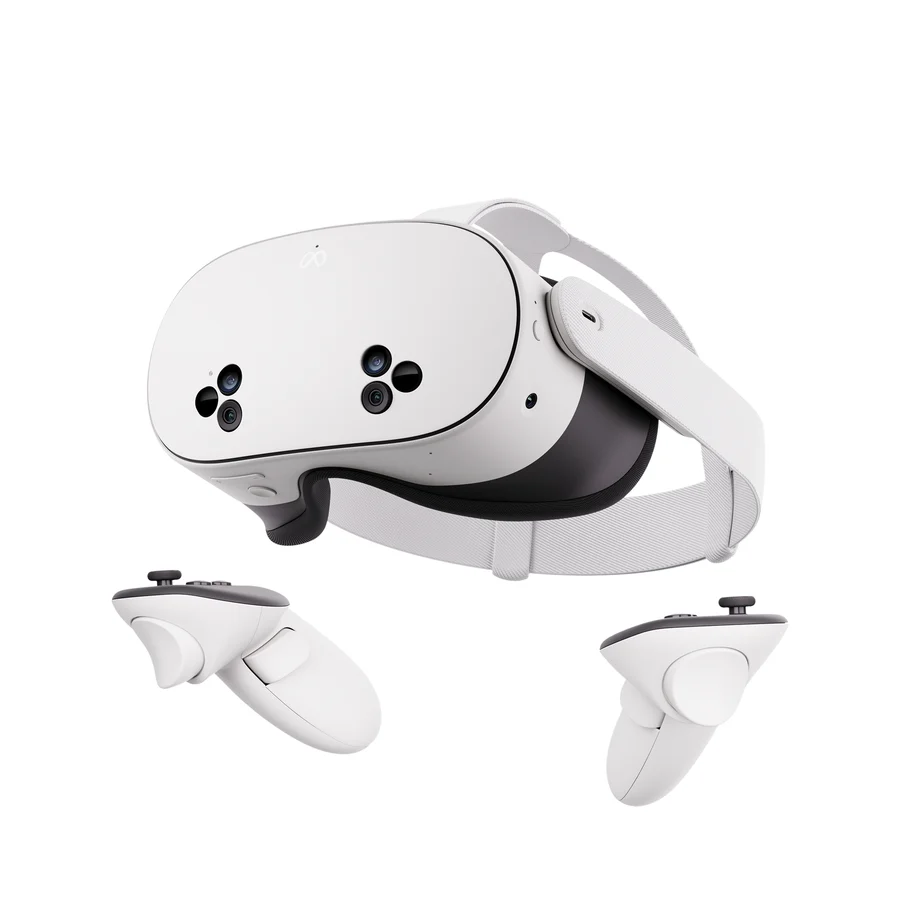
Meta Quest 3S 128GB
Standalone 128GB headset with Fresnel lenses
- 9 / 10IGN
- 4.5 / 5PCMag
- 4.5 / 5TechRadar
- 4 / 5Tom's Guide
The best budget VR headset brings flagship Quest 3 performance down to $300 with older optics
The Meta Quest 3S 128GB is the best entry point for anyone wanting to jump into modern virtual and mixed reality on a budget. It packs the same fast Snapdragon XR2 Gen 2 processor, responsive Touch Plus controllers, and full-color passthrough as the premium Quest 3, giving it access to every modern standalone release. The trade-off lies in visual clarity, where it reuses the Quest 2's lower-resolution Fresnel lenses and three-step IPD slider instead of pancake optics. If you can tolerate softer edge-to-edge clarity and budget for a more comfortable replacement head strap, it delivers roughly 80 percent of the Quest 3 experience for $200 less.
Buy it if
- First-time VR buyers wanting full mixed reality and next-generation gaming support without paying $500
- Quest 2 owners seeking faster loading, full-color passthrough, and access to Quest 3 exclusives on a budget
- Casual VR gamers who prioritize standalone wireless freedom over ultra-sharp edge-to-edge optics
Skip it if
- Enthusiasts who demand edge-to-edge sharpness, wider FOV, and pancake lens clarity
- Gamers who store multiple 30GB+ VR games locally without uninstalling
- Users sensitive to fixed IPD steps or those requiring an integrated 3.5mm headphone jack
Where to buy
We may earn a commission from purchases or qualifying sign-ups through our links. Affiliate links explained
What reviewers liked
- Identical Snapdragon XR2 Gen 2 chipset and 8GB RAM as the pricier Quest 3
- Full-color mixed-reality passthrough for augmented reality and room awareness
- Unrestricted access to the entire Horizon OS library including Quest 3 exclusive games
- Slightly longer battery life in benchmark tests than the standard Quest 3
- Very aggressive $299.99 entry price
What they didn’t
- Older Fresnel lenses produce a narrow focal sweet spot and peripheral blur
- Coarse three-position IPD slider instead of a smooth continuous adjustment dial
- Uncomfortable stock cloth head strap that causes facial pressure during long sessions
- No 3.5mm headphone jack for wired audio
- 128GB storage fills quickly with marquee 30GB+ VR installations
Key specs
- Launch price
- $299.99
- Reported price
- $299.99
- Chipset
- Qualcomm Snapdragon XR2 Gen 2
- Memory
- 8GB RAM
- Storage
- 128GB
- Display
- Single fast-switch LCD, 1832 x 1920 pixels per eye
- Optics
- Fresnel lenses (96° horizontal / 90° vertical FOV)
- Refresh Rate
- 90Hz, 120Hz
- IPD Adjustment
- 3-position mechanical slider (58mm, 63mm, 68mm)
- Passthrough
- Dual 4MP RGB color cameras with IR depth sensors
- Weight
- 514 g (1.13 lbs)
- Battery Life
- Rated 2.5 hours (2.0 to 2.5 hours tested)
- Audio
- Integrated spatial stereo speakers, no 3.5mm jack (USB-C or Bluetooth only)
In depth
Performance and game compatibility
Equipped with the Qualcomm Snapdragon XR2 Gen 2 chipset and 8GB of RAM, the Quest 3S matches the raw compute power of the standard Quest 3. Reviewers across IGN and TechRadar confirmed that every modern Quest title runs without graphical downgrades or frame drops, with the headset supporting refresh rates of 90Hz and 120Hz. Because it drives a lower total pixel count than the Quest 3, the chipset experiences slightly less thermal strain. IGN reported smooth execution in demanding releases like Batman: Arkham Shadow, noting rapid load times and consistent frame delivery. PC VR streaming over Wi-Fi 6E or a USB-C link cable also functioned reliably in PCMag's testing.
Display and controls
The primary cost compromise is in optics: the Quest 3S uses the Quest 2's single LCD panel (1,832 x 1,920 pixels per eye) paired with Fresnel lenses. Tom's Guide observed visible peripheral softness and a narrower field of view (96 degrees horizontal, 90 degrees vertical) compared to the Quest 3's pancake lenses. Interpupillary distance (IPD) adjustment is limited to three manual positions (58mm, 63mm, and 68mm), which IGN noted makes finding a clear focal sweet spot harder for those whose eye spacing falls between steps. For tracking and controls, it includes the ringless Touch Plus controllers, which PCMag praised for dependable 6DoF tracking, alongside accurate bare-hand tracking and full-color RGB passthrough for mixed reality. One notable omission from the chassis is a 3.5mm headphone jack.
Battery life
Meta rates the 4,324 mAh battery for approximately 2.5 hours of runtime, slightly edging out the Quest 3's rated 2.2 hours. Independent testing confirmed these estimates: Android Central recorded 2.5 hours during video streaming and casual gaming, dropping to 2.0 hours in intensive Quest 3 titles with mixed reality enabled. IGN saw sessions average roughly 2 hours under mixed-reality loads in apps like Vermillion and PianoVision, which slightly outlasted their standard Quest 3. TechRadar logged approximately 3 hours during lighter gaming sessions. Recharging from empty with the included adapter takes approximately 2 hours.
Comfort and portability
Weighing 514 grams and measuring 7.5 x 5.6 x 4.0 inches, the Quest 3S shares the front-heavy balance of older headsets because the Fresnel lens assembly is thicker than pancake optical stacks. Reviewers from Tom's Guide and TechRadar found the default Y-shaped fabric strap acceptable for quick sessions but uncomfortable after 30 to 45 minutes, citing pressure against the forehead and cheekbones. Both outlets recommend upgrading to a rigid Elite-style strap or an aftermarket halo mount for extended use. The headset includes an eyeglass spacer in the box, though users with wider frames may still experience tight side clearance.
Library, storage and software
The Quest 3S runs Meta Horizon OS, giving buyers immediate access to the largest standalone VR library available, spanning fitness, productivity, and major gaming franchises. However, the base model's 128GB storage ceiling presents a real limitation. PCMag and TechRadar noted that after the operating system takes roughly 15GB to 20GB, users have around 105GB to 110GB of free space. While casual VR games often occupy 2GB to 5GB, large marquee titles like Asgard's Wrath 2 (31GB) or Medal of Honor: Above and Beyond (over 40GB) will force users into frequent storage micromanagement.
Price and total cost
Launching at $299.99, the Quest 3S 128GB represents the lowest barrier of entry to current-generation VR gaming. However, buyers should factor in near-essential accessories. Because the cloth head strap creates facial fatigue and the battery caps playtime at two to three hours, most reviewers recommend budgeting for a rigid replacement strap ($30 to $70) or a battery strap. Furthermore, since Meta removed the 3.5mm headphone jack, users who prefer wired low-latency audio will need a USB-C headphone adapter. Those who want higher local storage without managing installs can opt for the 256GB version at $399.99.
Is it worth the money?
At $299.99, it undercuts the $499.99 Quest 3 512GB by $200 while playing the exact same software library. Occasional promotions drop pricing towards $249 to $279.
Help choosing
Compare before you buy
Key differences, review evidence and who should buy each model.
Also consider
- Meta Quest 3 (512GB)
Pancake lenses provide superior edge-to-edge visual clarity, a wider field of view, continuous IPD tuning, and 512GB of base storage for $499.99.
- Sony PlayStation VR2
Tethered console VR offering higher-fidelity OLED panels, eye tracking, and headset rumble, though it requires a PS5 or PC adapter.
- Meta Quest 2
Older predecessor with identical Fresnel optics and resolution, but lacks color passthrough and cannot run newer Quest 3 exclusives.
Reviews we read
This roundup summarizes professional reviews and published specifications; Next Interrupt did not test the product. Roundup updated October 17, 2026. How we work
- Tom's Guide — Meta Quest 3S review: The best VR headset for the money
- TechRadar — Meta Quest 3S review: the world's best affordable VR headset
- IGN — Meta Quest 3S Review
- PCMag — Meta Quest 3S Review