Watches & wearables / Review roundup
Fitbit Edge
Fitbit Edge
- 4.0 / 5PCMag
- 4 / 5TechRadar
A slim, week-long fitness tracker with a bright OLED screen held back by missing tap-to-pay
The Fitbit Edge is an appealing choice for anyone who wants a lightweight, unobtrusive wearable with a screen that works seamlessly on both Android and iOS. Its primary strengths are a bright 1.34-inch AMOLED display, an easy-to-wear 11.5mm aluminum case, a tactile physical side button, and dependable daily activity tracking. The biggest catch is Google's puzzling removal of NFC contactless payments, stripping away Google Wallet convenience. While it lacks the rich app ecosystems of true smartwatches like the Apple Watch SE 3 or Google Pixel Watch 5, it lasts days longer between charges and delivers the core health fundamentals.
Buy it if
- Shoppers wanting 6 to 7 days of battery life without giving up a bright color display
- iPhone and Android owners seeking lightweight 24/7 sleep and step tracking
- Runners and walkers who want built-in GPS and elevation tracking without wearing a bulky smartwatch
Skip it if
- You rely on contactless payments from your wrist, as Google omitted NFC hardware
- You want on-wrist voice replies, phone calls, or third-party Wear OS apps
- You require pinpoint dual-frequency GPS accuracy for competitive race training
Where to buy
We may earn a commission from purchases or qualifying sign-ups through our links. Affiliate links explained
What reviewers liked
- Bright 1.34-inch AMOLED screen with 46 percent more viewing area than the Charge 6
- Dependable 6 to 7-day real-world battery life in standard raise-to-wake mode
- Physical clicky side button replaces clumsy capacitive touch panels
- Integrated altimeter accurately monitors elevation changes and flights of stairs
- Broad cross-platform compatibility across both Android and iOS
What they didn’t
- Lacks NFC, eliminating tap-to-pay Google Wallet support found on earlier models
- Enabling the always-on display plummets battery endurance down to roughly 2 days
- Advanced AI insights and certain trend metrics require an ongoing monthly subscription
Key specs
- Launch price
- $179.99 ($219.99 for Stephen Curry Edition)
- Reported price
- $179.99
- Display
- 1.34-inch AMOLED color touchscreen, up to 1,000 nits
- Case Dimensions
- 39.2 x 25.5 x 11.58 mm
- Weight
- 17.7 g (without band)
- Water Resistance
- 5 ATM / 50 meters
- Sensors
- Built-in GPS, optical heart rate, altimeter, ECG, SpO2, skin temperature
- Battery Life
- Up to 7 days (standard mode); approx. 2 days (always-on display)
- Charging
- Approx. 90 minutes full recharge; 5-minute quick charge yields ~1 day
- Compatibility
- Android 11 or later, iOS 16.4 or later
In depth
Design and comfort
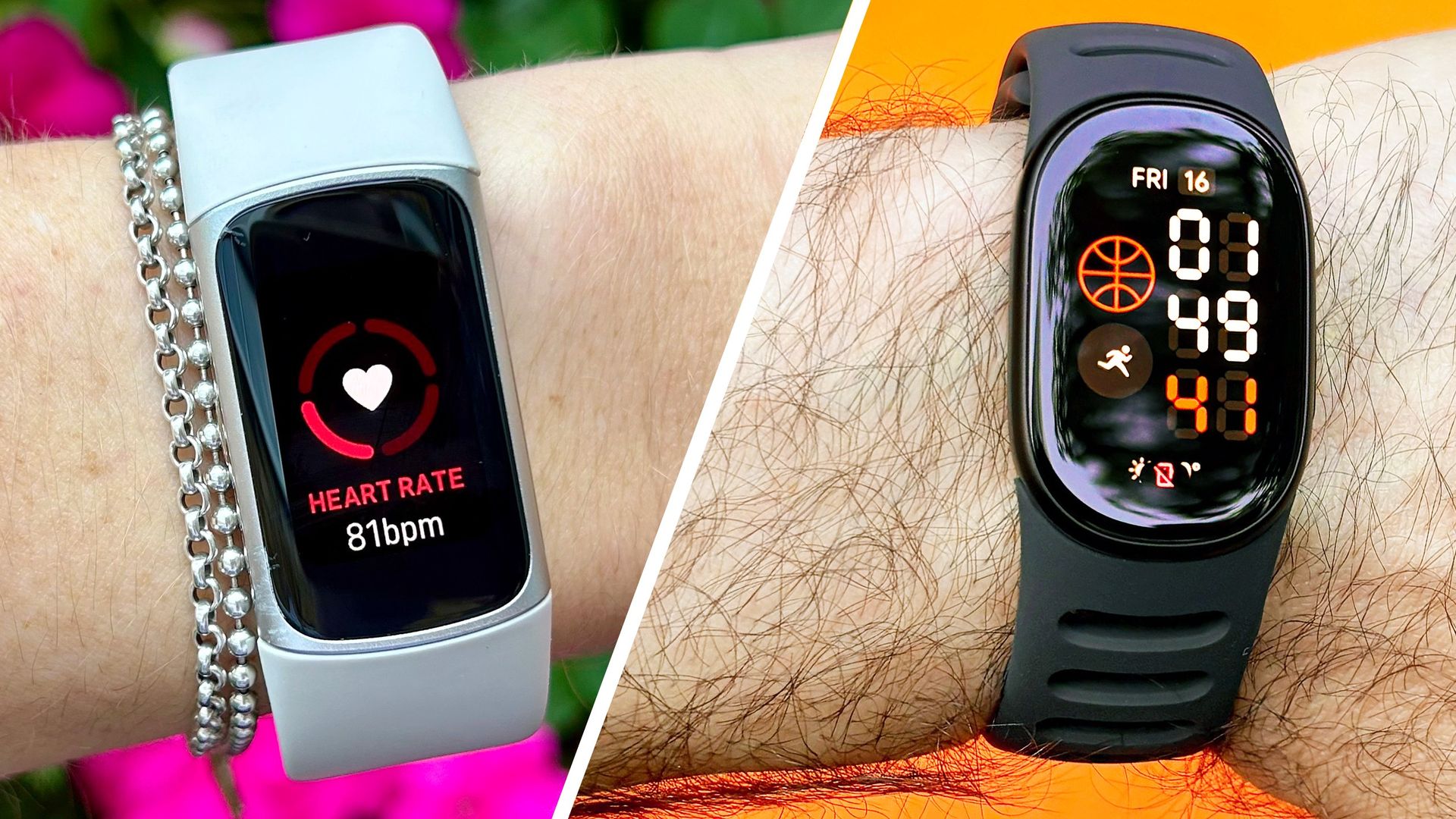
The Fitbit Edge refines the classic band form factor with a 11.58mm-thin aluminum housing and a curved profile that sits flush against the wrist. Weighing just 17.7 grams without bands, reviewers at Android Authority, TechRadar, and DC Rainmaker emphasized that it is virtually unnoticeable during sleep tracking and exercise. The front features a 1.34-inch AMOLED panel that provides 46 percent more viewing space than the Charge 6, reaching a peak brightness of 1,000 nits for outdoor readability. One of the most praised hardware revisions is the return of a tactile, clicky physical side button, which DC Rainmaker noted is far easier to operate with sweaty fingers than the capacitive haptic indent on the Charge 6. The Edge also introduces a user-serviceable battery design, a rare nod toward product longevity in the wearable space.
Health and fitness tracking accuracy
Reviewers found the Edge exceptionally reliable for day-to-day activity tracking and baseline cardio monitoring. In controlled walk tests at Tom's Guide, the Edge logged 5,016 steps against a manual clicker tally of 5,005 steps (within 11 steps), and 6,079 steps against a 6,094-step manual count, outperforming the Apple Watch SE 3 and Series 12 on raw step counting. The integrated altimeter proved accurate as well, recording 476 feet of elevation gain against a 480-foot reference control. TechRadar tested the Edge on a 5km run against a Garmin Fenix 9 Pro and found heart rate tracking nearly identical, averaging 156 bpm compared to the Garmin's 153 bpm. However, GPS tracking is a mixed bag: TechRadar logged 5.45km on a 5.15km course—roughly a 6 percent overestimate—making the standalone GPS adequate for casual outings but less suited for strict pace training.
Battery life
Google rates the Fitbit Edge for up to 7 days on a charge, and real-world testing largely validates that claim under standard settings. Outlets including PhoneArena, DC Rainmaker, and TechRadar reported getting 6 to 7 days of normal use with continuous heart rate monitoring, daily notifications, and three to four GPS-tracked workouts. However, turning on the always-on display alters endurance dramatically: DC Rainmaker and PhoneArena found that runtime dropped to roughly 2 days with the screen always visible. Tom's Guide also observed that continuous GPS usage draws noticeable power, draining around 6 to 10 percent per hour-long outdoor session. A full replenishment via the included magnetic cable takes about 90 minutes, while a 5-minute top-off supplies roughly 24 hours of standard use.
Smart features and app ecosystem
Smart features are intentionally minimalist, but Google made one controversial reduction: the Edge completely eliminates NFC. While the older Charge 6 supported Google Wallet, Google stated that sub-1% utilization justified omitting mobile payments on the Edge, a decision Android Police, Android Authority, and TechRadar criticized for an $180 device. There is also no microphone or speaker, meaning no wrist-based calls, sound-based alarms, or voice input. You do receive basic mirrored smartphone notifications with canned text replies on Android, phone media playback controls across music apps, and turn-by-turn prompts mirrored from Google Maps. The interface runs on responsive, gesture-driven Google Material 3 Expressive tiles rather than full Wear OS.
Compatibility (iPhone/Android)
Cross-platform flexibility remains a major selling point. Unlike the Apple Watch (exclusive to iOS) or the Pixel Watch 5 (exclusive to Android), the Fitbit Edge pairs with Android devices running Android 11 or later as well as iPhones running iOS 16.4 or later. Syncing is handled entirely through the redesigned Google Health app, which requires a standard Google account. Reviewers on both platforms noted smooth Bluetooth pairing and reliable background synchronization, though Android users gain the slight perk of replying to text notifications directly from the screen.
Price and subscriptions
The Fitbit Edge retails for $179.99 for the standard aluminum models, while a pale gold Stephen Curry special edition costs $219.99. The purchase includes three months of Google Health Premium, which subsequently costs $9.99 per month or $80 annually. Essential tracking tools—including 24/7 heart rate, step counting, sleep stages, continuous stress tracking, and ECG readings—do not require a subscription. However, the premium tier gates the generative Gemini AI Health Coach, advanced sleep breathing trends, and insulin resistance analysis. TechRadar noted that the free tier covers everything the casual fitness enthusiast needs, though the updated app layout prominently nudges users toward paid AI features.
Is it worth the money?
Priced slightly above older band trackers, it offsets the cost with an aluminum chassis, built-in GPS, an altimeter, and three months of included Google Health Premium.
Benchmarks
PERFORMANCE
Benchmarks
during my ~45-minute walk
Lower is better · %Apple Watch SE 3 scores 0% higher reported percentage than Fitbit Edge in this test.
Tom’s Guide · full test results ↗Published 2026-11-05 · checked 2026-11-09
during my ~45-minute walk · Apple Watch SE 3: Apple Watch SE 3; Fitbit Edge: Fitbit Edge
Results apply to this publication’s tested models and settings. Check those details before comparing another review.
Test data and methodology
| Product | Result | Against first measured model |
|---|---|---|
| Fitbit Edge | 6 | 0% |
| Apple Watch SE 3 | 6 | 0% |
Bars start at zero. Results apply to the tested configuration and settings. Percentage differences use the first measured model as the baseline; they are not a combined rating. Missing products are never assigned zero.
Also consider
- Fitbit Inspire 3
Costs nearly half the price ($99.95) and delivers 10-day battery life for basic step and sleep tracking if you do not need onboard GPS or an altimeter.
- Fitbit Charge 6
Retains NFC tap-to-pay via Google Wallet at a lower price point if mobile payments on the wrist are non-negotiable.
- Apple Watch SE 3
Provides full smartwatch functionality, Siri, wrist calls, and Apple Pay for iPhone users willing to accept daily charging.
- Google Pixel Watch 5
A full-featured Wear OS smartwatch for Android users that adds Google Assistant, LTE options, and tap-to-pay.
Reviews we read
This roundup summarizes professional reviews and published specifications; Next Interrupt did not test the product. Roundup updated November 16, 2026. How we work
- Tom's Guide — I walked 5,000 steps with the Fitbit Edge vs Apple Watch SE 3 — and the winner surprised me
- Tom's Guide — I walked 6,000 steps with the Fitbit Edge vs Apple Watch 12 — and I'm shocked by the results
- Android Police — I reviewed the Fitbit Edge. Did it do enough to bring me back to traditional fitness trackers?