Watches & wearables / Review roundup
Fitbit Air
Fitbit Air
- 4.5 / 5PCMag
- 4.5 / 5Tom's Guide
A featherweight, distraction-free tracker that nails 24/7 health monitoring without mandatory fees
The Fitbit Air is ideal for anyone seeking continuous health, sleep, and activity tracking without the distraction and nightly recharging of a smartwatch. Its biggest strength is an exceptionally light 12-gram build paired with full access to core wellness metrics without a paywall. The primary catch is the lack of onboard GPS and a complete reliance on your smartphone to view stats. While the rival Whoop platform offers deeper athletic strain metrics and longer endurance, the Fitbit Air costs a fraction of the price upfront at $99.99 and requires no recurring subscription.
Buy it if
- Anyone who wants comprehensive health and sleep tracking without wearable screens or wrist notifications
- Traditional mechanical watch wearers who want a discreet secondary biometric tracker on the other wrist
- Shoppers looking for an alternative to Whoop that does not require an ongoing annual membership fee
Skip it if
- Outdoor runners and cyclists who require built-in GPS and glanceable pace metrics on their wrist
- Users who need smartwatch utilities like on-wrist notifications, voice calls, and third-party apps
- Athletes seeking medical-grade ECG tracking or electrodermal stress monitoring hardware
Where to buy
We may earn a commission from purchases or qualifying sign-ups through our links. Affiliate links explained
What reviewers liked
- Featherweight 12-gram total weight makes it exceptionally comfortable to wear 24/7 and during sleep
- No monthly subscription required to view core metrics like heart rate, sleep scores, and SpO2
- Delivers 7 to 8 days of battery life on a single charge with rapid top-up charging
- Reliable sleep staging and an effective Smart Wake silent vibration alarm
- Works consistently across both Android and iOS via the Google Health app
What they didn’t
- Lacks built-in GPS, requiring a tethered smartphone for outdoor route and distance tracking
- No screen or physical buttons to view real-time workout stats or time of day
- Omits advanced hardware sensors like ECG and continuous electrodermal activity (cEDA)
- Conversational Gemini AI Health Coach requires an optional Google Health Premium subscription
Key specs
- Launch price
- $99.99
- Reported price
- $99.99
- Weight
- 5.2 g (tracker pod), 12 g (with Performance Loop band)
- Display
- Screenless design (multi-color status LED indicator)
- Water Resistance
- 50 meters (5 ATM)
- Sensors
- Optical heart rate, SpO2 (red/IR), skin temperature, 3-axis accelerometer, gyroscope
- Battery Life
- Up to 7 days rated (tested up to 8 days); 90-minute full recharge
- Charging
- Proprietary magnetic USB cable; 5-minute fast charge adds 1 day
- Haptics
- Vibration motor for Smart Wake alarms and activity pacing
- Platform Compatibility
- Android and iOS (via Google Health app)
In depth
Design and comfort
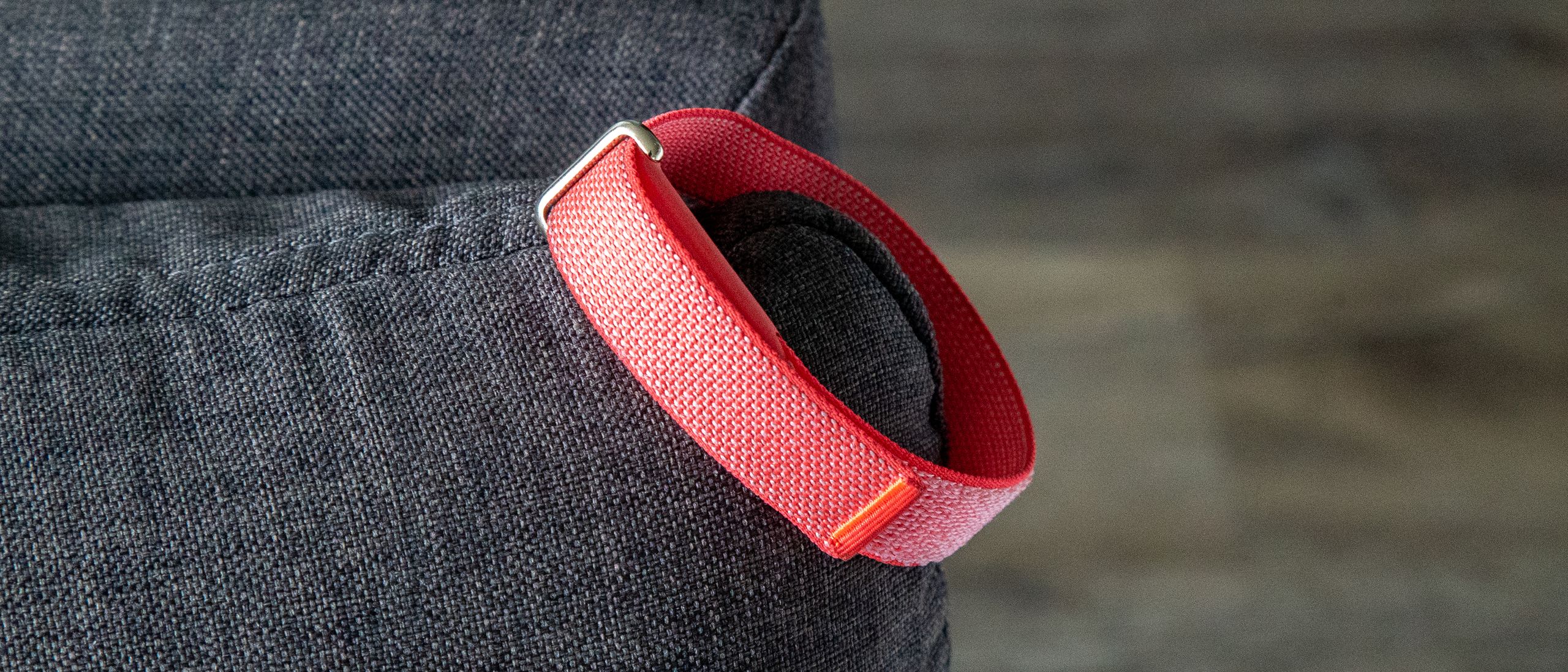
Reviewers agreed that comfort is the strongest physical asset of the Fitbit Air. The tracker module itself is a compact pebble weighing 5.2 grams, rising to roughly 12 grams when installed in the included woven Performance Loop fabric band. Outlets including Android Central and Mashable noted that it is easy to forget you are wearing it, making it far less intrusive overnight than standard smartwatches. The tracker carries a 50-meter water resistance rating for swimming and workouts, though Google recommends taking it off in soapy showers. Minor ergonomic complaints were limited: PhoneArena pointed out that the double-layer strap design can occasionally catch on long-sleeve shirts or jackets, and Android Central noted the lighter Berry fabric colorway tends to show dirt easily during vigorous workouts. Google also offers optional silicone Active Bands, dressier polyurethane Modern bands, and stainless steel mesh straps.
Health and fitness tracking accuracy
The sensor suite consists of an optical heart rate sensor, red and infrared SpO2 monitors, a skin temperature variation sensor, and a motion accelerometer with gyroscope. In comparative benchmark tests, tracking accuracy proved solid for general wellness. Tom's Guide tested the Air concurrently against a Garmin Forerunner 70 over seven nights and logged closely matching sleep stage distributions, durations, and sleep scores. Android Central found daily step counts deviated by only a few steps compared to dedicated pedometers. In steady-state cardio and running tests against Garmin and Strava, Tom's Guide reported dependable heart rate numbers. However, DC Rainmaker noted that fast interval spikes can show slight optical latency. Crucially for runners, the Air lacks integrated GPS, requiring a connected phone to capture route maps and precise outdoor pace. It also omits the ECG and electrodermal stress sensors present on the Pixel Watch.
Battery life
Google rates the Fitbit Air for up to 7 days of continuous use, and laboratory tests met or exceeded that target. PCMag logged just over 8 full days on a single charge. Mashable also recorded over 8 days of day-and-night tracking before the battery fell to 4%, while Tom's Guide had 15% remaining after exactly 7 full days with a dozen workouts tracked. Recharging takes around 90 minutes via a proprietary magnetic cable, and a 5-minute quick top-up adds roughly 24 hours of endurance. While its battery life is shorter than the 14-day mark achieved by the bulkier Whoop 5.0, reviewers felt a full week of run time removes standard smartwatch charging fatigue.
Smart features and app ecosystem
By design, the Fitbit Air avoids digital distraction. It lacks a display, buttons, speakers, or smartphone notification relays. The hardware interaction is limited to a small LED that indicates battery status when tapped twice. It does, however, incorporate a vibration motor. Both Tom's Guide and Android Central praised its Smart Wake alarm, which monitors your sleep cycle and vibrates at an optimal lighter sleep stage up to 30 minutes before your set wake-up time. The tracker syncs with the revamped Google Health app, which visualizes daily Sleep Scores, Cardio Load, and Readiness. Google also supports dual-device pairing, enabling Pixel Watch owners to wear their smartwatch by day and seamlessly swap to the Fitbit Air for sleep without corrupting unified trends.
Compatibility (iPhone/Android)
The Fitbit Air offers balanced cross-platform compatibility, pairing with both Android devices and iPhones via the Google Health app. Background synchronization over Bluetooth 5.0 is reliable on both operating systems. Through Google Health Connect on Android and Apple Health on iOS, users can mirror basic workout and sleep statistics into third-party fitness and gaming applications, including Pokémon Sleep.
Price and subscriptions
The Fitbit Air launched at $99.99 for the standard version ($129.99 for the Stephen Curry Special Edition) and generally sells at that retail level. Its strongest selling point against rivals like Whoop is that no subscription is required to access baseline biometrics: 24/7 heart rate, sleep metrics, skin temperature, SpO2, and workout detection remain free. Google includes a 3-month trial of Google Health Premium, which costs $9.99 per month or $79.99 per year thereafter. Premium unlocks deeper trend metrics and the Gemini-powered Google Health Coach. Outlets like DC Rainmaker observed that the un-monetized tier provides more than enough clarity for most everyday users without spending another cent.
Is it worth the money?
At $99.99 with no mandatory ongoing fees for core tracking, the Fitbit Air offers significantly lower long-term costs than rival screenless bands that lock all biometric data behind yearly subscriptions.
Also consider
- Whoop 5.0
Provides deeper athletic strain modeling and 14-day battery life with on-wrist slide-on charging, but requires a costly ongoing subscription.
- Oura Ring 4
Offers an ultra-discreet finger-worn form factor for passive sleep and recovery tracking, but starts at over three times the price upfront.
- Fitbit Edge
Adds an AMOLED touchscreen, onboard GPS, and ECG heart measurements for $179.99 if you prefer seeing live workout metrics on your wrist.
Reviews we read
This roundup summarizes professional reviews and published specifications; Next Interrupt did not test the product. Roundup updated October 26, 2026. How we work
- Android Central — I've been using the Fitbit Air, and it's a pretty good fitness tracker that I keep forgetting about. And that's the point
- Tom's Guide — I tested the Fitbit Air for a week — and it's the best no-fuss fitness tracker in 2026
- PCMag — Fitbit Air Review
- Engadget — Fitbit Air vs. Whoop: Which screenless fitness tracker is better for you?