Laptops & desktops / Review roundup
Asus ProArt P16
The 20-core N1X chip, with 10 performance and 10 efficient cores, and the 6144 CUDA core GPU component. This version also comes with a 1 TB SSD (for a $4,400 spec? 😬 I know) and 64 GB of LPDDR5X-9400 memory
- 90%Notebookcheck
- 4/5Tom's Guide
A breathtaking OLED creator workstation with zero battery throttling, held back by Arm quirks and a high price
The Asus ProArt P16 (H7607) is built for creative professionals and AI engineers who need Nvidia CUDA capability and massive unified memory pools in a genuinely portable chassis. Its biggest strength is the RTX Spark N1X architecture, which maintains full GPU and CPU performance on battery power without the steep throttling typical of x86 workstations. The primary catch is the steep $4,400 price tag for only 1 TB of storage, alongside lingering Windows on Arm translation overhead in unsupported games. Compared to the 16-inch Apple MacBook Pro, it trades raw single-core speed and ultra-long battery runtimes for native Windows software flexibility and full desktop CUDA ecosystem compatibility.
Buy it if
- AI researchers running 70B+ parameter models locally using Nvidia CUDA
- Video editors and 3D animators needing full rendering speed away from wall outlets
- Digital creatives wanting a color-accurate 120Hz 4K OLED display with stylus support
Skip it if
- Competitive PC gamers who rely on anti-cheat engines like Vanguard or EA Javelin
- Shoppers seeking conventional rendering value from standard x86 and RTX laptops
- Users who prioritize all-day 15-plus hour battery endurance over heavy local compute
Where to buy
We may earn a commission from purchases or qualifying sign-ups through our links. Affiliate links explained
What reviewers liked
- Maintains identical GPU and CPU performance on battery power without throttling
- Gorgeous 16-inch 4K 120Hz Lumina Pro OLED touchscreen with 1,600 nits HDR brightness
- 64 GB unified LPDDR5X memory pool accessible directly by the Blackwell GPU
- Slim, rigid chassis weighing only 1.77 kg
- Generous connectivity with three USB4 ports, HDMI 2.1, and an SD Express 7.0 slot
- Two internal M.2 2280 PCIe SSD slots for storage expansion
What they didn’t
- High $4,400 asking price with only a 1 TB SSD in this configuration
- Windows on Arm Prism translation incurs frame rate penalties in non-native games
- Cooling fans reach 50 dB(A) under heavy multi-core and GPU loads
- 1080p webcam lacks a physical privacy shutter
Key specs
- Launch price
- $4,400 (64 GB / 1 TB configuration)
- Reported price
- $4,400
- Processor
- NVIDIA RTX Spark N1X (20-core Grace CPU: 10 P-cores, 10 E-cores)
- Graphics
- NVIDIA Blackwell GPU (6,144 CUDA cores)
- Memory
- 64 GB LPDDR5X-9400 unified memory
- Storage
- 1 TB PCIe 4.0 NVMe SSD (2x M.2 2280 slots total)
- Display
- 16-inch 4K (3840 x 2400) 120Hz Lumina Pro OLED touchscreen, 1,600 nits peak HDR
- Battery
- 99.9 Wh, 240 W fast charging
- Weight
- 3.90 lbs (1.77 kg)
- Dimensions
- 13.94 x 9.57 x 0.51-0.63 in (354 x 243 x 13-16 mm)
- Operating System
- Windows 11 Pro
In depth
Design, build and portability
Asus redesigned the ProArt P16 chassis around the unified RTX Spark platform, making the frame 13 percent thinner and 16 percent lighter than previous iterations. At 1.77 kg (3.90 lbs) and measuring between 13 mm and 16 mm (0.51 to 0.63 inches) in thickness, Notebookcheck highlighted that the machine is more than 300 grams lighter than the 16-inch MacBook Pro. The chassis is finished in matte Nano Black metal, which reviewers noted offers high torsional rigidity with minimal keyboard flex. Despite its slim profile, Asus managed to retain an active cooling system that keeps palm rests comfortable, though Notebookcheck recorded fan noise reaching 50 dB(A) under sustained full compute loads.
Display
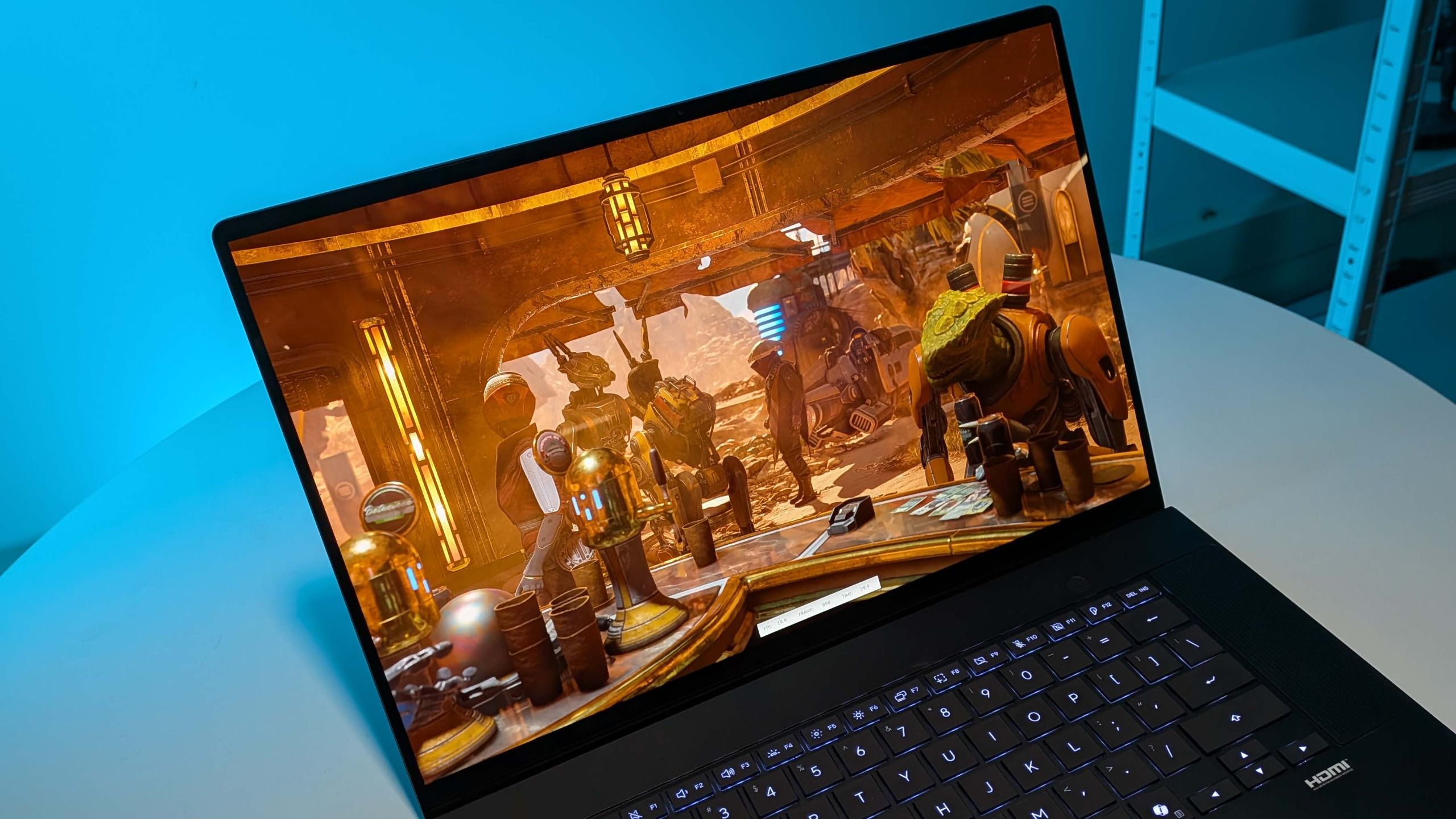
The laptop features a 16-inch 16:10 Lumina Pro OLED touchscreen panel with a 3840 x 2400 resolution and a 120Hz refresh rate. Official specifications confirm up to 1,600 nits of peak HDR brightness, 100 percent DCI-P3 color gamut coverage, Pantone validation, and active stylus support. Notebookcheck and Tom's Guide commended the display for its deep black levels, razor-sharp text rendering, and smooth motion clarity. The display also features an anti-reflective coating that reduces ambient glare by 65 percent without muddying color vibrancy, alongside Nvidia G-Sync variable refresh rate support for tearing-free creative playback and gaming.
Performance in everyday and demanding work
At the core of the laptop is Nvidia's RTX Spark N1X SoC, pairing a 20-core Grace CPU with a Blackwell GPU packing 6,144 CUDA cores and 64 GB of unified LPDDR5X-9400 memory. In Cinebench 2024 multi-core, the P16 reached 1,726 points, edging out AMD's Ryzen AI Max+ 395 at 1,673 points, while trailing Apple's M5 Max at 2,490 points. Single-core output hit 130 points, landing on par with Intel's Core Ultra 9 285H. In 3DMark Steel Nomad, Notebookcheck recorded 3,134 points, placing the Blackwell GPU roughly on par with a discrete 90W mobile RTX 5070 despite consuming roughly 43W. Crucially, both Tom's Guide and Notebookcheck confirmed that the P16 experiences zero performance throttling on battery power, matching its AC-plugged render times in Blender and DaVinci Resolve. For AI developers, the unified memory pool allows running local 70B+ parameter models that exceed the capacity of conventional 8 GB to 16 GB laptop GPUs. The caveat lies in non-native software: PC games relying on Microsoft's Prism x86 translation layer exhibit lower frame rates, and several kernel-level anti-cheat titles like Valorant remain completely unplayable.
Battery life
Outlets measured varying battery results based on workload intensity against the 99.9 Wh internal cell. In Notebookcheck's automated Wi-Fi browsing test at 150 nits, the P16 lasted just under 10 hours, held back somewhat by a relatively high 7.7W idle power draw. Trusted Reviews logged 13 hours 55 minutes during a local 1080p video loop. Under heavy graphical load, endurance shrinks significantly: Tom's Guide measured 1 hour 38 minutes in its gaming endurance test, while PC Gamer recorded 86 minutes in continuous battery gaming. In contrast, Wccftech logged 205 minutes under a lighter mixed creative workload. The included 240W power adapter supports rapid charging over USB4.
Keyboard, trackpad, speakers and webcam
The keyboard offers 1.7 mm of key travel, three-level white backlighting, and a crisp actuation point, though Asus opted not to include a numeric keypad in order to center the layout. The large glass haptic trackpad features Asus's integrated DialPad, a virtual rotary control that lets users scrub timelines, tweak brush sizes, or adjust settings in Adobe Creative Cloud and system controls. Notebookcheck and Tom's Guide both praised the six-speaker array with Dolby Atmos and Smart Amp technology, calling the bass response and vocal separation among the best on any Windows laptop. The webcam captures 1080p video and includes an infrared sensor for Windows Hello biometric facial recognition, but Notebookcheck lamented the absence of a physical privacy shutter.
Ports and upgradeability
Physical connectivity is well-rounded for creative workstations. The chassis provides three USB4 Type-C ports supporting 240W charging and DisplayPort video out, one USB 3.2 Gen 2 Type-A port, a full-sized HDMI 2.1 port, an SD Express 7.0 card reader, and a 3.5 mm combo audio jack. Wireless networking is handled by a MediaTek Wi-Fi 7 card with Bluetooth 5.4. Notebookcheck verified internal maintenance access: while the 64 GB of unified memory is soldered directly to the N1X platform package and cannot be upgraded, users have access to two M.2 2280 PCIe 4.0 SSD slots, an easily removable Wi-Fi card, and accessible cooling fans.
Price and configurations
The Asus ProArt P16 (H7607) configured with the 20-core N1X chip, 6,144 CUDA cores, 64 GB of LPDDR5X-9400 RAM, and a 1 TB SSD retails for $4,400. Entry models with an 18-core chip, 5,120 CUDA cores, and 24 GB of RAM start at $2,599 to $2,799. The flagship tier with 128 GB of unified memory and a 2 TB SSD sells between $6,499 and $6,999. Reviewers pointed out that pairing a modest 1 TB drive with a $4,400 price tag feels tight, although having an open second M.2 slot helps mitigate the cost of adding storage later.
Is it worth the money?
The $4,400 price tag reflects the premium cost of large-capacity unified memory and unthrottled battery operation for AI models, but the inclusion of only 1 TB of storage at this price point remains a clear downside.
Also consider
- Apple MacBook Pro 16 (M5 Max)
Provides faster CPU performance and longer battery life in light tasks, but lacks Nvidia CUDA compatibility for local AI development.
- Asus ProArt P16 (AMD Ryzen AI 9 / RTX 5090)
Offers superior native PC gaming frame rates and x86 software compatibility, but heavily throttles performance when running on battery.
- Microsoft Surface Laptop Ultra (RTX Spark N1X)
Uses the same Nvidia N1X platform with a high-refresh mini-LED screen, but carries a bulkier 2.0 kg frame.
Reviews we read
This roundup summarizes professional reviews and published specifications; Next Interrupt did not test the product. Roundup updated October 20, 2026. How we work
- Notebookcheck — The $7,000 MacBook Pro alternative? (Asus ProArt P16 Review)
- Tom’s Guide — I tested the Asus ProArt P16 with Nvidia RTX Spark and it's the ultimate AI creator laptop (with a price to match)
- PC Gamer — Asus ProArt P16 (H7607) RTX Spark laptop review
- Wccftech — ASUS ProArt P16 “RTX Spark” Laptop Review – NVIDIA’s First Full PC Platform Brings Powerful AI & Gaming Capabilities