Laptops & desktops / Review roundup
Microsoft Surface Laptop Ultra
RTX Spark N1X chip with a 5120 GPU and 18-core CPU, 24GB of unified memory, and a 512GB SSD
- 7/10WIRED
- RecommendedTom's Guide
- RecommendedServeTheHome
A meticulously crafted Arm workstation for local AI developers with steep pricing and mixed battery endurance
The Surface Laptop Ultra is built specifically for AI developers, machine learning researchers, and creative professionals who need substantial local GPU compute and unified memory within Windows. Its standout strength is Nvidia's RTX Spark architecture, which runs sizable AI models locally alongside a gorgeous 2,000-nit Mini-LED display and exceptional build quality. The catch is that heavy compute drains the battery rapidly, and Windows on Arm still presents software friction for anti-cheat gaming and legacy x86 workflows. Compared with the Apple MacBook Pro 16, it delivers broader native CUDA support for local models, but cannot match Apple in unplugged battery life or single-core efficiency.
Buy it if
- AI researchers and software engineers running large language models and CUDA workloads locally
- Creative professionals wanting a color-accurate 3:2 touchscreen with full-size ports
- Windows power users seeking MacBook Pro-grade aluminum chassis quality and haptics
Skip it if
- You need all-day battery life while running heavy workstation tasks away from a desk
- Competitive PC gaming is a priority, due to Windows on Arm anti-cheat limitations
- You have a strict sub-$2,000 budget
Where to buy
We may earn a commission from purchases or qualifying sign-ups through our links. Affiliate links explained
What reviewers liked
- Unified memory architecture allows large local AI inference with native CUDA support
- Vibrant 15-inch Mini-LED display reaching 2,000 nits peak HDR brightness
- Generous port selection alongside a convenient breakaway magnetic USB-C charging cable
- Large, responsive haptic glass trackpad and rigid magnesium-aluminum build
- Accessible, user-replaceable M.2 SSD storage
What they didn’t
- Battery drains in roughly an hour during sustained heavy AI workloads
- Windows on Arm emulation penalties and anti-cheat incompatibilities hinder PC gaming
- Single-core CPU speeds trail current x86 and Apple silicon flagships
- High starting price of $2,599 for modest base storage
Key specs
- Launch price
- $2,599.99
- Reported price
- $2,599.99
- Starting Price
- $2,599.99
- Processor
- Nvidia RTX Spark N1X (18-core Arm CPU, 5,120-core Blackwell GPU)
- Memory
- 24GB unified LPDDR5X (up to 128GB on higher configurations)
- Storage
- 512GB PCIe Gen 4 SSD (removable M.2)
- Display
- 15-inch Mini-LED touchscreen (3270 x 2180, 120Hz, 2,000 nits peak HDR)
- Dimensions & Weight
- 17.8 mm thin; 4.45 lbs (2.02 kg)
- Battery
- 92Wh with 140W magnetic fast charger
In depth
Design, build and portability
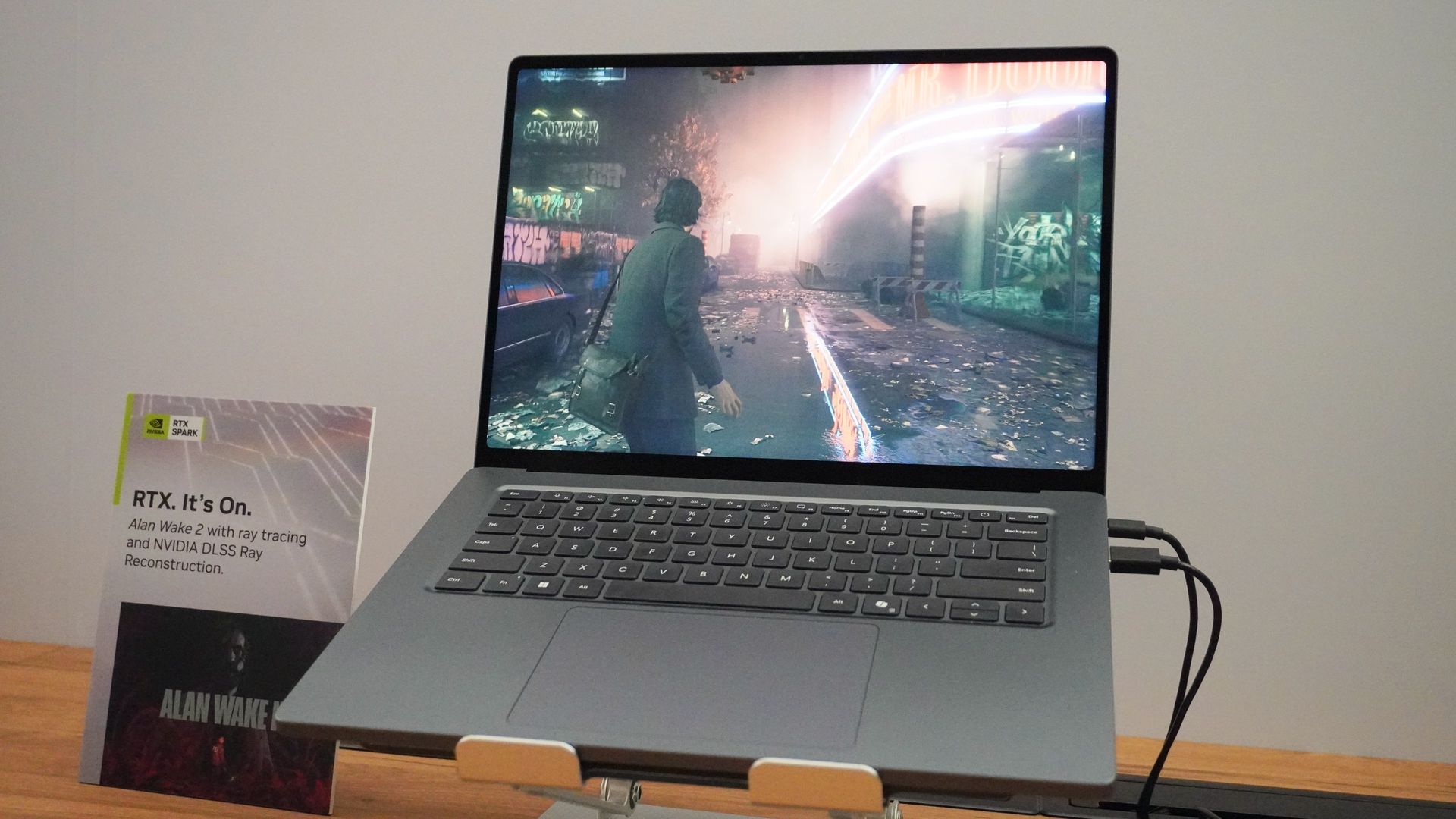
Microsoft adopts a minimalist, industrial language reminiscent of its traditional Surface line, wrapping the chassis in dark Nightfall or Platinum anodized aluminum and magnesium alloy. Tom's Hardware highlighted that the chassis feels exceptionally rigid, exhibiting virtually no flex along the keyboard deck or lid. At 17.8 mm thick and roughly 4.45 pounds (2.02 kg), it weighs less than conventional 16-inch mobile workstations packing discrete graphics, though it remains noticeably heavier than standard thin-and-light portables. Cooling intakes line the perimeter subtly, and while the machine runs whisper-quiet during office navigation, reviewers noted that its twin cooling fans become clearly audible under prolonged AI compilation runs.
Display
The 15-inch PixelSense Ultra touchscreen features a 3270 x 2180 resolution in Microsoft's signature 3:2 productivity aspect ratio, complete with a 120Hz dynamic refresh rate. Reviewers at Tom's Hardware and CNET praised the Mini-LED panel's brightness, which tops out at 2,000 nits for HDR highlights and provides deep black levels with 100% DCI-P3 color coverage. Windows Central noted that while blooming around small white objects on pitch-black backgrounds is kept well under control, local dimming algorithms can occasionally produce mild luminance shifting during rapid SDR video playback.
Performance in everyday and demanding work
Performance is driven by the unified Nvidia RTX Spark N1X superchip. StorageReview measured a 35-billion-parameter coding agent running locally at 89 tokens per second on the platform, showcasing the advantage of letting the Blackwell GPU address wide pools of high-bandwidth memory. In multithreaded rendering tests like Cinebench 24 and DaVinci Resolve 8K exports, ServeTheHome and Tom's Hardware found the multi-core Arm architecture consistently competitive with Intel Panther Lake and AMD Strix Point systems. However, PCWorld noted that single-core benchmark numbers remain comparatively modest. Gaming is a distinct weak point: while titles ported natively to Arm run fluidly, many popular competitive multiplayer games fail entirely due to kernel-level anti-cheat incompatibilities with Windows on Arm, and unoptimized x86 games lose frames to emulation overhead.
Battery life
How long the 92Wh battery lasts depends entirely on the workload. ServeTheHome recorded between 11 and 13 hours during moderate mixed web browsing and video streaming at moderate display brightness. Under heavy agentic AI inference and 3D rendering, however, ServeTheHome saw battery life drop to roughly an hour. WIRED and The New Stack both reported that the system throttles GPU inference throughput by 20% to 25% when disconnected from AC power to protect the cells. Consequently, reviewers recommend keeping the included 140W magnetic power brick close at hand for any intensive developer or rendering session.
Keyboard, trackpad, speakers and webcam
Tom's Guide described the expansive haptic glass trackpad as the best ever fitted to a Windows laptop, highlighting precise tracking, uniform click resistance across the entire surface, and subtle haptic feedback triggers. The full-travel keyboard delivers crisp actuation and includes a dedicated Copilot key. Audio output from the multi-speaker system earned praise for clear mids and reasonable bass presence. PCWorld noted the webcam delivers clean 1080p resolution and reliable Windows Hello facial authentication, though dynamic range in harsh backlighting is fairly ordinary compared with high-end external webcams.
Ports and upgradeability
Port selection is versatile for a creator machine, featuring three USB-C ports with 40Gbps USB4 support, one USB-A 3.2 port, an HDMI 2.1 display output, a full-size SD card reader, and a 3.5mm headphone jack. Charging is handled via Microsoft's Magnetic Connect breakaway USB-C cable, which Tom's Guide praised for its secure latch and snag-free safety. For upgradeability, the unified LPDDR5X memory is integrated into the silicon package and cannot be altered after purchase, but the M.2 NVMe SSD is accessible beneath a removable bottom hatch.
Price and configurations
The Surface Laptop Ultra starts at $2,599.99 for the 18-core CPU, 5,120-core GPU, 24GB memory, and 512GB SSD configuration. Mid-tier specifications scale through 32GB, 48GB, and 64GB memory options, while the top developer edition climbs to $5,899.99 with a 20-core CPU, 6,144-core GPU, 128GB of unified memory, and 1TB of storage. Ars Technica and PCWorld cautioned that 24GB of unified memory leaves tight headroom once the operating system, display, and memory-hungry AI models compete for the same pool, suggesting that serious developers should budget for higher-capacity configurations.
Is it worth the money?
The entry price is steep for 512GB of base storage, but the integrated Nvidia Blackwell GPU and unified memory architecture provide local AI capabilities that are otherwise unattainable in conventional Windows laptops without purchasing a bulky desktop replacement.
Also consider
- Apple MacBook Pro 16 (M5 Pro / M5 Max)
Offers significantly longer real-world battery life away from the wall and faster single-core performance, though it lacks native Nvidia CUDA support.
- ASUS ProArt P16 (RTX Spark N1X)
Provides a similar Nvidia Spark unified computing platform with an alternative 4K OLED display and creator dial controls.
- Dell XPS 16
A traditional x86 Windows laptop alternative that avoids Arm software emulation hurdles and anti-cheat gaming restrictions.
Reviews we read
This roundup summarizes professional reviews and published specifications; Next Interrupt did not test the product. Roundup updated October 17, 2026. How we work
- Tom's Guide — I broke up with my MacBook Pro for Microsoft Surface Laptop Ultra — RTX Spark surprised me
- Tom's Hardware — Microsoft Surface Laptop Ultra review: RTX Spark in a straight-up beautiful Windows PC
- WIRED — Microsoft Surface Laptop Ultra Review: The First Real AI PC
- PCWorld — Microsoft Surface Laptop Ultra review: A monster AI laptop with a monster price
- ServeTheHome — Microsoft Surface Laptop Ultra Review
- StorageReview — Microsoft Surface Laptop Ultra for Business Review: RTX Spark N1X Runs a 35B-Parameter Coding Agent at 89 Tokens per Second, With One Major Caveat