Laptops & desktops / Review roundup
Asus ProArt P16
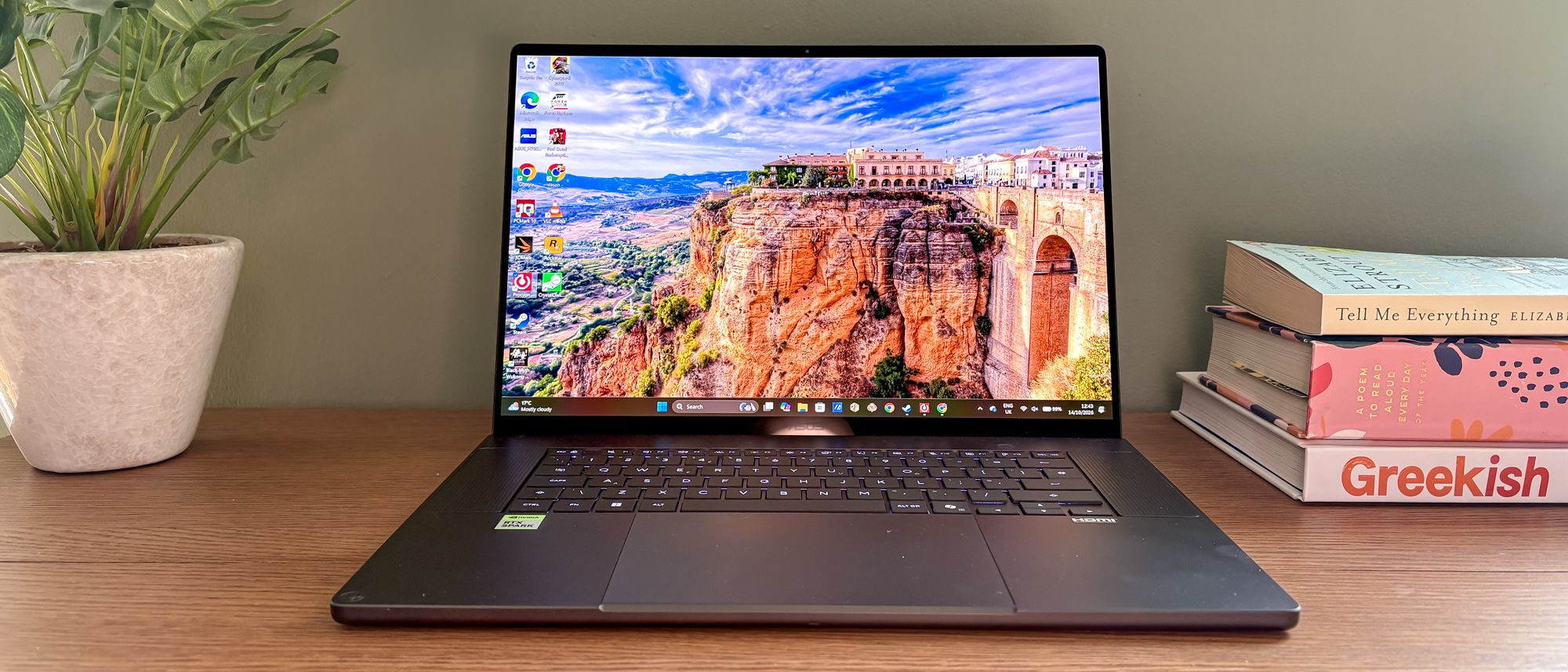
Asus ProArt P16 (RTX Spark) (tested)
- 90.3%Notebookcheck
- 8.7/10Engadget
- 78%PC Gamer
A razor-thin creator workstation with groundbreaking unified memory and an exorbitant price tag
The Asus ProArt P16 powered by Nvidia's RTX Spark platform delivers workstation-class local AI inference and creative muscle inside an exceptionally sleek 3.9-pound aluminum chassis. Its primary appeal is the unified memory architecture, allowing creators and developers to run huge local AI models without cloud fees alongside a stunning 4K 120Hz tandem OLED touchscreen. However, entry pricing starts high and maxed-out tiers reach $7,000, while fan noise ramps up quickly under sustained loads. Compared to Apple's 16-inch MacBook Pro, the ProArt offers superior local AI flexibility and touch capabilities, but trails slightly in CPU single-core efficiency and battery longevity.
Buy it if
- AI developers running large multi-gigabyte models and LLMs locally without cloud API fees
- Digital artists and video editors needing an accurate, 120Hz 4K OLED canvas with stylus input
- Creative professionals wanting desktop-class VRAM capacity in a sub-4-pound traveling chassis
Skip it if
- You only need a laptop for conventional PC gaming, where anti-cheat compatibility and price-to-fps favor standard GPUs
- You are shopping on a moderate budget, as configurations escalate rapidly past $4,000
- You require near-silent operation under heavy multi-threaded CPU and GPU rendering loads
Where to buy
We may earn a commission from purchases or qualifying sign-ups through our links. Affiliate links explained
What reviewers liked
- Up to 128GB unified memory enables enormous local AI models impossible on traditional consumer laptops
- Gorgeous 16-inch 4K 120Hz tandem OLED touchscreen with up to 1,600 nits HDR brightness
- Remarkably thin 0.51-inch profile and light 3.95-pound weight for a 16-inch workstation
- Generous physical connectivity including three USB4 ports, HDMI 2.1, and full-size SD Express 7.0
- Rich, punchy six-speaker audio array with Dolby Atmos
What they didn’t
- Astronomical pricing reaching $7,000 for top-tier memory configurations
- Fans get noticeably loud and chassis warms up under sustained workloads
- Windows on Arm Prism emulation still encounters friction with specific legacy software and anti-cheat engines
- 1080p webcam lacks a physical privacy shutter
Key specs
- Launch price
- $2,799 to $7,000 depending on configuration
- Reported price
- $2,799 (32GB / 1TB); $4,400 (64GB / 2TB); $6,499–$7,000 (128GB / 2TB)
- Processor
- Nvidia RTX Spark N1X (20-core Arm CPU, up to 4.0 GHz)
- Graphics
- Nvidia Blackwell RTX GPU (6,144 cores, up to 80W TDP)
- Unified Memory
- 32GB, 64GB, or 128GB LPDDR5X-9400
- Display
- 16.0-inch 16:10 4K (3840 x 2400) Lumina Pro Tandem OLED, 120Hz, touch/stylus support
- Storage
- 1TB or 2TB PCIe 4.0 SSD (2x M.2 slots supporting PCIe 5.0)
- Battery
- 99.9 Wh lithium-polymer
- Weight
- 3.95 lbs (1.79 kg)
- Dimensions
- 13.94 x 9.57 x 0.51–0.63 inches (354.1 x 243 x 12.9–15.9 mm)
In depth
Design, build and portability
Asus redesigned the ProArt P16 chassis around Nvidia's RTX Spark platform, producing one of the leanest 16-inch creator notebooks available. Notebookcheck measured its dimensions at 354.1 x 243 x 12.9–15.9 mm with a weight of 1.792 kg (3.95 lbs), making it roughly 300 grams lighter and noticeably slimmer than Apple's 4.7-pound 16-inch MacBook Pro. Engadget praised the rigid CNC aluminum unibody, noting its clean matte finish resists smudges better than earlier iterations. Despite its thin profile, the chassis feels rigid and resistant to torsional flex, though testers noted the laptop requires aggressive internal fan profiles to vent heat generated by the dense unified chip.
Display
The ProArt P16 features a 16-inch 16:10 Lumina Pro Tandem OLED panel running at 3840 x 2400 with a smooth 120Hz refresh rate and touch and pen support. Notebookcheck found the tandem OLED structure delivers 500 nits in standard dynamic range and achieves up to 1,600 nits of peak HDR brightness, accompanied by full 100% DCI-P3 coverage and sub-1.0 Delta E color accuracy. An effective anti-reflective coating cuts down the harsh glare common to touch glass displays without dulling contrast. Reviewers universally praised the panel's deep black levels and crisp detail for fine photo grading, 3D design, and video mastering.
Performance in everyday and demanding work
Under the hood sits Nvidia's RTX Spark N1X superchip, pairing a 20-core Grace Arm CPU with a 6,144-core Blackwell graphics architecture and up to 128GB of unified LPDDR5X memory. In local AI workflows, reviewers found it unrivaled in mobile form factors: the massive shared memory pool allows running multi-billion-parameter LLMs, ComfyUI, and Stable Diffusion locally without hitting VRAM bottlenecks. In gaming, PC Gamer reported the integrated Blackwell GPU trades blows with mobile RTX 5060 and 5070 cards while sipping less power, recording an average draw of 43W in Metro Exodus compared to 97W on conventional x86 gaming rivals. CPU single-threaded performance is more modest, and Windows on Arm Prism emulation means certain legacy apps and multiplayer anti-cheat tools do not yet run reliably.
Battery life
Asus squeezed a maximum airline-legal 99.9 Wh battery into the thin chassis. In real-world battery endurance testing, Tom's Guide recorded 12 hours and 26 minutes during web browsing and video streaming at 150 nits. TechRadar saw 11 hours and 23 minutes playing looped 1080p video at 50% brightness. Notebookcheck's standard Wi-Fi surfing benchmark logged 9.5 hours on the 4K tandem OLED configuration, noting the display consumes noticeable idle power. When under heavy gaming load, PC Gamer measured 86 minutes in the PCMark 10 gaming battery test. Endurance comfortably clears a full standard workday, though continuous rendering drains the battery considerably faster.
Keyboard, trackpad, speakers and webcam
Input hardware drew high marks. Asus outfits the laptop with a chiclet keyboard boasting 1.7 mm of key travel, which Windows Central and Notebookcheck rated as more tactile and comfortable than the shallower switches on Apple's MacBook Pro. The oversized haptic glass touchpad is smooth and responsive, incorporating the Asus DialPad shortcut wheel in its upper-left quadrant for scrubbing timelines and adjusting brush settings. PC Gamer highlighted the upward-firing six-speaker sound system with Dolby Atmos, praising its surprising low-end bass and volume. The 1080p IR webcam supports Windows Hello and presence detection, though Notebookcheck noted the absence of a physical privacy shutter.
Ports and upgradeability
Connectivity is comprehensive for a thin notebook. Asus includes three USB4 40 Gbps Type-C ports (all supporting Power Delivery and DisplayPort), one USB 3.2 Gen 2 Type-A port, a full-size HDMI 2.1 output, a 3.5 mm audio jack, and an SD Express 7.0 card reader capable of near-gigabyte per second transfers. Wireless connectivity covers Wi-Fi 7 and Bluetooth 5.4. Inside, the unified LPDDR5X system memory is permanently soldered to the superchip package and cannot be upgraded post-purchase. However, Asus includes two accessible M.2 2280 SSD slots with PCIe 5.0 support alongside replaceable Wi-Fi and battery modules.
Price and configurations
The Asus ProArt P16 launched in October 2026 with a base configuration starting at $2,799 (featuring 32GB of unified memory and a 1TB SSD). A mid-tier model with 64GB of memory and a 2TB SSD retails around $4,400. The flagship configuration tested by most review outlets—combining the top-bin RTX Spark N1X chip, a 4K 120Hz tandem OLED touchscreen, and 128GB of unified memory—carries a staggering launch price of $6,499 to $7,000. Reviewers emphasize that unless a buyer specifically leverages local AI processing or massive 3D scenes that require the colossal unified memory footprint, standard gaming and creator laptops offer substantially higher price-to-performance value.
Is it worth the money?
Entry pricing is steep, and configuring up to 64GB or 128GB unified memory pushes the laptop into specialized workstation territory. It represents compelling value only for professionals whose local AI workflows or massive project assets justify paying a premium over traditional x86 laptops.
Also consider
- Apple MacBook Pro 16 (M4 Max / M5 Pro)
Offers superior single-core CPU efficiency, longer real-world battery endurance, and native macOS creative app optimization, though it lacks touch input and CUDA hardware support.
- Asus ROG Zephyrus G16
Provides comparable thin-and-light portability with standard x86 Intel/AMD silicon and discrete GeForce graphics, avoiding Arm compatibility issues at a significantly lower price point.
- Microsoft Surface Laptop Ultra
Shares the same Nvidia RTX Spark platform with a magnetic breakaway charger, but features a thicker chassis and lacks the ProArt's OLED panel and pen input.
Reviews we read
This roundup summarizes professional reviews and published specifications; Next Interrupt did not test the product. Roundup updated November 3, 2026. How we work
- Tom's Guide — I tested the Asus ProArt P16 with Nvidia RTX Spark and it's the ultimate AI creator laptop (with a price to match)
- PC Gamer — Asus ProArt P16 (H7607) RTX Spark laptop review
- Notebookcheck — The $7,000 MacBook Pro alternative? (Asus ProArt P16 Review)
- Wccftech — ASUS ProArt P16 “RTX Spark” Laptop Review – NVIDIA’s First Full PC Platform Brings Powerful AI & Gaming Capabilities
- Engadget — ASUS ProArt P16 Review: A Sleek Showcase For NVIDIA's RTX Spark