Graphics cards / Review roundup
ASRock Creator Radeon AI Pro R9700
ASRock Creator Radeon AI Pro R9700
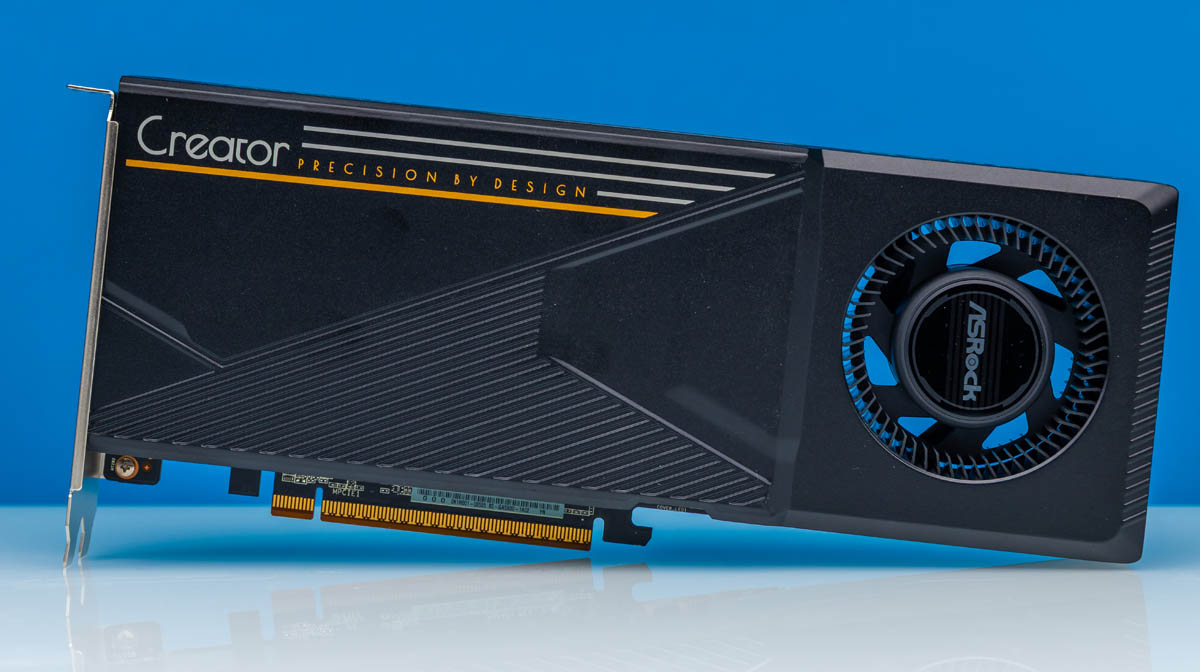
A compact 32GB blower graphics card delivering capable AI inference and CAD speed at an approachable price
The ASRock Creator Radeon AI Pro R9700 fills an important niche for developers and workstation professionals seeking 32GB of VRAM without paying enterprise premiums. Its biggest strengths are its strict dual-slot form factor, tail-mounted power connector, and low 300W board power that make multi-GPU workstation and rack builds straightforward. However, the lateral blower cooler runs warm and audibly loud under sustained workloads, and AMD's software stack still trails Nvidia's CUDA and OptiX ecosystems. For users who need generous memory capacity for local LLM inference or CAD applications like SolidWorks, it offers compelling value compared to far pricier Nvidia hardware.
Buy it if
- Local AI developers running 27B-to-35B language models on workstations or 3U server racks
- Engineers using CAD packages like SolidWorks, AutoCAD, and Creo that thrive on AMD Pro drivers
- Multi-GPU workstation builders who need compact 2-slot cards with rear-facing power connectors
Skip it if
- Gamers seeking high-refresh 4K gaming, who are better served by standard consumer cards with Adrenalin drivers
- Users heavily dependent on Nvidia CUDA pipelines, TensorRT, or OptiX ray tracing rendering
- Silent desktop PC builders sensitive to blower-fan noise under sustained compute loads
Where to buy
We may earn a commission from purchases or qualifying sign-ups through our links. Affiliate links explained
What reviewers liked
- Generous 32GB GDDR6 memory pool with optional Linux soft ECC support
- Strict dual-slot blower format fits cleanly in dense multi-card and 3U rack systems
- Tail-mounted 16-pin 12V-2x6 connector eliminates clearance issues in server enclosures
- Strong performance in CAD applications, beating competing Nvidia Ada GPUs in SolidWorks
- Manageable 300W Total Board Power requirement
What they didn’t
- Blower-style fan gets noticeably loud under full computational loads
- VRAM and hotspot temperatures reach up to 90°C under extended peak stress
- OptiX-based 3D rendering and CUDA-optimized AI frameworks continue to favor Nvidia rivals
Key specs
- Launch price
- $1,299 MSRP
- Reported price
- $1,699 - $1,700
- GPU Architecture
- AMD RDNA 4 (Navi 48 XTW, 4nm TSMC)
- Stream Processors / CUs
- 4,096 shaders / 64 Compute Units
- Matrix / AI Accelerators
- 128 (382.7 TFLOPS FP8, 47.8 TFLOPS FP32)
- VRAM
- 32GB GDDR6 (256-bit bus, 20 Gbps, 640 GB/s)
- Board Power (TBP)
- 300W (750W PSU recommended)
- Dimensions
- 271 x 112 x 39 mm (Dual-slot blower)
- Display Outputs
- 4x DisplayPort 2.1a
- Power Connector
- 1x 16-pin 12V-2x6 (tail-mounted)
In depth
Workstation compute and gaming performance
While built on the Navi 48 silicon shared with AMD's consumer graphics cards, the Creator Radeon AI Pro R9700 targets engineering and professional compute. In professional benchmarks, Igor's Lab recorded a composite score of 4.40 points in Dassault Systèmes SolidWorks, taking top position ahead of the consumer RX 9070 XT (4.39) and the Radeon Pro W7800 (4.26), and soundly defeating Nvidia's competing workstation cards. ServeTheHome also found the card capable in SPECviewperf 15 4K tests, scoring just under 200 points in PTC Creo and outpacing the GeForce RTX 5090 in SolidWorks, though trailing the Nvidia card by roughly half in Maya and seismic visualization workloads. Although the card supports DirectX 12 Ultimate and provides the raster power of high-end Navi 48 hardware, reviewers note that it uses AMD's enterprise Pro drivers rather than gaming-focused Adrenalin packages, meaning it is not optimized for consumer gaming rigs.
Ray tracing and upscaling
The RDNA 4 architecture introduces third-generation ray tracing units and updated matrix cores. However, reviewers found that production rendering remains divided by software support. In Blender rendering via AMD's HIP backend, Igor's Lab reported that the R9700 is the fastest AMD card tested, outpacing the Radeon Pro W7800. Even so, it continues to lag behind Nvidia GPUs using OptiX, because HIP does not leverage specialized hardware ray tracing to the same extent. Upscaling through AMD FSR is available in compatible creative tools, but developers relying specifically on Nvidia DLSS, TensorRT, or CUDA pipelines will find broader turnkey support on competing GeForce and RTX Ada hardware.
Memory (VRAM) and AI inference
VRAM capacity is the centerpiece of the R9700. AMD equips the card with 32GB of GDDR6 across a 256-bit bus, offering 640 GB/s of bandwidth alongside 64MB of Infinity Cache and optional Linux soft ECC. ServeTheHome evaluated the card under local AI inference tasks using Qwen3.8-27B (quantized to INT4) and recorded code generation throughput scaling to 113 tokens per second at 16 concurrent users, with agent tasks reaching 97 tokens per second at 32 users. When running Qwen3.6-35B, ServeTheHome found the R9700 trailed the flagship RTX 5090 by roughly 2-to-1 at lower user counts and 3-to-1 under heavy concurrency, but stressed that the R9700 fits large 27B-to-35B parameter models entirely into local memory at a much lower hardware cost.
Power draw, heat and noise
AMD rates the R9700 at a 300W Total Board Power. Igor's Lab measured thermal characteristics under sustained loads, observing that core GPU temperatures stayed reasonable, but hotspot temperatures reached up to 90°C and GDDR6 memory chips climbed slightly above 90°C, inducing modest thermal throttling at prolonged peak loads. Igor's Lab attributed this to a relatively thin decorative backplate that lacks active thermal coupling for the memory. ServeTheHome noted that the 300W envelope prevents the blower cooler from becoming unbearable, but as with all lateral blower designs, fan noise is distinctly audible under full stress compared to multi-fan open-air desktop cards.
Size, power connector and PSU needs
ASRock designed the Creator model specifically for dense chassis deployments. Measuring 271 mm long, 112 mm high, and 39 mm thick, it strictly adheres to a dual-slot footprint. Most notably, ASRock placed the 16-pin 12V-2x6 power connector at the rear end of the card rather than on the top edge. Reviewers highlighted that this tail-mounted connector eliminates top cable bending issues and allows the card to slide cleanly into 3U rackmount enclosures or densely stacked dual- and quad-GPU workstation chassis. A minimum 750W power supply is recommended for single-card installations.
Price versus competing cards
AMD announced the Radeon AI Pro R9700 at a $1,299 MSRP, with ASRock's Creator edition typically listing around $1,699 to $1,700. ServeTheHome noted that this pricing undercuts high-end alternatives like the GeForce RTX 5090 (which retails above $2,000) while matching its 32GB memory capacity. Consumer cards such as the RTX 5080 cost less but offer only 16GB of VRAM, limiting their ability to load larger models. While dedicated workstation GPUs like the 32GB Radeon Pro W7800 cost more, the R9700 provides updated RDNA 4 matrix hardware in an efficient form factor.
Is it worth the money?
Official AMD MSRP was set at $1,299, but retail models from ASRock commonly sell closer to $1,699–$1,700 due to demand for high-capacity local inference memory.
Also consider
- NVIDIA GeForce RTX 5090
Offers 32GB of VRAM with two- to four-fold faster inference throughput and native CUDA support, but draws far more power and costs significantly more.
- AMD Radeon RX 9070 XT
Shares the same underlying Navi 48 silicon and delivers similar gaming performance for hundreds less, but is restricted to 16GB of VRAM.
- AMD Radeon Pro W7800
Provides 32GB of workstation memory with certified enterprise driver support, but relies on older RDNA 3 architecture with slower matrix compute.
Reviews we read
This roundup summarizes professional reviews and published specifications; Next Interrupt did not test the product. Roundup updated October 28, 2026. How we work