Graphics cards / Review roundup
GeForce RTX 5090
Desktop GPU, 32GB; Founders Edition specifications
- 4.0 / 5Tom's Hardware
- 4.0 / 5PCMag
Unrivaled 4K and AI speed in a sleek dual-slot design, but massive power draw and inflated pricing limit its appeal
The GeForce RTX 5090 Founders Edition delivers unprecedented 4K rasterization and ray-tracing frame rates alongside a massive 32GB memory buffer, making it the top choice for uncompromising gamers and local AI researchers. However, its 575W power rating drives significant heat into the memory modules and demands at least a 1000W power supply. In everyday value, the card faces diminishing returns at lower resolutions where CPU bottlenecks erase its lead over previous-generation flagships. Compared to the RTX 4090 and RTX 5080, it offers roughly 25% to 35% higher 4K speed, but at a retail cost that often doubles or triples the price per frame.
Buy it if
- Uncompromising native 4K and high-refresh path-traced gaming
- Local machine learning, LLM fine-tuning, and heavy 3D rendering workloads
- Builders wanting flagship graphics in a standard dual-slot clearance footprint
Skip it if
- You play primarily at 1440p or 1080p resolutions
- Your PC case and existing power supply cannot manage 575W of sustained heat and power draw
- You are shopping strictly on price-to-performance value
Where to buy
We may earn a commission from purchases or qualifying sign-ups through our links. Affiliate links explained
What reviewers liked
- Fastest consumer graphics card on the market for 4K rasterization and ray tracing
- Massive 32GB GDDR7 memory buffer with 1,792 GB/s of bandwidth
- Founders Edition fits in a true dual-slot form factor, shedding bulk from prior generations
- Full DisplayPort 2.1b UHBR20 support for next-generation high-bandwidth monitors
What they didn’t
- Extremely high 575W power rating leads to high operating temperatures on GDDR7 chips
- Severe CPU bottlenecks at 1440p and 1080p yield minimal gains over older GPUs
- Launch MSRP of $1,999 frequently inflated by severe market markups
Key specs
- Launch price
- $1,999
- Reported price
- $3,500 to $4,500
- GPU Architecture
- Nvidia Blackwell (GB202)
- CUDA Cores
- 21,760
- Tensor / RT Cores
- 680 (5th Gen) / 170 (4th Gen)
- VRAM
- 32GB GDDR7 (512-bit bus, 1,792 GB/s bandwidth)
- Base / Boost Clock
- 2.01 GHz / 2.41 GHz
- Total Board Power (TBP)
- 575W
- Card Dimensions
- 304 mm x 137 mm x 40 mm (2 slots)
- Display Connectivity
- 3x DisplayPort 2.1b (UHBR20), 1x HDMI 2.1b
- Power Connector
- 1x 16-pin 12V-2x6 (or 4x 8-pin adapter)
In depth
Gaming performance at 1080p, 1440p and 4K
The RTX 5090 establishes a distinct lead at 4K, where modern CPUs finally get out of the GPU's way. Gamers Nexus recorded an overall 4K rasterization advantage between 20% and 50% over the RTX 4090 depending on the title. In TechSpot's 4K benchmark suite, the RTX 5090 delivered 125 fps in The Last of Us Part I (a 40% gain over the 4090), 102 fps in Star Wars Jedi: Survivor (a 21% uplift), and 160 fps in Warhammer 40,000: Space Marine 2 (a 30% jump). Tom's Guide similarly logged 161 fps in Far Cry 6 and 176.3 fps in Borderlands 3 at native 4K Ultra. Step down to 1440p, however, and gains shrink rapidly. TechSpot recorded a 28% margin in The Last of Us Part I at 204 fps, but saw the card trail the RTX 4090 by 4% in Space Marine 2 due to engine and platform bottlenecks. At 1080p, the card is almost completely bound by processor overhead; across multiple test labs, frame rates were practically identical to the RTX 4090, meaning shoppers on sub-4K displays will see little to no benefit.
Ray tracing and upscaling (DLSS/FSR)
In ray-traced workloads, the RTX 5090 expands its performance cushion. Gamers Nexus reported a consistent 27% to 35% improvement at 4K over the RTX 4090 in dedicated ray-tracing runs. In Cyberpunk 2077 at 4K using Ray Tracing Ultra, Tom's Guide recorded 57.3 fps native on the RTX 5090 compared to 41.1 fps on the 4090. Turning on the fully path-traced Ray Tracing Overdrive preset still proves challenging at native 4K, where TechSpot observed an average of 36 fps; engaging DLSS Performance mode boosted that average to 85 fps. The Blackwell architecture introduces DLSS 4 with Multi Frame Generation (MFG), allowing users to interpolate up to three frames per traditionally rendered frame. While Tom's Hardware found that MFG provides fluid visuals on high-refresh panels, the outlet cautioned that overall input latency remains governed by base framerates rather than the inflated display rate.
Power draw, heat and noise
Dissipating 575W of board power requires serious cooling. LanOC measured an average power consumption of 613W and a peak draw of 648W in intensive stress workloads, while Tom's Hardware logged around 560W during demanding 4K gameplay in A Quiet Place: The Road Ahead. Nvidia managed this within a dual-slot cooler using a dual flow-through design, but memory components run warm. Tom's Hardware recorded the GPU core operating at 81°C while the GDDR7 memory modules reached 96°C under prolonged load, with exterior shroud temperatures reaching 75°C. In acoustic testing, Tom's Hardware measured 50.0 dB(A) at 10cm under heavy load in Cyberpunk 2077. Gamers Nexus concluded that while the thermal solution is remarkably effective for a two-slot heatsink, the high GDDR7 operating temperatures and fan noise require a case with abundant intake airflow.
Memory (VRAM) and future-proofing
Nvidia equipped the RTX 5090 with 32GB of GDDR7 memory operating on a 512-bit bus. This configuration yields 1,792 GB/s of total bandwidth, representing a 78% increase in memory throughput over the RTX 4090's GDDR6X subsystem. For gaming, PCMag and Tom's Hardware observed that 32GB provides absolute headroom against high-resolution texture packs, heavy visual mods, and future game engines that exceed traditional 16GB or 24GB thresholds. For creators and developers running local artificial intelligence models, the 32GB capacity enables running larger parameter sets (such as FP8 and FP4 quantized LLMs) that cannot fit entirely on consumer cards with lower VRAM allocations.
Size, power connector and PSU needs
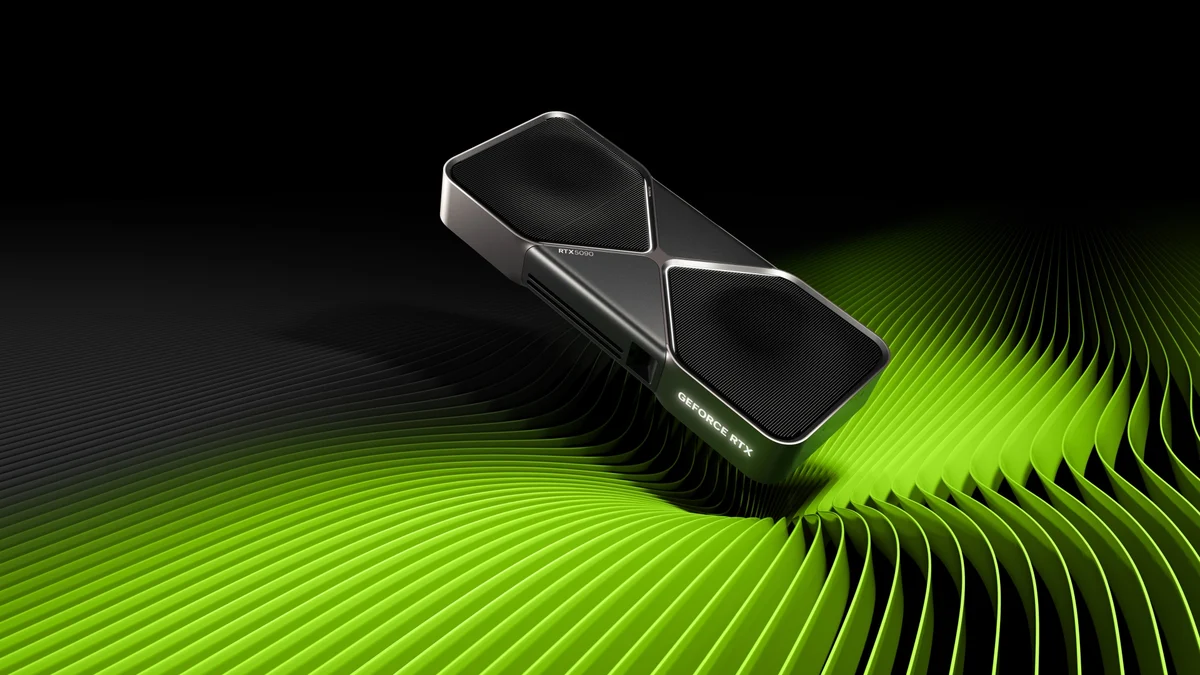
Nvidia notably compressed the physical profile of the Founders Edition, moving from the three-slot thickness of the RTX 4090 to a strict two-slot design measuring 304 mm long and 40 mm wide. It also weighs roughly a pound less than its predecessor. Power delivery relies on an angled 16-pin 12V-2x6 connector, which improves clearance inside narrower chassis. An included adapter allows connection via four traditional 8-pin PCIe cables. Given the card's 575W baseline and transient power excursions, reviewers recommend a minimum 1000W power supply, with 1200W ATX 3.0 or 3.1 units preferred to comfortably sustain system-wide peaks alongside top-tier processors.
Price versus competing cards
At an official list price of $1,999, the RTX 5090 launched at a 25% premium over the RTX 4090's original $1,599 price point. TechSpot noted that delivering roughly 25% to 35% higher 4K performance for 25% more launch money makes it an incremental value proposition rather than a pricing breakthrough. The practical situation is further complicated by severe retail shortages and high enterprise demand, which have pushed typical standalone prices to between $3,500 and $4,500. For shoppers purely seeking smooth 4K visuals, the RTX 5080 (starting at $999 MSRP) or a discounted previous-generation card delivers far better frames per dollar.
Is it worth the money?
While Nvidia set the Founders Edition MSRP at $1,999, persistent scarcity and AI datacenter demand have kept street prices dramatically elevated across retail outlets, making prebuilt systems one of the few avenues to approach fair pricing.
Benchmarks
PERFORMANCE
Benchmarks
4K Ultra · 16-game average
Higher is better · FPSGeForce RTX 4090 scores 20.2% lower average frame rate than GeForce RTX 5090 in this test.
Tom’s Hardware · full test results ↗ · Original chart ↗Published January 29, 2025 · checked 2026-10-05
Founders Edition cards; Ryzen 7 9800X3D, 32GB DDR5-6000 CL30. Same launch-review test system. Native rasterization, 3840 × 2160; geometric mean. No upscaling or generated frames.
Historical launch-review snapshot. Later drivers, games and software may change results.
Test data and methodology
| Product | Result | Against first measured model |
|---|---|---|
| GeForce RTX 5090 | 105.8 | 0% |
| GeForce RTX 4090 | 84.4 | -20.2% |
| GeForce RTX 5080 | 70.1 | -33.7% |
Bars start at zero. Results apply to the tested configuration and settings. Percentage differences use the first measured model as the baseline; they are not a combined rating. A suite average is not the frame rate of every game. 1% lows describe the slowest portion of frames and help expose uneven delivery. Missing products are never assigned zero.
Also consider
- Nvidia GeForce RTX 5080
Provides modern Blackwell features and strong 4K frame rates at roughly half the MSRP and with a much lower 400W power profile.
- Nvidia GeForce RTX 4090
Delivers roughly 75% to 80% of the 5090's 4K gaming speed with 24GB of VRAM at substantially lower used or secondary prices.
- AMD Radeon RX 7900 XTX
Offers 24GB of VRAM and capable traditional raster performance for well under $1,000, though it trails significantly in ray tracing and AI compute.
Reviews we read
This roundup summarizes professional reviews and published specifications; Next Interrupt did not test the product. Roundup updated November 3, 2026. How we work
- Tom's Hardware — Nvidia GeForce RTX 5090 Founders Edition review: Blackwell commences its reign with a few stumbles
- TechSpot — Nvidia GeForce RTX 5090 Review
- Gamers Nexus — NVIDIA GeForce RTX 5090 Founders Edition Review & Benchmarks: Gaming, Thermals, & Power
- PCMag — Nvidia GeForce RTX 5090 Founders Edition Review
- TechSpot — Is the Radeon RX 9070 XT Really Faster Than the RTX 5090?