A 1,000-mile cloud on Mars may reveal physics never seen in nature
A new model suggests Mars may host ice-forming physics never directly observed before.
via Ars TechnicaReported by 2 outlets
The story so far
AI summary of the reporting below · Updated · How we work
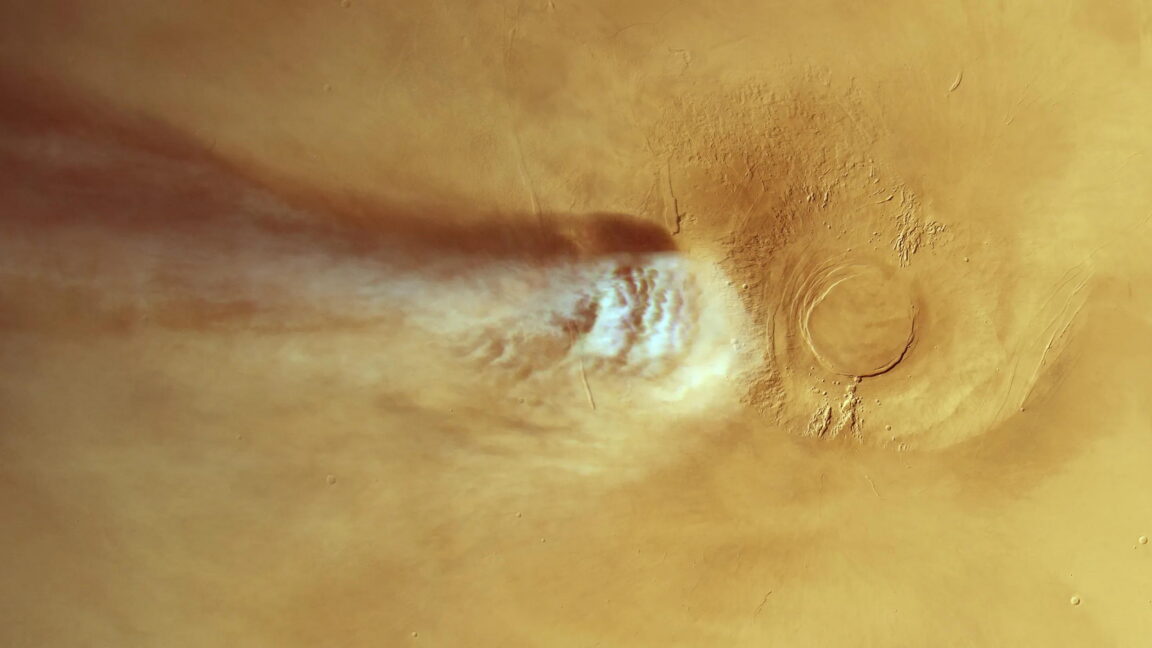
Planetary scientists have successfully simulated the formation of the Arsia Mons Elongated Cloud, a mysterious 1,000-mile-long atmospheric formation on Mars. First recorded by a space probe in 2018, the wispy structure appears every morning near the Arsia Mons volcano throughout the Martian spring and summer, stretches for months across an expanse roughly equal to the distance from New York to Kansas City, and then dissipates. [1][2]
According to lead study author Jorge Hernández-Bernal of Sorbonne Université in Paris, standard atmospheric models could not explain the cloud's behavior until researchers incorporated theoretical physics never before observed in nature. While these mechanisms are documented in physics textbooks, scientists previously considered them unlikely to occur naturally, yet adding them to the simulation finally reproduced the massive cloud's recurring daily cycle. [1]
A new model suggests Mars may host ice-forming physics never directly observed before.
via Ars Technica
The cloud has baffled astronomers since its discovery in 2018. Now, a new study offers a possible cause for its appearance.
via WIRED