Graphics cards / Review roundup
Radeon RX 9060 XT 16GB
Desktop GPU, 16GB model; not the 8GB version
- 85/100TechSpot
- 85/100TweakTown
A balanced 1440p graphics card that delivers generous VRAM and solid frame rates below rival pricing
The AMD Radeon RX 9060 XT 16GB is ideal for mid-range PC builders targeting smooth 1440p gameplay without paying an excessive premium. Its primary strength is offering a full 16GB GDDR6 memory buffer and competitive rasterization performance for roughly 20 percent less money than comparable green-team hardware. The main catch is that Nvidia still holds the upper hand in raw heavy ray tracing workloads and broader upscaler adoption, even with AMD's improvements in FSR 4. Compared directly to the GeForce RTX 5060 Ti 16GB, it matches frame rates within single-digit margins while carrying a significantly lower price tag.
Buy it if
- Gamers seeking high-refresh 1080p and native 60-plus fps 1440p gaming
- Builders upgrading older mid-range GPUs without replacing a modest 500W PSU
- Players wanting a future-proof 16GB VRAM buffer under $400
Skip it if
- You demand path-traced visual fidelity with DLSS 4 frame generation in every title
- You are targeting uncompromised native 4K gaming in modern AAA releases
Where to buy
We may earn a commission from purchases or qualifying sign-ups through our links. Affiliate links explained
What reviewers liked
- Spacious 16GB GDDR6 frame buffer prevents texture choking and frame drops
- Competes closely with the RTX 5060 Ti 16GB while undercutting its price by around $80
- Modest 160W board power requires only a standard 8-pin PCIe connector
- Notable generational ray-tracing improvements and machine-learning upscaling via FSR 4
- Acoustics and temperatures stay well controlled on dual-fan and triple-fan partner cards
What they didn’t
- Heavy ray tracing in demanding titles still trails Nvidia architecture
- Narrow 128-bit memory bus limits bandwidth at native 4K
- Cheaper 8GB sibling creates potential buyer confusion in retail listings
Key specs
- Launch price
- $349 MSRP ($379 for factory-overclocked partner cards)
- Reported price
- $350 - $380
- GPU Architecture
- AMD RDNA 4 (Navi 44 XT, 4nm TSMC)
- Stream Processors
- 2,048 (32 Compute Units)
- Ray Accelerators
- 32
- AI Accelerators
- 64
- Game / Boost Clock
- Up to 2,530 MHz / Up to 3,130 MHz (reference)
- VRAM
- 16GB GDDR6 (128-bit, 20 Gbps)
- Typical Board Power (TBP)
- 160W
- Power Connectors
- 1x 8-pin PCIe
- Recommended PSU
- 450W to 500W
- Display Outputs
- 1x HDMI 2.1b, 2x DisplayPort 2.1a
In depth
Gaming performance at 1080p, 1440p and 4K
Across outlet testing suites, the RX 9060 XT 16GB establishes itself as a capable 1080p and 1440p card. In TechSpot's 18-game test suite at native 1440p resolution, the card achieved an average of 70 fps, landing within 1% of the RTX 5060 Ti 16GB while beating the standard RTX 5060 by roughly 30%. Tom's Hardware and early benchmark aggregations found the card reaching 187 fps on average across 10 titles at 1080p, and 134 fps at 1440p, representing an approximate 35% generational leap over the previous-generation RX 7600 XT 16GB. At native 4K, reviewers noted performance drops significantly; while older titles remain playable above 60 fps, demanding modern engines require upscaling to stay fluid, constrained primarily by the card's 128-bit bus width and 320 GB/s bandwidth.
Ray tracing and upscaling (DLSS/FSR)
Ray tracing is an area of noticeable progress for RDNA 4. TechPowerUp noted that updated compute units and dedicated ray-tracing hardware substantially reduce the frame rate penalty compared to RDNA 3 architectures. In titles with moderate ray tracing, such as Forza Horizon 5 or Marvel's Spider-Man Remastered, frame rates remained smooth. However, in path-traced workloads like Alan Wake 2 and Cyberpunk 2077 Ray Tracing Overdrive, reviewers observed that Nvidia retains an architectural lead. On upscaling, AMD's machine-learning-based FSR 4 represents a notable step forward in edge clarity and temporal stability over FSR 3, approaching DLSS quality presets, though DLSS still maintains slightly broader native game support and superior multi-frame generation tooling.
Power draw, heat and noise
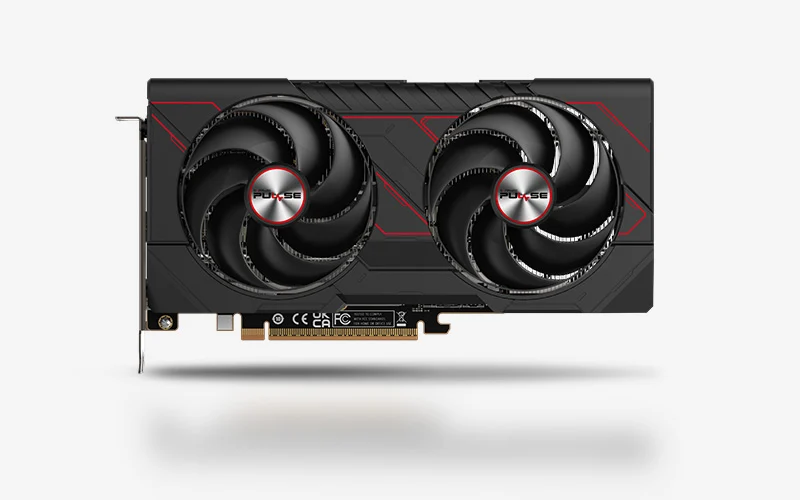
AMD rates the typical board power of the RX 9060 XT 16GB at 160W, which translates into manageable operating characteristics. TechPowerUp measured board-only power draw right at spec under full gaming loads, alongside idle draw settling around 10W to 12W. Thermal and acoustic testing on partner designs earned widespread praise: TweakTown and TechPowerUp observed that dual-fan models like the Sapphire Pulse OC operated quietly at approximately 32 dB(A) to 35 dB(A) under load, while GPU core temperatures held steady between 52°C and 65°C. All tested retail units feature fan-stop modes at idle to preserve silence during desktop productivity.
Memory (VRAM) and future-proofing
The 16GB GDDR6 buffer is widely cited by outlets as the primary reason to choose this model over 8GB competitors. Reviews from TechSpot, Tom's Hardware, and Gamers Nexus explicitly caution shoppers against buying sub-$400 cards with only 8GB of VRAM in modern gaming environments. Titles such as Hogwarts Legacy, The Last of Us Part I, and Ratchet & Clank routinely exceed 8GB allocations at 1440p high settings, triggering stuttering and degraded mipmap textures on 8GB cards. The 16GB allocation on the 9060 XT prevents memory bottlenecks and ensures texture headroom for years ahead.
Size, power connector and PSU needs
Unlike many higher-tier GPUs that mandate proprietary 16-pin connectors and bulky cooling shrouds, the RX 9060 XT is straightforward to install. Most partner models measure between 220 mm and 280 mm in length with a standard dual-slot thickness, making them compatible with small form factor and compact mid-tower enclosures. Power delivery relies on a single standard 8-pin PCIe power cable. AMD and board partners recommend a minimum power supply of 450W to 500W, allowing most gamers to perform an in-place upgrade without purchasing a new power supply unit.
Price versus competing cards
At an official launch MSRP of $349 ($379 to $380 for factory-overclocked partner editions), the RX 9060 XT 16GB positions itself aggressively against Nvidia's stack. It directly challenges the GeForce RTX 5060 Ti 16GB, which launched at $439 and frequently commands retail prices near $450 to $480. Because the RX 9060 XT delivers rasterized performance within 1% to 5% of the RTX 5060 Ti 16GB while costing nearly $90 less, outlets consider it one of the strongest mainstream value propositions on the market.
Is it worth the money?
The card offers roughly 98% of the rasterized performance of the $439 RTX 5060 Ti 16GB while undercutting its cost by nearly 20%, making it a standout price-to-performance choice.
Benchmarks
PERFORMANCE
Benchmarks
1080p Medium · 14-game rasterization average
Higher is better · FPSGeForce RTX 5060 Ti 16GB scores 2.6% higher average frame rate than Radeon RX 9060 XT 16GB in this test.
Tom’s Hardware · full test results ↗ · Original chart ↗Published June 10, 2025 · checked 2026-10-06
June 2025 review; Ryzen 7 9800X3D, 32GB DDR5-6000, Windows 11 24H2. PowerColor RX 9060 XT 16GB Reaper, PNY RTX 5060 Ti 16GB OC, Asus RTX 5060 Dual, RTX 5070 Founders Edition, PowerColor RX 9070 Reaper. Native rendering; no upscaling or generated frames.
Historical review snapshot. Tests use this publication’s common system and suite; game patches and drivers can differ between the included cards. Results are kept separate from other review suites.
Test data and methodology
| Product | Result | Against first measured model |
|---|---|---|
| Radeon RX 9060 XT 16GB | 116.5 | 0% |
| GeForce RTX 5060 Ti 16GB | 119.5 | 2.6% |
| GeForce RTX 5060 | 102.2 | -12.3% |
| GeForce RTX 5070 | 148.8 | 27.7% |
| Radeon RX 9070 | 159.1 | 36.6% |
Bars start at zero. Results apply to the tested configuration and settings. Percentage differences use the first measured model as the baseline; they are not a combined rating. A suite average is not the frame rate of every game. 1% lows describe the slowest portion of frames and help expose uneven delivery. Missing products are never assigned zero.
Also consider
- Nvidia GeForce RTX 5060 Ti 16GB
Provides superior heavy ray-tracing performance and DLSS ecosystem support, though it costs noticeably more.
- AMD Radeon RX 7700 XT 12GB
Offers similar rasterized speed on a wider 192-bit bus, but consumes more power and carries an older architecture.
- Nvidia GeForce RTX 5060 8GB
Costs less up front, but trails in raw speed by roughly 30% and is hampered by half the video memory.
Reviews we read
This roundup summarizes professional reviews and published specifications; Next Interrupt did not test the product. Roundup updated October 29, 2026. How we work
- Tom's Hardware — AMD Radeon RX 9060 XT 16GB review: plenty of performance with 16GB
- TechSpot — AMD Radeon RX 9060 XT 16GB Review
- TweakTown — SAPPHIRE Radeon RX 9060 XT 16GB PULSE OC Review - AMD's Best Mainstream GPU in Years
- TechPowerUp — Sapphire Radeon RX 9060 XT Pulse OC 16 GB Review - An Excellent Choice
- TweakTown — Radeon RX 9060 XT 16GB review