CPUs & PC components / Review roundup
MSI Maestro 900R
MSI Maestro 900R
- 71/100PC Gamer
- 3.6/5GeekaWhat
A dramatic showcase full-tower hindered by immense weight, awkward internal cabling, and a staggering price
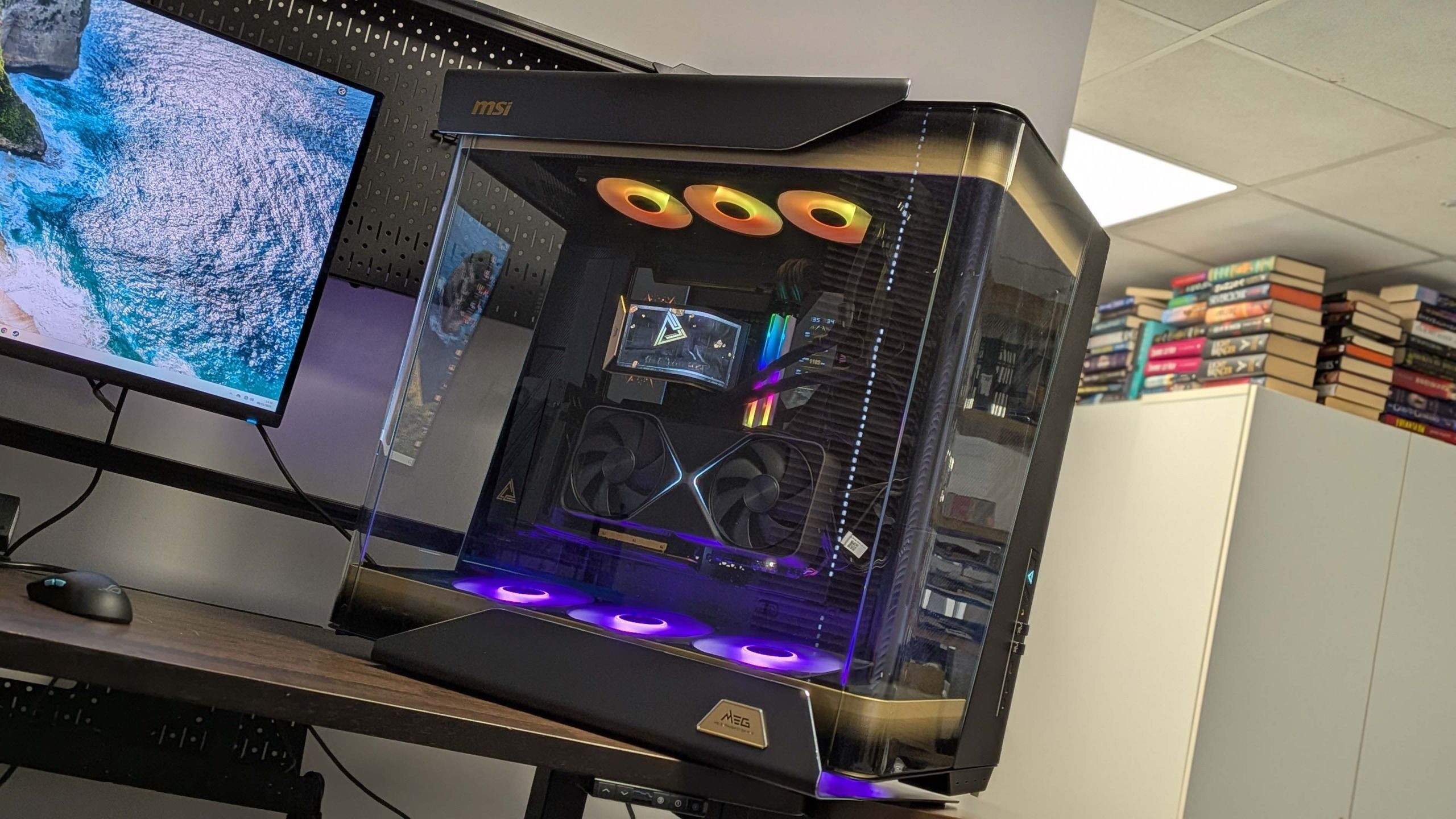
The MSI MEG Maestro 900R is aimed squarely at deep-pocketed enthusiasts seeking a dramatic centerpiece for an ultra-high-end custom loop or showcase build. Its greatest asset is presentation: three seamless tempered-glass panels wrap around a centered, four-way rotatable motherboard tray that detaches to function as a standalone test bench. The primary catch is practical usability, as routing display and rear I/O cables through the cramped internal channels is tedious, and its 33-kilogram unbuilt weight requires two people to move safely. Compared to rival showcase chassis like the Lian Li O11 Dynamic EVO XL or Cooler Master Cosmos Alpha, the Maestro 900R offers unmatched modular versatility, but demands more space, patience, and money than most PC builders can reasonably justify.
Buy it if
- Enthusiasts building an ultra-high-end custom liquid-cooling loop
- Hardware showcase builds designed to be viewed from multiple angles
- Builders who frequently test components using a detachable open-air test bench
Skip it if
- You need to move or reposition your desktop PC without assistance
- You want effortless plug-and-play access to rear motherboard and GPU ports
- You want a balanced price-to-performance ratio for your chassis
Where to buy
We may earn a commission from purchases or qualifying sign-ups through our links. Affiliate links explained
What reviewers liked
- Striking 270-degree triple-sided panoramic glass presentation with diamond-cut aluminum exterior
- Detachable four-way rotatable motherboard tray doubles as a standalone open-air test bench
- Substantial liquid-cooling capacity with support for dual 420mm radiators and custom reservoirs
- Abundant front connectivity including five USB-C ports (one with 60W power delivery) and four USB-A ports
- Includes a PCIe 5.0 riser cable and three pre-installed 160mm bottom intake fans
What they didn’t
- Extremely expensive at $699 while including only three pre-installed fans
- Immense footprint and 33kg empty weight make transport and desk placement strenuous
- Frustrating internal cable management with cramped pass-through holes for external display and I/O cords
- Mismatched top dust filter and flexible plastic accent panels undermine the premium finish
Key specs
- Launch price
- $699
- Reported price
- $699 to $700
- Form Factor
- Full Tower (E-ATX, ATX, Micro-ATX, Mini-ITX)
- Motherboard Support
- E-ATX (up to 305 x 280 mm), ATX, back-connect (MSI Project Zero)
- Dimensions
- 671 x 379 x 695 mm (26.4 x 14.9 x 27.4 inches)
- Weight
- 33 kg (72.8 lbs) net / 38 kg (83.8 lbs) gross
- Included Fans
- 3x 160 mm ARGB fans (bottom intake)
- Radiator Support
- Up to 420 mm (top), up to 360 mm (side), up to 420 mm (bottom)
- Maximum GPU Length
- 400 mm (with included vertical mount bracket and PCIe 5.0 riser)
- Maximum CPU Cooler Height
- 170 mm
- Front Panel Ports
- 1x USB-C 20Gbps (60W PD), 4x USB-C 10Gbps, 4x USB-A 5Gbps, 3.5 mm audio combo
- Drive Bays
- Up to 5x 3.5-inch HDD or up to 9x 2.5-inch SSD
In depth
Gaming performance
Reviewers evaluated the MEG Maestro 900R's gaming performance through real-world thermal and acoustic stress testing. In Club386's gaming test utilizing the Cyberpunk 2077 benchmark on a system equipped with an AMD Ryzen 9 9950X3D and an Nvidia GeForce RTX 5090 Founders Edition, both the processor and graphics card stabilized at 69°C. Club386 noted that acoustic output remained well controlled at 34 dBA, though the vertical GPU bracket placed the card in an orientation where horizontal mounting might yield slightly more direct bottom-fan intake. TechPowerUp's gaming stress testing confirmed that the massive internal volume and pre-installed bottom intake fans provide unrestricted airflow to high-wattage graphics cards, eliminating the thermal throttling that can plague tighter dual-chamber cases during extended gaming sessions.
Power consumption and cooling needs
With components requiring immense cooling, the Maestro 900R is purpose-built to handle flagships. Out of the box, MSI includes three 160mm ARGB bottom intake fans, though both TechPowerUp and PC Gamer observed that a $700 chassis ought to include side or top exhaust fans as standard. Radiator support is extensive: builders can install up to a 420mm radiator along the tilted top bracket, another 420mm radiator at the bottom, and up to a 360mm radiator on the side bracket. Under heavy synthetic processor loads, Club386 recorded peak temperatures of 81°C on a 9950X3D using a 360mm AIO cooler during a 10-minute Cinebench run, following an idle temperature of 27°C. While baseline temperatures remain stable, reviewers noted that the immense air volume does not inherently out-cool smaller, tightly channeled high-airflow cases without adding supplemental fans or a custom liquid loop.
Platform: socket, motherboard and memory costs
The Maestro 900R's party piece is its centered, removable motherboard tray. Compatible with standard E-ATX, ATX, and back-connect motherboards such as MSI Project Zero, the tray can be oriented in four different directions or extracted entirely to function as an open-air test bench using bundled modular feet, power buttons, and handle screws. TechPowerUp praised how quickly the tray can be reoriented, but OC3D and Club386 pointed out significant compromises. Because the motherboard and GPU are isolated in the center behind three panes of glass, rear motherboard I/O ports and display outputs must route through internal channels. OC3D found that all external display, power, and peripheral cables are forced through a single pass-through hole barely wide enough for two fingers, turning initial setup into a cramped, two-hour wiring challenge.
Upgrade value versus previous generation
MSI originally established the product line with the MEG Maestro 700L PZ, a $419 dual-chamber case featuring curved front glass and back-connect support. The Maestro 900R represents a fundamental redesign rather than a simple refresh, adopting a centered 360-degree floating aesthetic, modular test-bench capabilities, and an included PCIe 5.0 riser cable. However, OC3D, having praised the 700L, expressed disappointment in the 900R's execution. In particular, reviewers singled out the top dust filter, which sits partially exposed beneath an aluminum cover and clashes with the chassis styling, as well as thin plastic interior cable shrouds that flex when handled. For builders who already own a spacious super-tower or the Maestro 700L PZ, the 900R does not justify upgrading unless the rotatable showpiece layout is an absolute necessity.
Price
At a launch price of $699 in the United States (£799.99 in the UK), the MEG Maestro 900R enters an ultra-premium bracket usually reserved for limited-run artisan cases. MSI softens the blow by bundling a PCIe 5.0 riser cable, a fan and ARGB hub, three 160mm fans, and a comprehensive kit of test-bench hardware and handling accessories. Nevertheless, PC Gamer, Club386, and GeekaWhat all concluded that value is the chassis' weakest attribute. Given that users must still supply additional cooling fans to fill out the top and side mounts, and considering minor material blemishes like flexible trim panels and awkward cable pass-throughs, reviewers widely agreed that the Maestro 900R is a luxury indulgence rather than a practical purchase.
Is it worth the money?
Retailing around $699 (£799.99 in the UK), the Maestro 900R commands a steep luxury premium. While the bundled PCIe 5.0 riser and test-bench accessories add utility, the need for supplemental fans and several build finish quirks make it poor value for anyone outside committed showcase modders.
Also consider
- Lian Li O11 Dynamic EVO XL
Provides dual-chamber panoramic glass aesthetics, versatile motherboard positioning, and far simpler cable routing for less than half the price.
- Cooler Master HAF 700 EVO
A massive full-tower with superior out-of-the-box airflow, pre-installed 200mm intake fans, and extensive custom loop support at a lower cost.
- MSI MEG Maestro 700L PZ
MSI's predecessor offers curved panoramic glass and Project Zero back-connect motherboard support without the 900R's 33kg mass and cabling hassles.
Reviews we read
This roundup summarizes professional reviews and published specifications; Next Interrupt did not test the product. Roundup updated November 11, 2026. How we work