Laptops & desktops / Review roundup
MacBook Pro M6
16GB of RAM and a 1TB SSD
- 4.5/5Tom's Guide
- 4.5/5Tom's Hardware
- RecommendedEngadget
A modest chip upgrade delivers 19-hour endurance and snappy graphics while keeping the classic pro chassis
The 14-inch MacBook Pro M6 is a refined, reliable work laptop best suited for professionals upgrading from an M1, M2, or Intel machine. The M6 chip brings a noticeable 31% graphics boost and dual Neural Engines, while delivering over 19 hours of battery life on a single charge. However, it keeps the older mini-LED design and Thunderbolt 4 ports rather than adopting the flashy OLED touchscreen and Thunderbolt 5 speeds found on the premium PROLED models. For anyone who wants MacBook Pro build quality, ports, and display without paying the steep $2,899 entry price of the OLED version, the $1,999 base model hits the practical sweet spot.
Buy it if
- Creatives and developers upgrading from M1, M2, or Intel-based MacBooks
- Remote workers needing class-leading 19-hour battery life and an excellent webcam
- Users who need full-sized HDMI and SD card ports without spending $2,899 on the OLED tier
Skip it if
- You already own an M4 or M5 MacBook Pro with sufficient daily performance
- You want Apple's latest tandem OLED touchscreen display
- You need Thunderbolt 5 transfer speeds or more than 32GB of unified memory
Where to buy
We may earn a commission from purchases or qualifying sign-ups through our links. Affiliate links explained
What reviewers liked
- Outstanding battery endurance reaching 19 hours and 5 minutes in web browsing tests
- GPU benchmark scores jump roughly 31% over the base M5 generation
- Generous 1TB base storage with 16GB of unified memory out of the box
- Superb Liquid Retina XDR mini-LED screen with an optional nano-texture finish
- Upgraded Wi-Fi 7 and Bluetooth 6 support alongside a sharp 12MP Center Stage webcam
What they didn’t
- High starting price of $1,999 after Apple raised base configurations to 1TB
- Ports remain limited to Thunderbolt 4 rather than Thunderbolt 5
- Memory bandwidth is capped on the 16GB configuration relative to higher memory tiers
- Identical exterior chassis with no design changes or lighter OLED slimming
Key specs
- Launch price
- $1,999
- Reported price
- $1,999
- Base Price
- $1,999
- Processor
- Apple M6 (12-core CPU, 12-core GPU, Dual 16-core Neural Engine)
- Unified Memory
- 16GB (configurable to 24GB or 32GB)
- Internal Storage
- 1TB SSD (configurable up to 4TB)
- Display
- 14.2-inch Liquid Retina XDR mini-LED (3024 x 1964, 120Hz ProMotion)
- Peak Brightness
- 1,600 nits HDR, 1,000 nits sustained SDR/XDR
- Weight
- 3.4 lbs (1.54 kg)
- Dimensions
- 12.31 x 8.71 x 0.61 inches (31.26 x 22.12 x 1.55 cm)
- Battery Capacity
- 72.4 Wh
- Tested Battery Life
- 19 hours 5 minutes (Tom's Guide web surfing test)
- Webcam
- 12MP Center Stage with Desk View
- Connectivity
- Wi-Fi 7, Bluetooth 6, 3x Thunderbolt 4, HDMI 2.1, SDXC slot, MagSafe 3
In depth
Design, build and portability
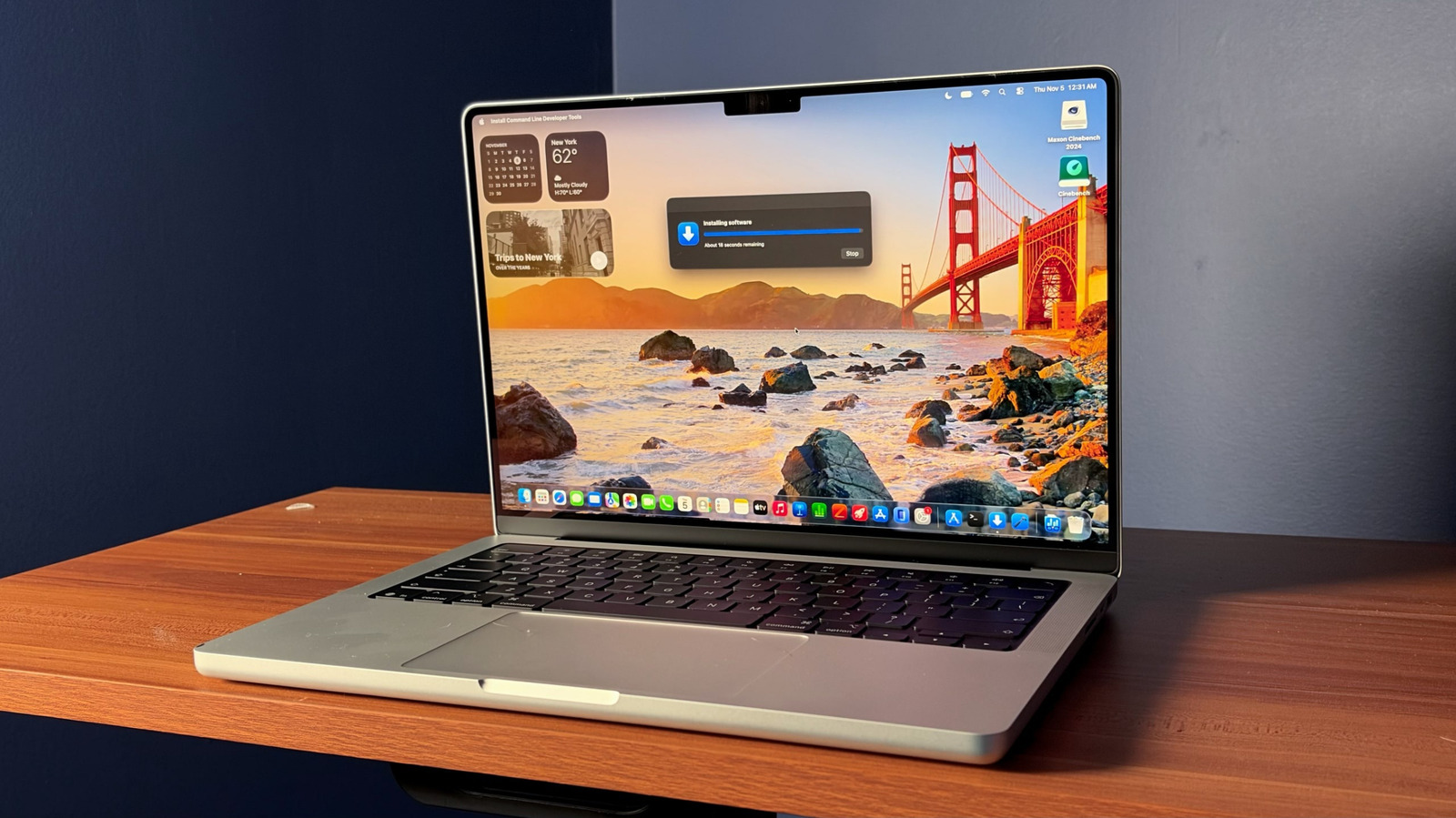
The 14-inch MacBook Pro M6 uses the familiar aluminum unibody chassis Apple introduced in late 2021. Measuring 12.31 x 8.71 x 0.61 inches and weighing 3.4 pounds, reviewers at Tom's Hardware and Engadget noted that it feels virtually identical in hand to the preceding M4 and M5 models. While the newly introduced PROLED line shaved half a millimeter of thickness and reduced weight to roughly 3.0 pounds, the standard M6 enclosure remains sturdy, rigid, and resistant to chassis flex. Apple offers the laptop in Silver and anodized Space Black, the latter featuring an effective fingerprint-resistant seal. Although reviewers describe the look as conservative after several generations, build tolerances and hinge mechanics remain among the sturdiest in the premium laptop segment.
Display
The 14.2-inch Liquid Retina XDR screen continues to rely on mini-LED technology with a sharp 3024 x 1964 resolution and a 120Hz ProMotion adaptive refresh rate. It reaches 1,000 nits of sustained brightness for SDR content and peaks at 1,600 nits for HDR mastering and media playback. Reviewers at Tom's Guide highlighted that contrast and black levels remain exceptional, even if it lacks the pixel-level inking and touch input of Apple's higher-priced PROLED panel. A key addition for the base M6 chassis is the optional $150 nano-texture matte glass finish, which previously was restricted to top-tier models; testers found it reduces ambient glare and reflections in bright workspaces without washing out colors.
Performance in everyday and demanding work
The M6 system-on-chip moves to a 12-core CPU configuration (composed of two primary performance cores, four multithreaded performance cores, and six efficiency cores) alongside a 12-core GPU and dual 16-core Neural Engines. In benchmarks, Tom's Guide logged Geekbench 6 scores of 4,708 for single-core and 21,405 for multi-core. Graphics workloads showed the largest improvement: Engadget recorded a Geekbench 6 GPU score of 64,115 points, a 31% jump over the M5 model's 48,840 points. In a 4K Handbrake transcoding run, Tom's Hardware reported a completion time of 2 minutes and 50 seconds, shaving 41 seconds off the M5. The single active cooling fan kept noise imperceptible during general office workflows, spinning up to an audible hush only during back-to-back Cinebench stress runs.
Battery life
Apple advertises up to 24 hours of video streaming on a single charge, and independent testing confirms exceptional real-world longevity. In Tom's Guide's battery benchmark—which tests continuous automated web browsing over Wi-Fi at 150 nits—the MacBook Pro M6 endured for 19 hours and 5 minutes. Engadget ran its heavy MacBatteryBenchmark script simulating continuous developer workflows, where the laptop lasted 9 hours and 35 minutes. Engadget's real-world office rotation took six full hours of mixed browser tabs, Slack, and video calls just to drop the 72.4 Wh battery to 50%. The laptop ships with a 70W USB-C charger, and pairing it with a 96W brick allows fast charging to 50% in roughly 30 minutes.
Keyboard, trackpad, speakers and webcam
Input and communication hardware receive minor internal tweaks while retaining proven mechanics. The Magic Keyboard delivers 1mm of stable key travel, crisp bottoming out, and a reliable full-height function row capped by Touch ID. The Force Touch trackpad remains the industry standard for palm rejection and haptic clicks. Video calls are handled by an upgraded 12MP Center Stage webcam with Desk View support, which reviewers at Mashable and Tom's Hardware praised for keeping subjects centered with crisp exposure and accurate skin tones. The six-speaker audio array with force-cancelling woofers continues to lead the 14-inch laptop category, delivering full low-end punch and wide stereo separation.
Ports and upgradeability
Port selection includes three USB Type-C ports, an HDMI 2.1 video output, a full-sized SDXC slot, a 3.5mm headphone jack with high-impedance headphone support, and a dedicated MagSafe 3 charging port. However, reviewers flagged that these three USB-C ports run on Thunderbolt 4 rather than the faster Thunderbolt 5 protocol reserved for M5 Pro and M5 Max models. The machine supports up to two external displays. Internally, components are entirely soldered: unified memory and the SSD cannot be upgraded after purchase, meaning buyers must choose their desired storage and RAM allocations when ordering.
Price and configurations
The 14-inch MacBook Pro M6 starts at $1,999. While that represents a higher barrier to entry than previous base models that launched at $1,599 with smaller drives, Apple now includes a 1TB SSD and 16GB of unified memory as the standard baseline. Buyers can configure 24GB or 32GB of RAM, with reviewers pointing out that opting for 24GB or 32GB unlocks higher memory bandwidth up to 170 GB/s. Storage expands up to 4TB. The nano-texture glass option adds $150. Because retail pricing is holding firm at the $1,999 launch mark, shoppers looking to save should watch for occasional retailer rebates on previous-generation M5 inventory.
Is it worth the money?
The $1,999 floor is high, but it includes 16GB of unified memory and 1TB of storage by default, avoiding the small storage upgrades Apple previously required.
Also consider
- Apple MacBook Pro 14 (PROLED XDR)
Offers an ultra-bright tandem OLED touchscreen and faster M5 Pro silicon, but starts at a much higher $2,899.
- Apple MacBook Air 13 (M5)
Provides exceptional battery life in a thinner, fanless 2.7-pound chassis starting at $1,099, but lacks mini-LED 120Hz and HDMI/SD ports.
- Asus Zenbook Duo
A dual-screen Windows alternative offering vibrant OLED displays, though its 14-hour battery life falls well behind the MacBook's 19 hours.
Reviews we read
This roundup summarizes professional reviews and published specifications; Next Interrupt did not test the product. Roundup updated November 7, 2026. How we work