Monitors & TVs / Review roundup
LG UltraGear Evo 52G930B
LG UltraGear Evo 52G930B
- 78 / 100PC Gamer
- 4.0 / 5PCMag Middle East
Massive 52-inch 5K2K curved monitor delivers unmatched immersion but compromises on VA pixel speed and HDR.
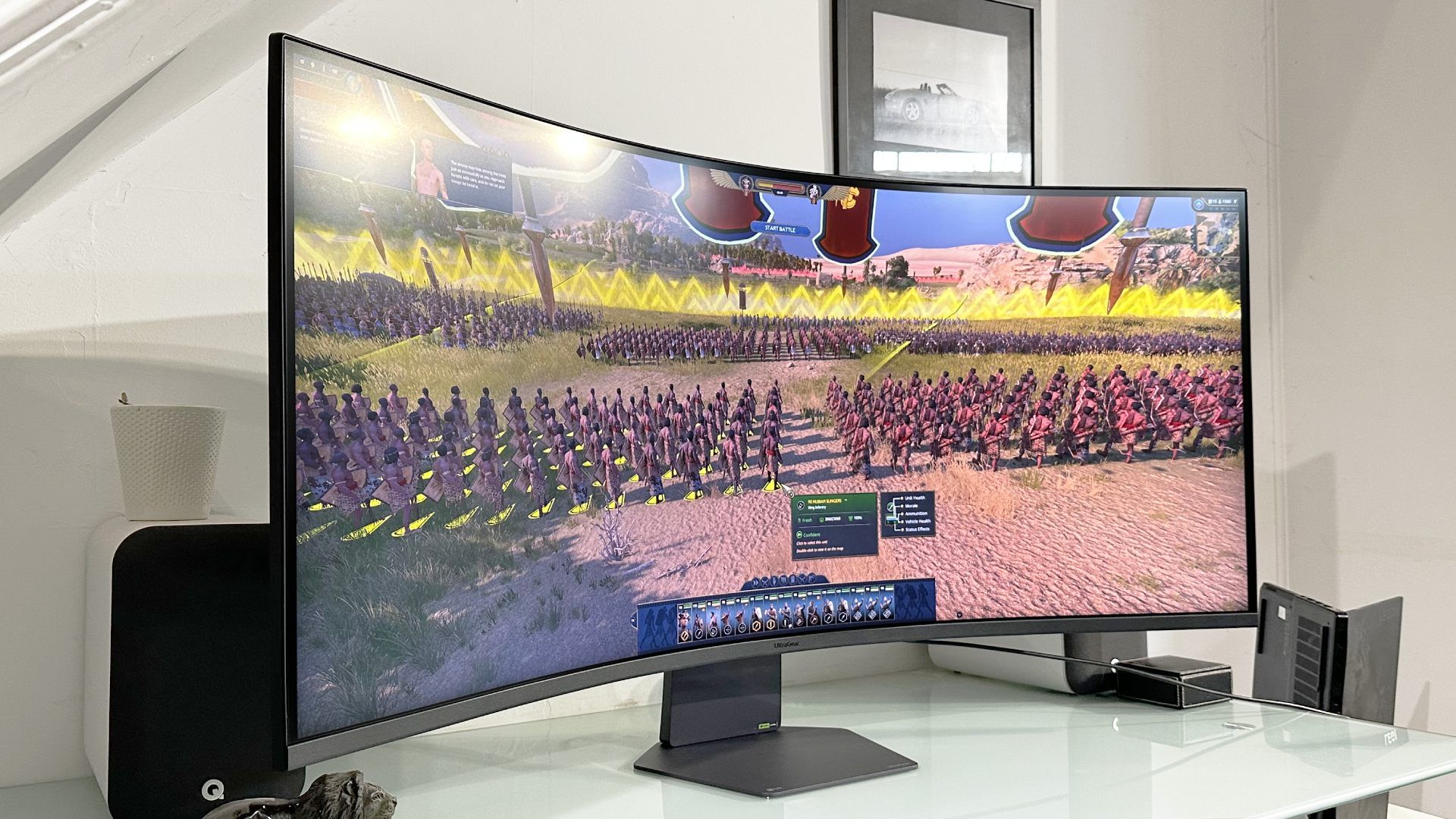
The LG UltraGear Evo 52G930B is aimed squarely at simulation racers, flight sim fans, and strategy gamers who want an expansive 51.6-inch ultrawide desktop experience without the coarse pixel grid of 1440p displays. Its biggest strength is sheer panoramic immersion, combining 5120x2160 clarity with a wrap-around 1000R curve and a 240Hz refresh rate. Its biggest catch is panel technology: at $1,699 to $1,999, it uses a standard edge-lit VA panel that suffers from sluggish dark-pixel transitions and mediocre HDR. Against rivals like LG's own 45-inch OLED and Samsung's 57-inch Neo G9 Mini LED, the 52G930B provides taller vertical viewing area and zero burn-in risk, but it falls well short of OLED motion clarity and contrast.
Buy it if
- Flight simulation and racing enthusiasts who prioritize wrap-around screen scale over esports reaction speeds
- Strategy and open-world PC gamers wanting high 5K2K vertical workspace without burn-in risk
- Users seeking a dual-monitor replacement with 90W USB-C docking and DisplayPort 2.1
Skip it if
- Competitive esports players needing instantaneous pixel response times without VA dark smearing
- Enthusiasts seeking true HDR with deep black levels, local dimming, or OLED-grade contrast
- Desk setups with less than 30 inches of usable surface depth
Where to buy
We may earn a commission from purchases or qualifying sign-ups through our links. Affiliate links explained
What reviewers liked
- Massive 51.6-inch 21:9 screen delivers panoramic immersion with sharp 107 PPI pixel density
- Smooth 240Hz refresh rate paired with DisplayPort 2.1 and HDMI 2.1 connectivity
- Strong native SDR contrast of 4,000:1 with vibrant out-of-the-box color
- Single-cable USB-C connectivity with 90W power delivery and decent 10W built-in stereo speakers
- Zero risk of permanent burn-in compared to large OLED alternatives
What they didn’t
- Sluggish VA pixel transitions cause noticeable dark-level smearing in fast-motion scenes
- VESA DisplayHDR 600 relies on basic edge lighting with no Mini LED local dimming zones
- Overdrive Fast mode creates heavy inverse ghosting and overshoot at lower refresh rates
- Narrow VA viewing angles introduce color and gamma shift away from dead center
- Expensive launch pricing puts it in direct competition with premium OLEDs and Mini LED displays
Key specs
- Launch price
- $1,999.99
- Reported price
- $1,699.00
- Screen Size
- 51.6 inches (marketed as 52-inch)
- Panel Type
- VA LCD (1000R curvature)
- Native Resolution
- 5120 x 2160 (WUHD / 5K2K, 21:9 aspect ratio)
- Pixel Density
- 107 PPI
- Refresh Rate
- 240 Hz (AMD FreeSync Premium, VRR)
- Response Time
- 1 ms GtG (rated)
- Static Contrast Ratio
- 4,000:1 (rated)
- Brightness
- 400 nits SDR, 600 nits HDR (rated)
- HDR Standard
- VESA DisplayHDR 600 (edge-lit)
- Color Coverage
- 95% DCI-P3
- Video Inputs
- 1x DisplayPort 2.1 (UHBR20), 2x HDMI 2.1, 1x USB-C (90W PD)
- Built-in Audio
- 2x 10W stereo speakers
In depth
Picture quality: brightness, contrast, colour
With 5120x2160 pixels spread over 51.6 inches, the 52G930B achieves 107 pixels per inch, which PC Gamer highlighted as a major upgrade over the coarse 80 PPI found on 49-inch 1440p ultrawides. Text and fine in-game geometry render cleanly, matching the sharpness of a standard 27-inch 1440p monitor. In terms of contrast, the VA panel delivers a rated 4,000:1 static contrast ratio, which PC Gamer noted provides roughly three to four times the black depth of conventional IPS panels in standard dynamic range. PCMag Middle East found the out-of-the-box Gamer 1 profile well calibrated, displaying punchy, natural tones with 95% DCI-P3 gamut coverage without requiring extensive adjustments. However, Tweakers observed that default color accuracy could be tighter and praised the hardware calibration feature. PC Gamer also noted an annoying limitation: pixel overdrive is locked out entirely when switching to calibrated sRGB or DCI-P3 color profiles, forcing users into gaming presets if they want overdrive enabled.
Motion, refresh rate and gaming features
Driving 11 million pixels at up to 240Hz requires serious hardware, with PCMag Middle East noting that even an Nvidia RTX 5080 will struggle to sustain 240fps in modern AAA titles at native resolution without upscaling. AMD FreeSync Premium and VRR keep motion tear-free across a 48Hz to 240Hz range. However, motion clarity is constrained by VA panel physics. While LG rates the display for a 1ms GtG response time, Tweakers measured dark color transitions reaching up to 16ms, leading to noticeable trailing in shadowy scenes. PC Gamer confirmed visible dark-smearing and found the panel significantly slower than OLEDs. Overdrive settings also require careful handling: Tweakers discovered that the Fast overdrive setting causes severe overshoot and inverse ghosting when frame rates fall to 120Hz or 60Hz, where overshoot scores quadrupled compared to 240Hz. Both outlets recommend leaving overdrive on Normal. Reviewers agree the display is ill-suited for fast-paced competitive esports, but excels in slow-paced exploration games, strategy titles, and simulators.
HDR performance
High dynamic range is the monitor's most compromised attribute. The 52G930B is certified for VESA DisplayHDR 600 with a rated peak brightness of 600 nits, but it lacks full-array Mini LED backlighting or pixel-level dimming zones. Instead, it relies on simple edge-lit dynamic dimming. PC Gamer noted that without local dimming, the monitor simply lacks the granular lighting control needed to produce convincing HDR, relying entirely on the native contrast of the VA panel. Tweakers concluded that its HDR image quality barely improves upon that of an entry-level SDR screen due to edge-lit bleed. On the other hand, PCMag Middle East felt that vibrant HDR films still looked reasonably bright and colorful on the expansive screen with no visible color banding, though admitting it cannot match the depth of OLED or high-zone Mini LED backlights.
Design, stand and ports
The physical footprint of the 52G930B is massive. Measuring 46.2 inches wide, 28.1 inches tall on its stand, and nearly 14 inches deep, PC Gamer noted that it eats up a massive portion of desk space and can feel overwhelming at standard sitting distances. The tight 1000R curve helps bring the outer edges into peripheral view. The bundled stand offers smooth height, tilt, and swivel adjustments. Port selection is modern and generous: one DisplayPort 2.1 socket with UHBR20 support, two HDMI 2.1 ports, and a USB-C port supporting 90W Power Delivery and data upstream for a two-port USB-A hub. PCMag Middle East praised the built-in 10W stereo speakers, noting they deliver substantial volume, decent bass body, and wide stereo separation that easily outclasses standard monitor speakers for calls and casual media. However, PCMag criticized LG for failing to include a wireless remote control for a display this large.
Viewing angles, reflections and burn-in risk
Viewing angles exhibit the classic shortcomings of VA LCD panels. Tweakers recorded noticeable gamma shifting, loss of color saturation, and a subtle purple hue when viewing the screen from off-axis positions. The aggressive 1000R curvature keeps the outer corners relatively equidistant to someone seated directly in the center, mitigating gamma shift in normal use, but off-center viewers will see washed-out shadows. Reflection handling is respectable thanks to a matte anti-glare coating that diffuses ambient room lighting without severe glare. Crucially for productivity workers and simulation enthusiasts displaying static cockpits or desktop spreadsheets for long hours, the LCD architecture carries zero risk of permanent image retention or burn-in, offering an operational lifespan advantage over comparable OLED panels.
Price
The LG UltraGear Evo 52G930B launched at $1,999.99 in the United States and has since settled to a typical street price around $1,699 (and £1,499 in the UK). Both PC Gamer and PCMag Middle East questioned its value proposition against alternative display technologies. At roughly $1,700, the monitor commands a steep premium for an edge-lit VA display. Shoppers can purchase high-end 55- to 65-inch 4K OLED televisions, LG's own 45-inch 5K2K OLED gaming monitor, or Samsung's 57-inch Odyssey Neo G9 Mini LED with thousands of dimming zones for comparable or less money. While the unique combination of 51.6-inch scale, 21:9 ultrawide aspect ratio, and 240Hz refresh rate is unmatched in LCD form, buyers are paying primarily for size and resolution rather than bleeding-edge panel performance.
Is it worth the money?
At $1,699 to $1,999, the monitor carries a high price for an edge-lit VA panel, competing directly against OLED monitors and Mini LED superwides.
Also consider
- LG UltraGear OLED 45GX950A
Offers the same 5120x2160 resolution on an inky OLED panel with near-instant response times and 330Hz dual-mode for less money.
- Samsung Odyssey Neo G9 57" (G95NC)
Provides an even wider dual-4K (7680x2160) canvas with a 2,048-zone Mini LED backlight for vastly superior HDR brightness and contrast.
Reviews we read
This roundup summarizes professional reviews and published specifications; Next Interrupt did not test the product. Roundup updated October 24, 2026. How we work