Monitors & TVs / Review roundup
LG C6 48-inch
OLED48C6
- 5 / 5What Hi-Fi?
- 8.5 / 10AVForums
A versatile compact OLED that pairs punchy tandem brightness with stellar gaming chops
The 48-inch LG C6 is an outstanding choice for anyone seeking a premium display for a compact living space, bedroom cinema, or an immersive desk setup. Its biggest asset is the jump to an RGB Tandem OLED panel driven by the Alpha 11 AI Gen 3 processor, delivering exceptional full-array contrast, richer color volume, and far higher specular highlights than previous generations. The primary catch for desk users is its low 92 ppi pixel density, which leaves fine text softer than on 32-inch 4K monitors, alongside occasional VRR flicker in dark gaming sequences. Against dedicated desktop rivals like the Asus ROG Swift PG32UCDM Gen3, it sacrifices DisplayPort and higher refresh rates in exchange for a vastly larger screen, integrated smart TV streaming, and superior HDR brightness.
Buy it if
- Gamers wanting four full-bandwidth HDMI 2.1 ports with 165Hz VRR support
- Shoppers needing a reference-grade 4K HDR display for small living rooms or bedrooms
- PC users looking for an expansive, high-impact 48-inch alternative to standard desktop monitors
Skip it if
- You do intensive desktop productivity and require sharp subpixel text rendering
- You watch TV in a bright room with harsh direct reflections opposite the display
- You need native DisplayPort connectivity or an integrated KVM switch
Where to buy
We may earn a commission from purchases or qualifying sign-ups through our links. Affiliate links explained
What reviewers liked
- Punchy peak brightness and vibrant colors from the Primary RGB Tandem OLED panel
- Four HDMI 2.1 ports supporting 4K at up to 165Hz VRR, G-Sync, and FreeSync Premium
- Infinite contrast with pixel-level dimming and zero backlight blooming
- Comprehensive HDR format support including Dolby Vision and Dolby Vision Gaming
- Low input lag and near-instantaneous pixel response times under 0.1ms
What they didn’t
- Glossy screen finish reflects direct lamps and sunlit windows
- 48-inch 4K resolution yields a relatively low pixel density for close-up desktop text
- Occasional VRR brightness flicker during large frame-rate dips in dark scenes
- webOS 26 interface features prominent home-screen ads and requires an LG account
Key specs
- Launch price
- $1,599.99
- Reported price
- $1,099.99 - $1,200.00
- Screen Size
- 48 inches (47.5 inches diagonal)
- Panel Type
- Primary RGB Tandem OLED
- Resolution
- 3840 x 2160 (4K UHD)
- Refresh Rate
- 120Hz native, up to 165Hz VRR
- Processor
- Alpha 11 AI Gen 3 Processor 4K
- HDR Formats
- Dolby Vision, HDR10, HLG
- HDMI Ports
- 4x HDMI 2.1 (48Gbps, eARC on HDMI 2)
- Audio System
- 2.2-channel, 40W total output with Dolby Atmos
- Smart Platform
- webOS 26
In depth
Picture quality: brightness, contrast, colour
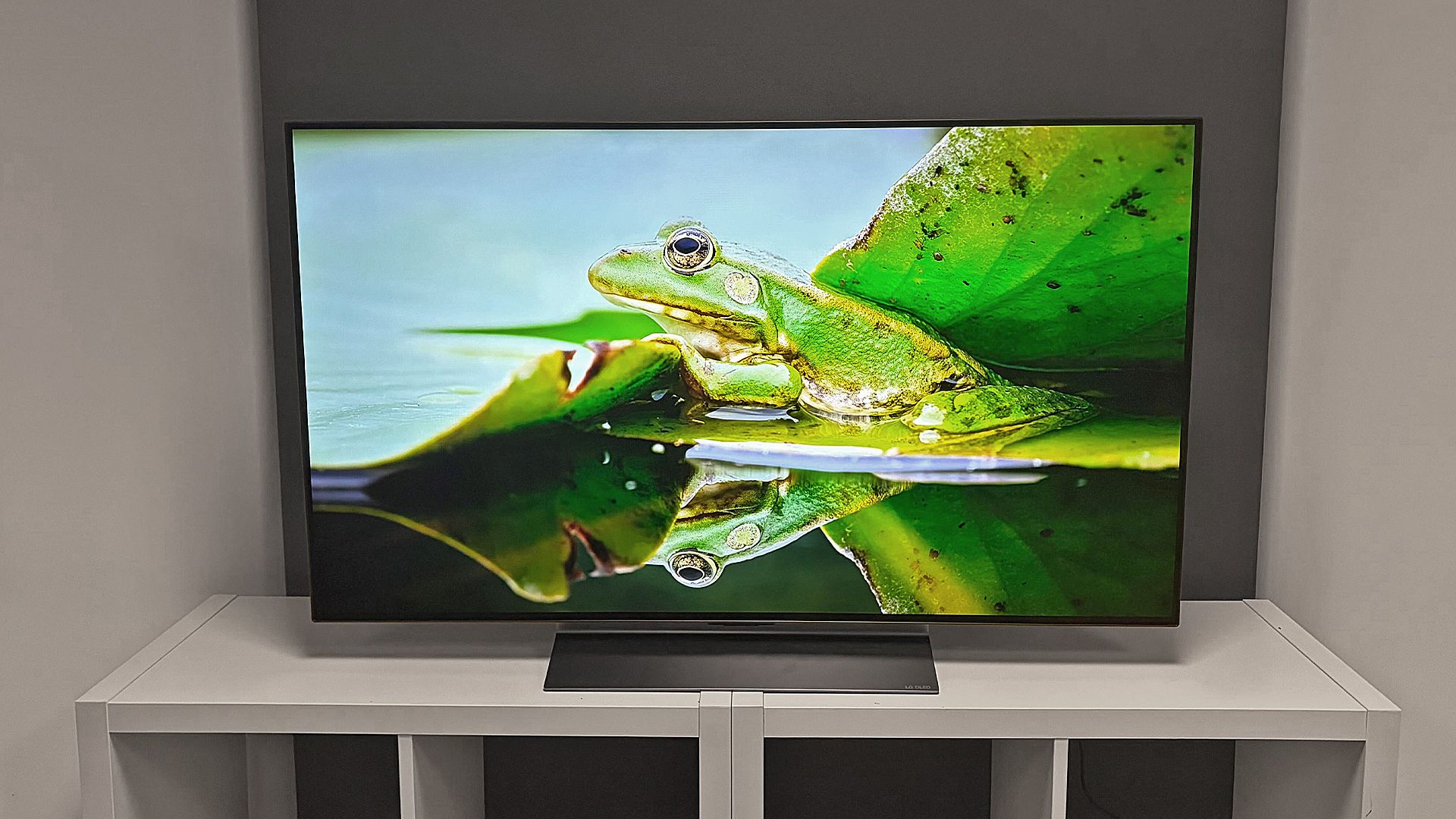
The defining upgrade of the OLED48C6 is LG's decision to fit the 48-inch size with a Primary RGB Tandem OLED panel driven by the Alpha 11 AI Gen 3 processor. In testing, RTINGS observed that this panel technology provides substantially wider color reproduction and higher luminance compared to traditional WOLED configurations. Because every pixel is self-emissive, black levels remain absolute with no light bleed or haloing around bright objects. What Hi-Fi? praised the panel for its clean color fidelity and depth, noting that images carry natural skin tones and rich saturation straight out of the box without looking overprocessed. Both AVForums and What Hi-Fi? recommend disabling default AI picture enhancement modes, as native Filmmaker Mode provides the most accurate and balanced rendition.
Motion, refresh rate and gaming features
Gaming is one of the strongest suits of the 48-inch C6. The display offers a 120Hz native refresh rate for consoles like the PS5 and Xbox Series X, but enables up to 165Hz VRR in Game Optimizer mode when connected to a capable gaming PC. RTINGS recorded near-instantaneous pixel response times under 0.1ms, eliminating visible ghosting and blur behind rapid motion. Variable refresh rate compatibility covers Nvidia G-Sync and AMD FreeSync Premium. However, RTINGS pointed out that, like many OLED panels, the display can exhibit visible VRR gamma flicker in scenes with low, fluctuating frame rates. Console gamers benefit from full 4K 120Hz Dolby Vision gaming support across all four HDMI ports.
HDR performance
HDR performance sees a noticeable jump over prior C-series iterations. AVForums measured peak brightness hitting roughly 1,400 nits on a 10% test window and reaching upwards of 1,700 nits on smaller specular windows with Brightness Booster enabled, falling only about 260 nits short of the flagship 48-inch G6. What Hi-Fi? found that this extra brightness creates far punchier specular highlights—such as glinting sunlight, explosions, and street lamps—while preserving fine shadow gradation just above pure black. Format coverage includes HDR10, HLG, and Dolby Vision, though AVForums noted the continued absence of HDR10+ support, which remains standard for LG screens.
Design, stand and ports
The OLED48C6 features ultra-slim bezels and a central desktop pedestal stand that occupies a modest footprint, making it easy to place on smaller credenzas or deep computer desks. Physical connectivity is among the best on the market, featuring four full-bandwidth 48Gbps HDMI 2.1 inputs, one of which supports eARC for external sound routing. However, RTINGS noted that PC users should keep in mind the lack of native DisplayPort connectors or a built-in USB KVM switch, meaning you must rely on HDMI cables and graphics card ports. The onboard 40W 2.2-channel sound system delivers intelligible dialogue, but What Hi-Fi? and AVForums both note that serious movie fans will want an external soundbar or speaker system for impactful bass.
Viewing angles, reflections and burn-in risk
Viewing angles remain an inherent strength of the C6: color temperature and contrast stay virtually uniform even when seated well off-axis, making it ideal for group movie viewing. For reflections, the display retains a traditional glossy coating with an anti-reflective treatment. RTINGS found that it effectively preserves deep black levels under ambient lighting, but direct lights or bright windows produce clear reflections on screen. Regarding longevity, RTINGS included the 48-inch C6 in its accelerated Longevity 3.0 test bench. The tandem OLED architecture is designed to distribute electrical load across multiple emitter layers, enhancing efficiency and durability, though users running static desktop interfaces should still take advantage of LG's screen savers and pixel-cleaning routines.
Price
The 48-inch LG C6 debuted at an MSRP of $1,599.99 in the US, tested in the UK at £1,200. Retail discounts regularly bring the street price down to roughly $1,099.99 to $1,200 at major retailers like Best Buy and P.C. Richard. Reviewers consider it a strong value among compact OLEDs because it delivers near-flagship tandem brightness and the Alpha 11 processor at a price point roughly $400 below the equivalent 48-inch G6. However, buyers on a stricter budget will find that the previous-generation C5 remains an enticing option when clearance pricing drops it hundreds of dollars below the C6.
Is it worth the money?
The C6 48-inch delivers substantial value by sharing the tandem panel and Alpha 11 processor with much pricier tiers, often selling around $1,100, though outgoing C5 models remain cheaper for budget-conscious shoppers.
Also consider
- ASUS ROG Swift OLED PG32UCDM Gen3
A 32-inch 4K QD-OLED monitor that offers a higher 240Hz refresh rate, DisplayPort, and sharper text density for dedicated desktop computing.
- LG C5 48-inch
The predecessor offers the same gaming feature set and near-identical smart software at deep clearance discounts if peak tandem brightness is not a requirement.
- LG G6 48-inch
LG's flagship 48-inch model offers around 260 nits higher peak luminance and a flatter gallery design, but commands a roughly $400 premium.
- Samsung S90H
Samsung's competing mid-range OLED includes a matte Glare-Free screen finish that handles bright rooms better, though it lacks Dolby Vision.
Reviews we read
This roundup summarizes professional reviews and published specifications; Next Interrupt did not test the product. Roundup updated November 3, 2026. How we work