Monitors & TVs / Review roundup
LG C5 OLED (55-inch)
2025 55-inch C5; reviews include 65-inch samples
- 5/5Tom's Guide
- 5/5TechRadar
Exceptional contrast and top-tier gaming features make LG's mid-range OLED the benchmark for mixed living room use.
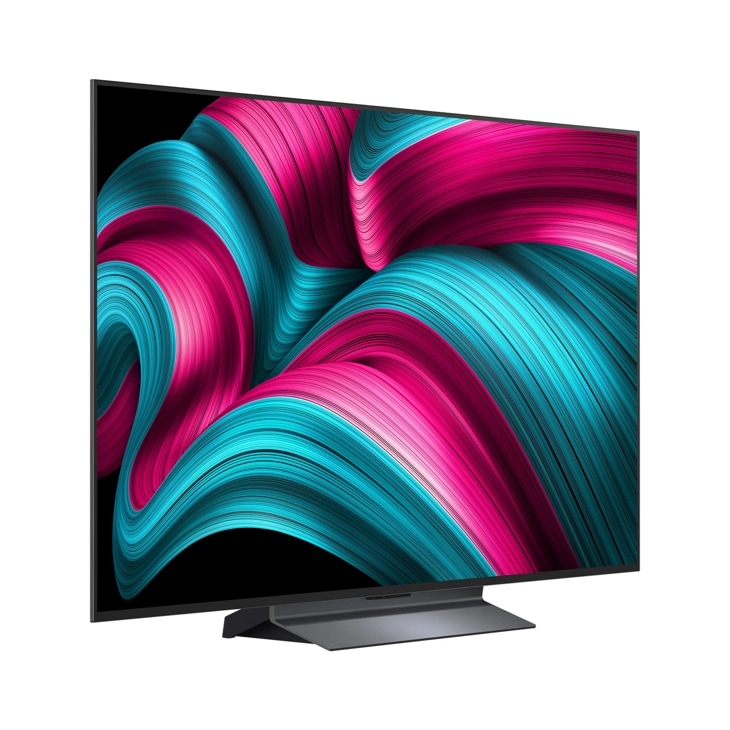
The 55-inch LG C5 is the benchmark television for movie enthusiasts and console gamers wanting top-tier picture quality without paying flagship prices. Its primary strength is balanced, class-leading contrast with measured HDR peak highlights reaching 1,165 to 1,198 nits alongside an exceptionally responsive 144Hz refresh rate across all four HDMI 2.1 inputs. The main drawback is modest full-screen brightness that drops to 200 nits under aggressive automatic brightness limiting, alongside the loss of DTS audio passthrough. Compared with Samsung's QD-OLED alternatives like the S90 series, the C5 offers Dolby Vision support and superior low-resolution video processing, even if it falls slightly behind in saturated color volume.
Buy it if
- Gamers seeking 4K 144Hz support, sub-10ms input latency, and four full-bandwidth HDMI 2.1 ports
- Movie enthusiasts prioritizing perfect black levels, precise shadow detail, and Dolby Vision HDR
- Buyers wanting balanced, high-end display performance without paying flagship G-series pricing
Skip it if
- Your television sits in a sun-drenched room opposite uncovered windows
- You rely on your TV for DTS audio passthrough to an external audio receiver
- You demand extreme full-screen sustained brightness above 300 nits
Where to buy
We may earn a commission from purchases or qualifying sign-ups through our links. Affiliate links explained
What reviewers liked
- Infinite contrast with pixel-level dimming and zero backlight blooming
- Measured 10% peak HDR brightness of 1,165 to 1,198 nits
- Four 48Gbps HDMI 2.1 ports supporting 4K at 144Hz, VRR, and ALLM
- Ultra-low gaming input lag measured at 9.1ms in Boost mode
- Wide viewing angles with negligible color shift from the sides
What they didn’t
- Full-screen brightness throttles to roughly 200 nits in bright scenes
- Dropped DTS audio decoding and passthrough support
- Built-in 2.2 speakers lack low-end bass impact
- No HDR10+ support
Key specs
- Launch price
- $1,999.99 (55-inch MSRP at launch)
- Reported price
- $1,199 - $1,299 during standard promotional sales
- Screen Size
- 55 inches (diagonal)
- Panel Type
- WOLED (OLED evo)
- Resolution
- 4K UHD (3840 x 2160)
- Refresh Rate
- 144Hz native
- Processor
- LG Alpha 9 AI Gen8
- HDR Formats
- Dolby Vision, HDR10, HLG
- HDMI Ports
- 4x HDMI 2.1 (48Gbps, 4K/144Hz, eARC on Port 2)
- Gaming Support
- Nvidia G-Sync, AMD FreeSync Premium, VRR, ALLM
- Audio Output
- 40W (2.2 channels, downward firing, Dolby Atmos)
- Smart Platform
- webOS 25
In depth
Picture quality: brightness, contrast, colour
The LG C5 delivers the quintessential OLED viewing experience, driven by individual self-lit pixels that achieve an infinite contrast ratio with absolute black levels. In dark-room environments, reviewers across Tom's Guide, TechRadar, and RTINGS noted completely clean transitions between bright objects and deep shadows without any of the backlight haloing or blooming that troubles Mini-LED alternatives. In color testing on the 55-inch set, Tom's Guide recorded an SDR Delta-E color accuracy score of 1.25 and 99.67% coverage of the standard Rec. 709 gamut. Upscaling also saw tangible refinement courtesy of LG's Alpha 9 AI Gen8 processor: both Tom's Guide and TechRadar reported that legacy 720p and 1080p content appeared crisp, retaining natural facial textures while eliminating digital noise and compression artifacts without over-sharpening.
HDR performance
Peak specular highlights show a distinct step forward compared to earlier generations. Testing the 55-inch model, Tom's Guide measured 1,165 nits on a 10% white window alongside 99.45% UHDA-P3 color gamut coverage. TechRadar recorded 1,180 nits in Filmmaker Mode and 1,198 nits in Standard mode on its 65-inch test bench. RTINGS confirmed that real-scene highlights mastered at 600 and 1,000 nits pop with convincing intensity and minimal tone-mapping compromises. However, automatic brightness limiting remains an inherent characteristic of the WOLED panel: when bright elements fill the majority of the display, full-screen sustained brightness falls to roughly 195 to 200 nits according to TechRadar and FlatpanelsHD measurements. Supported dynamic formats include Dolby Vision, HDR10, and HLG, but LG continues to forgo HDR10+ support.
Motion, refresh rate and gaming features
The C5 ranks among the most capable displays available for console and PC gaming. Unlike many rivals that restrict bandwidth to just two inputs, all four HDMI ports on the C5 support full HDMI 2.1 bandwidth up to 4K resolution at 144Hz with Variable Refresh Rate (VRR) and Auto Low Latency Mode (ALLM). Support extends across AMD FreeSync Premium and Nvidia G-Sync. When testing latency with a Leo Bodnar meter on the 55-inch panel, Tom's Guide measured a swift 9.1 ms of input lag with the Prevent Input Delay Boost feature enabled inside Game Optimizer (12.9 ms without Boost). FlatpanelsHD clocked 4K 60Hz lag at 10.8 ms and 2K 120Hz at 5.9 ms. Pixel response times are practically instantaneous, producing exceptionally crisp motion during high-speed action, though RTINGS noted minor VRR gamma flicker in extremely dark loading screens.
Design, stand and ports
LG maintains a minimalist aesthetic defined by pencil-thin panel borders and a compact, centrally mounted metal pedestal stand that fits easily on narrow furniture. All four HDMI 2.1 ports are side-facing for convenient access, with Port 2 dedicated to eARC audio routing. One notable backward step highlighted by RTINGS is that LG eliminated internal decoding and passthrough for DTS audio formats across its 2025 range, meaning legacy DTS-HD Master Audio and DTS:X tracks from physical Blu-ray discs require external audio decoding before hitting the television. The integrated 2.2-channel 40W sound system delivers intelligible dialogue and clean mid-tones, but both Tom's Guide and TechRadar found the downward-firing drivers thin on low-end bass, strongly advising an external soundbar for movies.
Viewing angles, reflections and burn-in risk
Off-axis performance remains virtually uncompromised: reviewers noted that colors and black levels stay rock-solid even when sitting far off to the side, making the 55-inch C5 well-suited for wide living room arrangements. Reflection handling is effective against ambient indoor illumination thanks to an anti-reflective coating, but direct, harsh light sources—such as uncovered windows directly opposite the panel—can cause noticeable purple tinting and wash out deep shadow details. While permanent image retention (burn-in) remains a theoretical concern for any organic emissive display displaying static channel logos for thousands of continuous hours, automated pixel cleaning cycles, subtle pixel shifting, and screen-saver timers keep burn-in risks negligible under normal mixed entertainment usage.
Price and value
The 55-inch LG C5 launched at an MSRP of $1,999.99, putting it directly against established premium displays. As is standard for LG OLED generations, street prices quickly moderated. Retail tracking from Tom's Guide and TechRadar noted typical promotional sales dropping the 55-inch model into the $1,199 to $1,299 window, where it presents significantly better value. While its year-over-year gains in peak brightness over the older C4 are iterative rather than revolutionary, its class-leading gaming connectivity, refined processing, and competitive discounted pricing make it a dependable recommendation in the sub-$1,300 bracket.
Is it worth the money?
At its original $1,999 launch price, the C5 competed closely with high-end flagship displays, but regular discounts to the $1,200 to $1,300 range make it one of the strongest overall price-to-performance sets on the market.
Also consider
- Samsung S90D
Provides wider color coverage and punchier saturated color brightness via its QD-OLED panel, but lacks Dolby Vision support.
- LG G5 OLED
Offers substantially higher peak and full-screen brightness using advanced MLA or tandem panel technology, but commands a steep price premium.
- LG B5 OLED
Retains perfect black levels and LG's core gaming interface at a lower price point, but drops refresh rate to 120Hz and delivers lower peak brightness.
- Sony Bravia 8
Features Sony's class-leading video processing and Acoustic Surface Audio, but only provides two HDMI 2.1 ports and higher input lag.
Reviews we read
This roundup summarizes professional reviews and published specifications; Next Interrupt did not test the product. Roundup updated October 29, 2026. How we work
- Tom's Guide — LG C5 OLED TV review
- TechRadar — LG C5 OLED TV review: already on course to be one of 2025's best TVs
- RTINGS — LG C5 OLED TV Review