CPUs & PC components / Review roundup
Gigabyte TRX50 AERO D
Gigabyte TRX50 AERO D
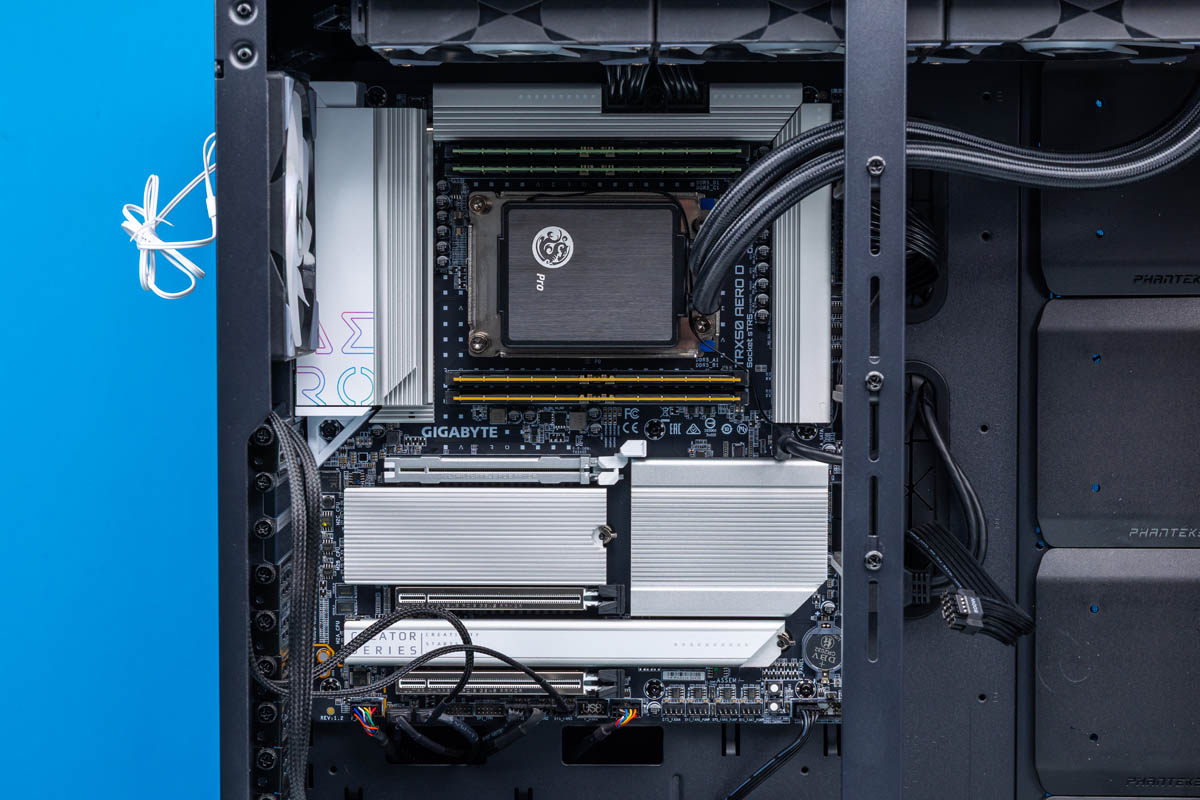
An accessible entry into AMD Threadripper with dual USB4 and extensive PCIe 5.0 connectivity
The Gigabyte TRX50 AERO D is the most cost-effective foundation for building an AMD Threadripper 7000 or 9000 series workstation. Its biggest strength is its consumer-friendly connectivity, pairing dual 40Gbps USB4 ports and 10GbE networking with ample PCIe 5.0 lanes for GPUs and NVMe drives. The main catch is the absence of an enterprise BMC for remote management and a purely passive VRM heatsink design that runs noticeably warm under heavy loads. Compared to the pricier Asus Pro WS TRX50-SAGE WIFI, the AERO D sacrifices active cooling and remote IPMI management to save roughly $300.
Buy it if
- Content creators and 3D animators needing Threadripper multi-threading without paying server-grade premiums
- Workstation builders who prioritize fast external storage via dual 40Gbps USB4 ports and 10GbE networking
Skip it if
- Enterprise IT administrators who require out-of-band server management via a dedicated BMC or IPMI
- Workstation professionals running memory-bound simulations that require the eight-channel bandwidth of WRX90
Where to buy
We may earn a commission from purchases or qualifying sign-ups through our links. Affiliate links explained
What reviewers liked
- Most affordable entry price in the sTR5 TRX50 motherboard category
- Dual 40Gbps USB4 Type-C ports powered by an Intel JHL8540 controller with DisplayPort-in passthrough
- Generous high-speed storage support with three PCIe 5.0 M.2 slots and one PCIe 4.0 M.2 slot
- Dual Ethernet with 10GbE and 2.5GbE alongside integrated Wi-Fi 7
- Tool-less M.2 EZ-Latch mechanisms make SSD installation straightforward
What they didn’t
- Passive VRM heatsinks run warmer under prolonged 350W loads than actively cooled rivals
- No integrated BMC or IPMI controller for remote system administration
- Limited to four memory channels, trailing eight-channel WRX90 platforms in memory-heavy tasks
Key specs
- Launch price
- $599.99
- Reported price
- $570.00 to $600.00
- Socket
- AMD Socket sTR5
- Chipset
- AMD TRX50
- Form Factor
- E-ATX (30.5 cm x 26.4 cm)
- Memory Support
- 4x DDR5 ECC RDIMM slots (quad-channel, up to 1TB)
- PCIe Expansion Slots
- 2x PCIe 5.0 x16, 1x PCIe 4.0 x16
- M.2 Storage Slots
- 3x PCIe 5.0 x4, 1x PCIe 4.0 x4
- SATA Ports
- 8x SATA 6Gb/s
- Networking
- 1x Marvell 10GbE, 1x Realtek 2.5GbE, Wi-Fi 7, Bluetooth 5.3
- Rear USB Ports
- 2x USB4 Type-C (40Gbps), 4x USB 3.2 Gen 2 Type-A, 4x USB 3.2 Gen 1 Type-A
- Power Delivery
- 16+8+4 digital power phases with 108A smart power stages
In depth
Productivity and multi-core performance
ServeTheHome tested the TRX50 AERO D with AMD's 64-core Ryzen Threadripper 9980X to evaluate its ability to feed and stabilize high-core processors. In pure multi-threaded compute workloads and integer-heavy compiling, the platform scaled effortlessly across all cores and threads. However, ServeTheHome noted that in memory-bound floating-point calculations, such as SPEC CPU floating-point suites, the non-Pro Threadripper setup trailed high-bandwidth workstation alternatives by approximately 24%. With 64 cores sharing four DDR5 channels, individual core throughput can hit memory bottlenecks in vectorized scientific workloads, a limitation inherent to the TRX50 architecture rather than a defect of this specific board.
Power consumption and cooling needs
The TRX50 platform handles chips with a standard 350-watt thermal design power, which dictates serious cooling hardware. ServeTheHome found that keeping a 64-core Threadripper processor under thermal limits required at least a 360mm all-in-one liquid cooler. For the motherboard itself, Gigabyte installed a 16+8+4 phase power delivery system covered by hefty finned heatsinks connected via heatpipes. Unlike server-grade motherboards that employ active VRM fans, the AERO D relies entirely on passive dissipation. Under sustained peak CPU loads, VRM temperatures reached approximately 72°C. While this is well within component thermal tolerances, it runs warmer than actively cooled competitors like the Asus Pro WS TRX50-SAGE WIFI, which stabilized around 57°C in similar testing conditions.
Gaming performance
Reviewers classify the TRX50 AERO D as a workstation and creative platform rather than a specialized gaming product. While modern Zen 4 and Zen 5 Threadripper CPUs achieve single-core clock speeds high enough to deliver fluid frame rates in contemporary titles, the platform suffers from higher inter-die memory latency and NUMA topology overhead compared to standard desktop hardware. For pure gaming tasks, mainstream AM5 boards paired with dedicated gaming chips like the Ryzen 7 7800X3D or 9800X3D provide faster gaming frame rates at a fraction of the power consumption and platform cost.
Platform: socket, motherboard and memory costs
Building on AMD's sTR5 socket entails substantial component costs beyond the motherboard itself. The TRX50 AERO D requires DDR5 registered ECC DIMMs (RDIMMs); standard unbuffered consumer DDR5 memory is not compatible. Memory manufacturers like V-Color demonstrated speeds up to DDR5-8000 using EXPO profiles on this board, but high-density RDIMM kits command a hefty price premium over consumer modules. The E-ATX form factor also requires a spacious PC case. Offsetting those expenses is strong expansion headroom: three PCIe x16 slots (two Gen5, one Gen4), four onboard M.2 slots (three Gen5, one Gen4), eight SATA connectors, dual 40Gbps USB4 ports via an Intel JHL8540 controller, and 10GbE networking.
Upgrade value versus previous generation
For owners of legacy Threadripper hardware, the sTR5 socket represents a major leap over older TRX40 and WRX80 platforms. TRX50 introduces full support for PCIe 5.0 lanes, DDR5 memory with higher bandwidth per channel, and Wi-Fi 7. Unlike the TRX40 generation—which AMD abandoned after a single processor family—sTR5 motherboards like the AERO D support both Zen 4 (Threadripper 7000) and Zen 5 (Threadripper 9000) desktop CPUs, as well as Threadripper Pro models running in quad-channel memory configurations. This broader compatibility ensures a clear CPU upgrade path over multiple architectural cycles.
Price
The Gigabyte TRX50 AERO D debuted at a launch price of approximately $599, and retail street prices currently sit between $570 and $600. That puts it well below its direct market competition: the Asus Pro WS TRX50-SAGE WIFI retails around $899, while the ASRock TRX50 WS typically sells near $799. By cutting server-centric add-ons like remote BMC chips and slimSAS ports, Gigabyte positioned the AERO D as the clear value leader among TRX50 motherboards.
Is it worth the money?
The TRX50 AERO D is the lowest-priced sTR5 motherboard on the market, undercutting alternatives from Asus and ASRock by $200 to $300 while retaining 10GbE and dual USB4.
Also consider
- ASUS Pro WS TRX50-SAGE WIFI
Offers active VRM fan cooling, dual 10GbE ports, and IPMI-grade remote management, but carries a higher price tag near $899.
- ASRock TRX50 WS
Provides five full-length PCIe slots for dense multi-GPU compute expansion, though it commands a roughly $200 price premium.
Reviews we read
This roundup summarizes professional reviews and published specifications; Next Interrupt did not test the product. Roundup updated November 9, 2026. How we work