Monitors & TVs / Review roundup
Gigabyte GO27Q24G
Gigabyte GO27Q24G
- 4.5/5 (Editor's Choice)Tom's Hardware
- 75%PC Gamer
- 86%TweakTown
An affordable 240Hz WOLED gaming monitor with brilliant contrast and deep blacks, tempered by fringe-prone text
Gamers seeking responsive OLED performance without a flagship price tag should keep the Gigabyte GO27Q24G near the top of their list. Its primary strength is blistering gaming speed and infinite contrast, using an LG MLA+ WOLED panel that preserves genuine ink-black levels even in moderately lit spaces. The catch is that its RWBG subpixel layout and 111 PPI pixel density introduce noticeable fringing around desktop typography, while connectivity excludes a USB hub and meaningful laptop charging. Compared to QD-OLED competitors like the Alienware AW2726DM, it holds up better in daylight without purple tinting, but falls behind in overall color brightness.
Buy it if
- Competitive esports and fast-paced PC gaming in standard room lighting
- Dark-room gaming and movie watching requiring true, inky black levels
- Shoppers wanting OLED performance without spending over 400 dollars
Skip it if
- You spend substantial hours reading documents, coding, or editing desktop text
- You need a single-cable laptop docking monitor with 65W or higher USB-C charging
- You require an integrated KVM switch or built-in desktop USB hub
Where to buy
We may earn a commission from purchases or qualifying sign-ups through our links. Affiliate links explained
What reviewers liked
- Infinite contrast with true blacks that resist ambient light wash-out
- Fluid 240 Hz refresh rate and instant pixel response with low input lag
- LG MLA+ WOLED panel achieves up to 1,300 nits on small HDR highlights
- Four-sided borderless design with a low-profile stand and full ergonomic adjustments
- Three-year manufacturer warranty that explicitly covers OLED panel burn-in
What they didn’t
- RWBG subpixel layout produces visible color fringing on high-contrast text
- Out-of-the-box SDR color temperature and grayscale need manual OSD tuning
- Connectivity omits a USB hub, KVM, and limits USB-C power delivery to 15 W
- Full-screen color brightness trails comparable QD-OLED displays in sunny rooms
Key specs
- Launch price
- $499
- Reported price
- $349 to $399
- Panel Type
- 27-inch WOLED with Micro Lens Array Plus (MLA+)
- Resolution & Density
- 2560 x 1440 (QHD), ~111 PPI
- Refresh Rate
- 240 Hz
- Response Time
- 0.03 ms GtG
- Brightness
- 275 nits typical SDR; up to 1,300 nits peak HDR (1.5% window)
- Color Coverage
- 99% DCI-P3 rated (96.87% measured), 100% sRGB
- Video Inputs
- 2x HDMI 2.1, 1x DisplayPort 1.4 (DSC), 1x USB-C (DP Alt Mode)
- USB Power Delivery
- 15 W
- Weight
- 5.6 kg with stand (4.1 kg panel only)
- Warranty
- 3 years including burn-in coverage
In depth
Picture quality: brightness, contrast, colour
The GO27Q24G relies on an LG Display WOLED panel equipped with Micro Lens Array Plus (MLA+) optical lenses. In testing at Tom's Hardware, Christian Eberle measured 263 nits of full-screen SDR brightness in uniform brightness mode, providing plenty of light for standard indoor sessions while avoiding distracting auto-dimming swings. TechPowerUp recorded 100% coverage of sRGB, 96.87% of DCI-P3, and 70.56% of BT.2020. Factory calibration proved somewhat uneven across publications: TechPowerUp measured an average grayscale Delta E of 4.54 in the default ECO profile, while Tom's Hardware noted a warm color temperature and light gamma out of the box that straightened out once adjusted via user sliders. Because WOLED uses a white subpixel alongside color filters, PC Gamer pointed out that full-field color saturation looks slightly less punchy than competing QD-OLED monitors, even though contrast remains effectively infinite.
Motion, refresh rate and gaming features
Motion clarity is the monitor's strongest asset. Operating at 240 Hz with a rated 0.03 ms Gray-to-Gray response time, pixel transitions are virtually instantaneous, eliminating motion blur and ghosting trails behind rapidly moving objects. Both Tom's Hardware and TechPowerUp found input lag exceptionally low, making it fully suitable for competitive first-person shooters like Valorant and Counter-Strike 2. Adaptive synchronization covers the 48 Hz to 240 Hz window with both AMD FreeSync Premium and Nvidia G-Sync Compatible support. Gigabyte also adds an OLED VRR Anti-Flicker toggle to smooth out brightness fluctuations during sharp frame rate drops, along with on-screen crosshairs, timers, and black frame insertion.
HDR performance
The display carries VESA DisplayHDR True Black 400 certification. Thanks to its MLA+ layer, it is rated to reach 1,300 nits on tiny 1.5% white windows, allowing specular highlights such as sparks, chrome reflections, and explosions to punch through against deep backgrounds. PC Gamer and TechPowerUp evaluated Gigabyte's HyperNits feature, which boosts mid-tone luminance along the EOTF curve to prevent darker scenes from feeling overly dim. While larger bright scenes are pulled back by Automatic Brightness Limiting (ABL) as expected on any OLED, smaller highlights deliver dramatic dynamic range that standard LCDs cannot replicate without blooming.
Design, stand and ports
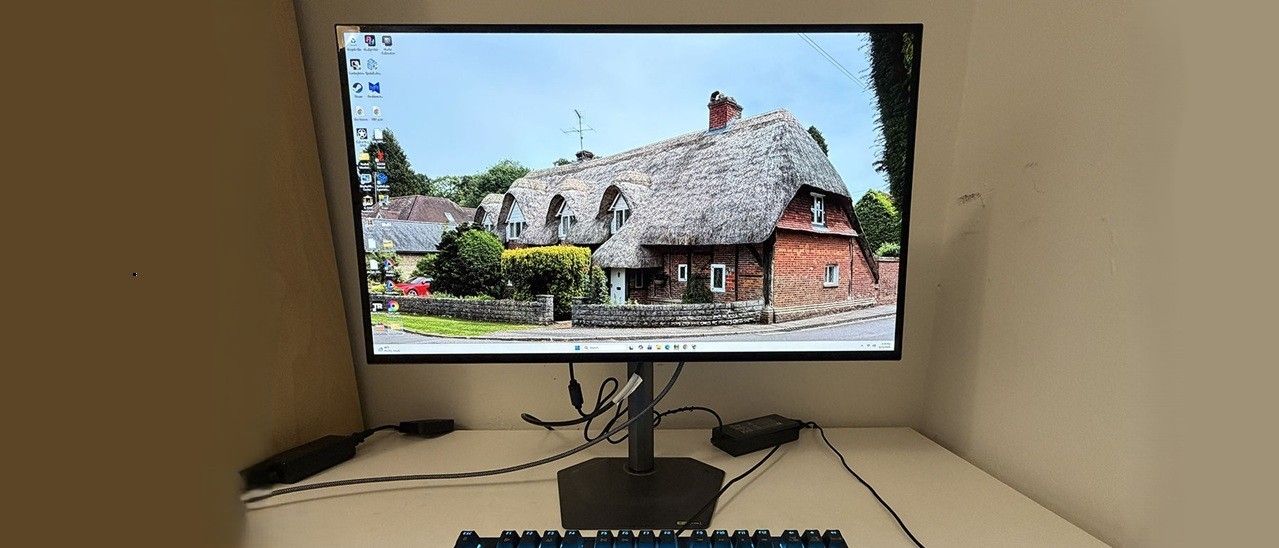
Gigabyte opted for a subdued, functional aesthetic. The panel features a sleek four-sided borderless bezel, while the flat rectangular metal base measures 24 cm wide and 18.8 cm deep, keeping desk obstruction minimal. Ergonomics include 130 mm of height adjustment, -5° to +21° tilt, ±15° swivel, and a 90° clockwise pivot into portrait orientation. Connectivity is where cost-cutting shows: it offers two HDMI 2.1 ports, one DisplayPort 1.4 port, a 3.5 mm headphone jack, and a single USB-C port with DisplayPort Alt Mode. However, TechPowerUp noted that the USB-C port provides only 15 W of power delivery, there are no built-in speakers, and there is no USB Type-A downstream hub or KVM switch.
Viewing angles, reflections and burn-in risk
Because it uses a WOLED panel paired with a circular polarizing filter, the GO27Q24G maintains deep, dark blacks under ambient room light. Unlike first- and second-generation QD-OLED screens that can lift black levels to a reddish-purple hue in well-lit rooms, the Gigabyte panel retains its contrast. TechPowerUp praised the RealBlack Glossy coating for minimizing diffuse reflection haze without creating harsh mirror reflections. Viewing angles are virtually flawless horizontally and vertically. The primary drawback is LG's RWBG subpixel structure: at 111 PPI, green and magenta fringing is visible on fine black-on-white text, making it poor for heavy office work. For burn-in protection, Gigabyte includes its AI OLED Care suite alongside a standard three-year warranty that explicitly covers burn-in.
Price
The Gigabyte GO27Q24G launched with an MSRP of $499. However, retailers and monitor deal trackers frequently discount the screen to between $349 and $399. At its original $500 price point, reviewers found the omitted USB hub and subpixel text fringing hard to ignore. At the typical $350 street price, Tom's Hardware declared it exceptional value, noting that getting a 240 Hz MLA+ OLED panel at that price makes it one of the most accessible entries into high-end gaming displays.
Is it worth the money?
Launched at $499, this monitor frequently sells for $349 to $399, making it one of the lowest-priced 240 Hz OLED panels on the market.
Also consider
- Alienware AW2726DM
A 240 Hz 1440p QD-OLED display that delivers slightly more vibrant color volume and cleaner text rendering, though blacks wash out in ambient daylight.
- Gigabyte MO27Q28G
Uses a newer 280 Hz Tandem WOLED panel and adds the missing USB hub and KVM switch for roughly $100 to $150 more.
- Samsung Odyssey OLED G6 (G60SD)
Pushes refresh rates to 360 Hz with a matte anti-glare coating for esports competitors willing to pay an extra premium.
Reviews we read
This roundup summarizes professional reviews and published specifications; Next Interrupt did not test the product. Roundup updated October 26, 2026. How we work
- Tom's Hardware — Gigabyte GO27Q24G 27-inch OLED 240 Hz QHD gaming monitor review: Tremendous bang for the buck
- TechPowerUp — Gigabyte GO27Q24G Review - Borderless by Design, Gaming by Nature
- PC Gamer — Gigabyte GO27Q24G review