Watches & wearables / Review roundup
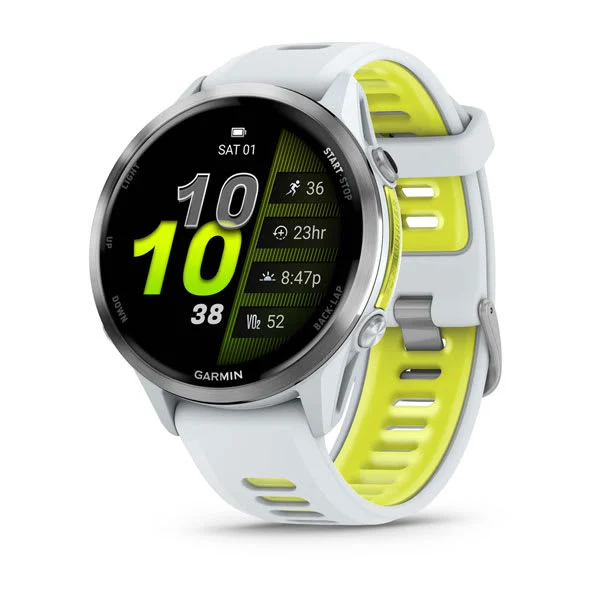
Garmin Forerunner 970
47mm GPS running watch; no LTE
- 4 / 5Tom's Guide
- RecommendedDC Rainmaker
A titanium-and-sapphire running watch with peerless navigation and metrics, tempered by a higher price
Serious runners and triathletes looking for elite training tools, onboard maps, and premium build quality will find the Garmin Forerunner 970 hard to beat. Its biggest strengths are pinpoint multi-band GPS accuracy, an integrated LED flashlight, and a sapphire-glass AMOLED display encased in lightweight titanium. The chief drawback is a steep $749 price tag combined with noticeable battery drain when using the always-on display. While the Coros Pace 4 Pro delivers comparable core GPS tracking and longer endurance for $300 less, the Forerunner 970 remains the more feature-rich sports watch.
Buy it if
- Marathoners and triathletes seeking comprehensive training analysis and onboard mapping
- Athletes who want Fenix-tier titanium and sapphire durability without the bulky 80g-plus weight
- Dawn or night runners who value an integrated wrist flashlight for visibility
Skip it if
- You want week-long battery life with an always-on display enabled
- You are on a budget and can get similar core tracking from watches priced under $500
- You have slim wrists and prefer a sub-44mm case size
Where to buy
We may earn a commission from purchases or qualifying sign-ups through our links. Affiliate links explained
What reviewers liked
- Bright 1.4-inch AMOLED display protected by durable sapphire crystal
- Lightweight titanium bezel brings the weight to just 56 grams
- Convenient built-in dual-color LED flashlight
- Pinpoint multi-band GPS tracking with SATIQ technology
- Elevate Gen 5 optical sensor adds ECG and skin temperature monitoring
- Zero ongoing subscription fees for training analytics and maps
What they didn’t
- Launch price increased significantly to $749
- Always-on display mode reduces battery life to roughly 2.5 to 3 days
- Flagship Running Economy and Step Speed Loss metrics require the optional $169 HRM 600 strap
- Only available in a single 47mm case size
Key specs
- Launch price
- $749.99
- Reported price
- $649 to $749
- Case Size
- 47mm x 47mm x 14mm
- Weight
- 56g
- Display
- 1.4-inch AMOLED touchscreen, Sapphire crystal
- Bezel Material
- Titanium
- Sensors
- Elevate Gen 5 optical HR, ECG, skin temperature, pulse ox, barometric altimeter
- Satellite Tracking
- Multi-band GNSS with SatIQ
- Water Resistance
- 5 ATM (50 meters)
- Audio & Mic
- Built-in speaker and microphone for voice commands and calls
- Battery Life (Smartwatch)
- Up to 15 days (gesture) / approx. 2.5–3 days (always-on display)
- Battery Life (GPS)
- Up to 26 hours in standard GPS mode
In depth
Design and comfort
The Forerunner 970 moves the series closer to Garmin's outdoor flagships by upgrading case materials. It features a lightweight titanium bezel paired with a scratch-resistant sapphire crystal lens over its 1.4-inch AMOLED panel. Reviewers at Tom's Guide and DC Rainmaker highlighted that despite these rugged materials, the watch weighs just 56 grams, making it substantially lighter and more comfortable on long runs than the bulkier Fenix 8. A major hardware addition is the integrated white-and-red LED flashlight at the top of the case. The main ergonomics complaint is sizing: unlike the Fenix line, the Forerunner 970 is sold in only one 47mm case, which reviewers noted can feel bulky on petite wrists or during sleep.
Health and fitness tracking accuracy
Tracking precision is a standout quality across testing outlets. Multi-band GNSS with SatIQ performed flawlessly in urban environments; Tom's Guide noted that during the London Marathon and Paris Half Marathon, the watch maintained strict line tracks despite tunnels and the skyscrapers of Canary Wharf. Heart rate monitoring is driven by the Elevate Gen 5 sensor, which adds skin temperature tracking and support for Garmin's ECG app. While wrist-based optical readings closely mirrored chest straps in steady-state workouts, testers noted the usual slight delay during high-intensity intervals. Garmin also introduced new metrics like Running Tolerance and Running Impact Load, but DC Rainmaker cautioned that two of the most publicized additions—Running Economy and Step Speed Loss—require pairing the separate HRM 600 chest strap.
Battery life
Garmin rates the watch for up to 15 days in smartwatch mode using gesture wake, and up to 26 hours of continuous GPS recording. In practice, battery longevity depends heavily on your screen mode. With raise-to-wake enabled and 4 to 6 weekly workouts, reviewers typically saw 5 to 8 days between charges. However, DC Rainmaker found that enabling the Always-On Display (AOD) burns battery at an aggressive pace, cutting run time to roughly 2.5 to 3 days when tracking 1 to 2 hours of daily GPS exercise. During running activities, drain hovered around 3.5% to 4% per hour, with community marathon runners reporting an 18% drop over five hours of continuous activity recording.
Smart features and app ecosystem
The addition of a built-in microphone and speaker brings the Forerunner 970 closer to everyday smartwatches. When paired with a phone, users can take wrist phone calls, trigger phone voice assistants such as Siri or Google Assistant, and issue offline watch voice commands to start workouts or set timers. It retains Garmin Pay NFC contactless payments and offline playlist caching for Spotify, Deezer, and Amazon Music. However, the Connect IQ app store remains basic compared to watchOS or Wear OS, and the watch lacks standalone LTE connectivity.
Compatibility (iPhone/Android)
The watch works seamlessly across iOS and Android devices through the Garmin Connect app. Setup, synchronization, course transfers, and health dashboard access are identical across platforms. The sole functional difference lies in messaging: Android users can reply to incoming text messages directly from the watch using pre-set canned responses, whereas Apple's iOS ecosystem restrictions prevent iPhone users from doing so.
Price and subscriptions
At $749.99, the Forerunner 970 sits at a noticeable $150 premium over its predecessor's launch price, bringing it close to premium outdoor and lifestyle smartwatches. Retail discounts typically see it sell between $649 and $749. Garmin charges no ongoing subscription fees for any of its training features, daily workouts, sleep tracking, or full-color topographic maps. The financial catch is accessory lock-in: to access advanced biomechanics like Running Economy and Step Speed Loss, runners must purchase the optional HRM 600 chest strap for $169.
Is it worth the money?
A significant price jump over the $599 Forerunner 965, though it adds a sapphire screen, titanium bezel, flashlight, and speaker while keeping all training analytics subscription-free.
Also consider
- Coros Pace 4 Pro
Costs $300 less at $449, weighs less, and delivers longer battery life with offline maps, but omits the LED flashlight, ECG, and on-wrist mic.
- Garmin Fenix 8 (47mm AMOLED)
Provides 40-meter dive capabilities and heavier steel or titanium chassis, but costs around $250 more and is bulkier on the wrist.
- Garmin Forerunner 570
Delivers Garmin's core AMOLED training software and Elevate Gen 5 HR tracking for $549, sacrificing full onboard topo maps and the flashlight.
- Apple Watch Ultra 2
Offers far superior everyday smartwatch apps and optional cellular connectivity for $799, but requires near-daily charging and only pairs with iPhones.
Reviews we read
This roundup summarizes professional reviews and published specifications; Next Interrupt did not test the product. Roundup updated October 19, 2026. How we work