Watches & wearables / Review roundup
Garmin Enduro 4
Garmin Enduro 4
- 4/5Tom's Guide
- 4/5Trusted Reviews
Monster battery life and a lightweight titanium build make this an ultra-endurance champ with few new tricks
The Garmin Enduro 4 is built for ultramarathoners, thru-hikers, and multi-day expedition athletes who want class-leading battery longevity without packing a charger. Its greatest strength is stamina, delivering up to 320 hours of GPS tracking with solar assistance and over two weeks of heavy real-world use. The catch is that its hardware is almost indistinguishable from the previous generation, and the single 51 mm casing will dwarf smaller wrists. Compared to the Garmin Fenix 9 Pro Solar, the Enduro 4 is lighter and significantly cheaper, though it foregoes a speaker, microphone, and luxury metal styling.
Buy it if
- Ultramarathon runners and backcountry hikers who need multi-week battery life and solar charging
- Outdoor athletes who prioritize a lightweight titanium and polymer build over bright AMOLED screens
- Users who want deep physiological metrics and offline maps without paying monthly subscription fees
Skip it if
- You have smaller wrists that cannot accommodate a 51 mm wide, 15.7 mm thick chassis
- You already own the Garmin Enduro 3, which delivers nearly identical battery life and shared software tools
- You want daily smartwatch luxuries such as voice calls, an on-wrist speaker, or a bright AMOLED panel
Where to buy
We may earn a commission from purchases or qualifying sign-ups through our links. Affiliate links explained
What reviewers liked
- Exceptional battery life delivering up to 320 hours of GPS with solar charging
- Lightweight 66-gram design wears comfortably during long training runs
- Expanded 64 GB storage supports extensive offline topographical maps and faster rendering
- No recurring subscription required to access training readiness, recovery, and routing tools
What they didn’t
- Single 51 mm case size is bulky and ill-suited for smaller wrists
- Transflective MIP display looks dull and muted under indoor lighting
- Lacks a speaker, microphone, voice assistant, and cellular or satellite connectivity
Key specs
- Launch price
- $899.99
- Reported price
- $899.99
- Dimensions
- 51 x 51 x 15.7 mm
- Weight
- 66 g with ComfortFit nylon band (57 g case only)
- Display
- 1.4-inch sunlight-visible MIP touchscreen (280 x 280 pixels), Power Sapphire solar lens
- Storage
- 64 GB onboard memory
- Water Resistance
- 10 ATM (100 meters)
- Sensors
- Garmin Elevate Gen 5 optical HR, multi-band GNSS, barometric altimeter, compass, pulse oximeter
- Battery Life Rating
- Up to 36 days (90 days with solar) in smartwatch mode; up to 120 hours (320 hours with solar) in GPS activity mode
In depth
Design and comfort
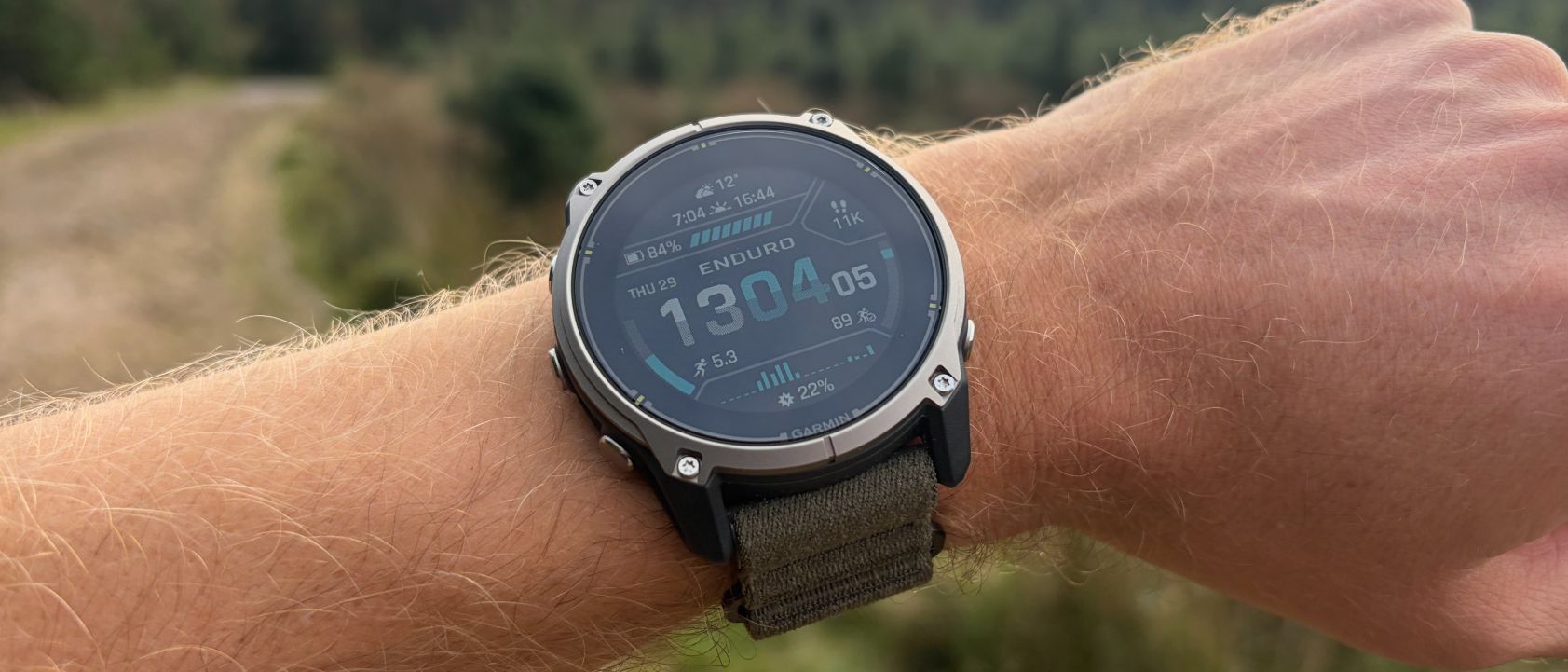
Reviewers agree that the Enduro 4 strikes an impressive balance between extreme physical size and wearable comfort. The watch retains a 51 mm case diameter and a 15.7 mm thickness, but Garmin pairs a lightweight fiber-reinforced polymer chassis with a titanium bezel. This keeps total weight down to 66 grams with the included 26 mm ComfortFit nylon band, compared to roughly 90 grams for comparable stainless-steel adventure watches. Tom's Guide noted that the lighter build prevents the watch from wobbling on the wrist during rough trail descents. The scratch-resistant Power Sapphire lens channels solar energy efficiently, while the integrated dual-LED flashlight features adjustable white intensity levels and a dedicated red night-vision setting. However, Trusted Reviews highlighted that the single 51 mm footprint is uncompromising, leaving smaller wrists without a compact alternative. Furthermore, the 1.4-inch transflective memory-in-pixel (MIP) display prioritizes direct sunlight legibility and energy efficiency over vibrancy; while crystal clear outdoors, reviewers noted that it appears dull and low-contrast indoors compared to AMOLED panels.
Health and fitness tracking accuracy
Tracking performance remains top-tier across testing. Equipped with Garmin's Elevate Gen 5 optical sensor and multi-band GNSS, the watch locks onto satellites rapidly and traces trail lines accurately under dense tree canopies and along steep alpine ridges. Heart rate accuracy proved reliable during steady endurance efforts like distance running, cycling, and long hikes. However, reviewers observed that sudden cadence shifts and sprint intervals still reveal the slight lag inherent to wrist-based optical sensors, where a chest strap remains preferable for interval training. On the software side, the watch includes Garmin's complete athletic toolset: Training Readiness, HRV Status, Hill Score, Endurance Score, and a dedicated rucking profile that allows on-the-fly pack weight adjustments. Garmin also adds VO2 max tracking for indoor rowing and Garmin Epic logging for multi-stage backcountry routes.
Battery life
Battery longevity is the Enduro 4's primary calling card, and real-world test results closely match Garmin's claims. Garmin rates the watch for up to 36 days in standard smartwatch mode, expanding up to 90 days with sufficient solar exposure (three hours daily at 50,000 lux). In GPS tracking, extended battery mode provides up to 120 hours, stretching to 320 hours under direct sun. In testing, Tom's Guide recorded over 16 days of continuous use with daily multi-band GPS tracking, lasting approximately 50% longer than leading AMOLED sports watches. Trusted Reviews logged close to a full month of battery life under normal daily activity and notification use. These numbers mean backcountry athletes can tackle multi-day adventures without packing charging cords or power banks.
Smart features and app ecosystem
Garmin keeps smart features focused on utility rather than full smartwatch convergence to preserve battery life. The Enduro 4 doubles onboard storage to 64 GB, which reviewers praised for comfortably holding extensive regional topographic map packages alongside offline music playlists from Spotify, Deezer, and Amazon Music. Garmin Pay enables contactless payments via NFC, and notifications push reliably from paired handsets. However, reviewers pointed out that Garmin deliberately omits a speaker and microphone, meaning users cannot take voice calls on the wrist or use digital voice assistants. The watch also lacks integrated LTE cellular connectivity or Garmin inReach satellite messaging, requiring hikers heading off-grid to carry a separate satellite communicator.
Compatibility (iPhone/Android)
The Enduro 4 works across both iOS and Android via the Garmin Connect application. Syncing of workouts, training metrics, and navigation courses works reliably regardless of smartphone operating system. However, standard platform restrictions apply: Android users can dismiss incoming notifications and reply using preset text templates directly from the watch face, whereas Apple iOS restricts watch interactions to read-only alert viewing. Additional watch faces and data fields are downloaded through the Garmin Connect IQ store, which operates smoothly across both platforms.
Price and subscriptions
The Garmin Enduro 4 launched at $899.99 (£799 in the UK). Reviewers consistently praise Garmin for refusing to hide core metrics behind paywalls; all training analysis, sleep staging, navigation tools, and health algorithms are fully accessible without a recurring monthly subscription. The main friction point for reviewers is upgrade value. The older Enduro 3 regularly retails between $699 and $799, sharing nearly identical battery life, case dimensions, and core tracking sensors, while also receiving the majority of new software features. Tom's Guide and other reviewers noted that unless you specifically require 64 GB of storage and faster map panning, the discounted Enduro 3 represents a smarter purchase.
Is it worth the money?
The Enduro 4 costs $200 less than the comparable 51 mm Garmin Fenix 9 Pro Solar with no monthly subscription required, but the discounted Enduro 3 offers roughly 90% of the same experience for $100 to $200 less.
Also consider
- Garmin Enduro 3
Offers virtually identical battery performance, casing dimensions, and software features for $100 to $200 less.
- Garmin Fenix 9 Pro
Provides a premium metal design, smaller 47 mm size options, a built-in speaker, and microphone, but costs significantly more.
- Suunto Vertical 2
Delivers multi-week battery life and offline mapping with solar charging at a lower retail price point.
Reviews we read
This roundup summarizes professional reviews and published specifications; Next Interrupt did not test the product. Roundup updated November 15, 2026. How we work