Consoles & handhelds / Review roundup
Evercade Nexus
Evercade Nexus
- 4/5Video Games Chronicle
- 8/10Time Extension
- 9/10Retro Dodo
A capable retro handheld elevated by twin sticks and Banjo-Kazooie, but held back by the lack of sleep mode
The Evercade Nexus is best suited for retro enthusiasts and physical media collectors who want a curated, legally licensed library without the hassle of configuring emulators and ROMs. Its biggest triumphs are a much larger, brighter 5.89-inch screen and responsive dual analog sticks that make 3D classics shine right out of the box. Its most frustrating omission is the lack of a quick sleep or suspend mode, alongside the removal of TV-out support. While open-source Android devices like the Retroid Pocket 4 offer raw processing power and broader format support for the same $200 price point, the Nexus provides an unmatched, hassle-free cartridge collecting experience.
Buy it if
- Retro enthusiasts who appreciate physical cartridges, box art, and printed color manuals.
- Fans of classic 3D platformers wanting to play native ports of Banjo-Kazooie and Banjo-Tooie on the move.
- Gamers suffering from setup fatigue who prefer plug-and-play simplicity over ROM tweaking.
Skip it if
- You need modern conveniences like instant sleep and wake functionality.
- You want to connect your handheld console to an external monitor or television over HDMI.
- You prefer loading your own digital ROM files from an SD card on an open operating system.
Where to buy
We may earn a commission from purchases or qualifying sign-ups through our links. Affiliate links explained
What reviewers liked
- Crisp 5.89-inch IPS display reaching over 500 nits of peak brightness
- Dual analog thumbsticks open the door to comfortable 3D navigation
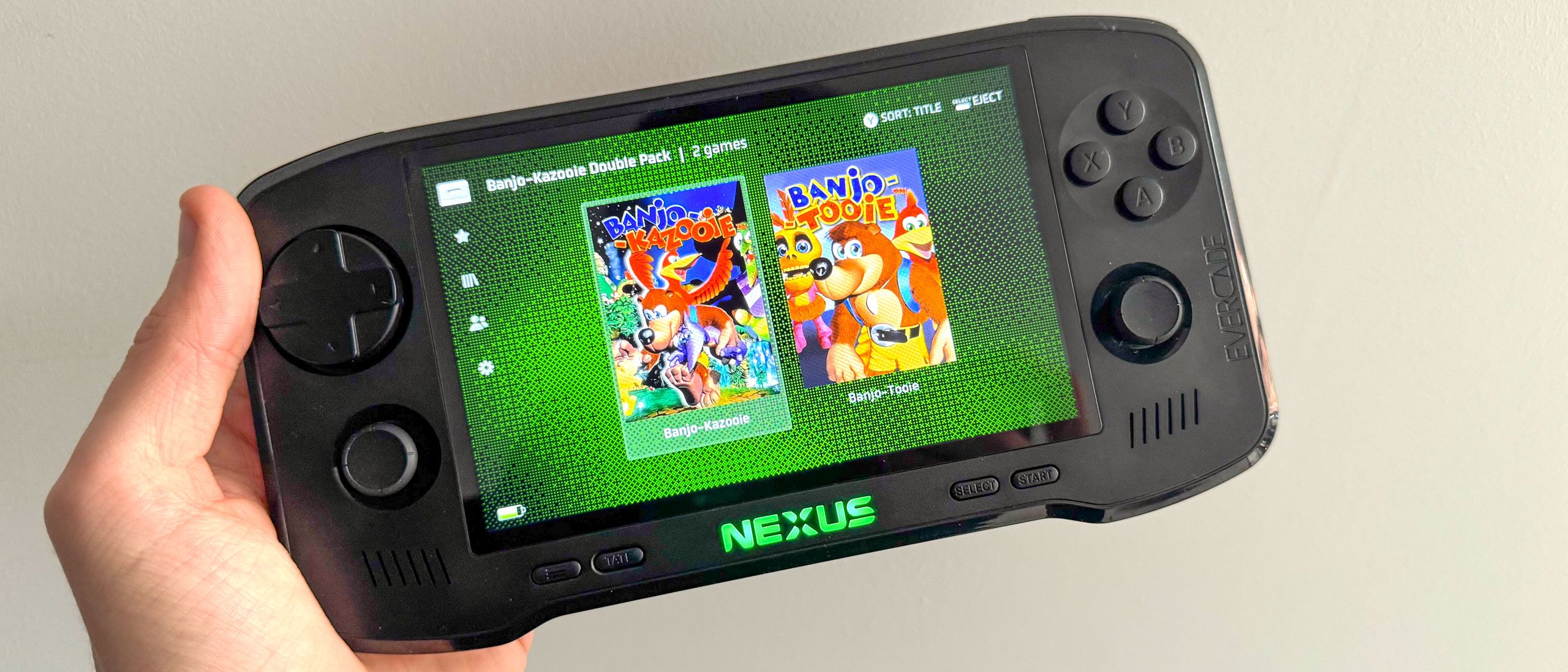
- Bundled with the Banjo-Kazooie Double Pack cartridge
- Full backwards compatibility with the entire Evercade physical cartridge catalog
- Modernized additions include Wi-Fi 6, Bluetooth audio, and EverSync local multiplayer
What they didn’t
- No instant sleep or suspend-and-resume mode
- Lacks an HDMI or external display output port
- Cold boot startup times remain on the slower side
- Analog sticks rely on standard potentiometers rather than Hall effect sensors
Key specs
- Launch price
- $199.99
- Reported price
- $199.99
- Display
- 5.89-inch IPS LCD, 840 x 512 pixels, 5:3 aspect ratio, 500+ nits
- Processor
- 1.5 GHz Quad-Core
- Memory & Storage
- 512MB RAM, 4GB eMMC internal storage
- Battery & Rated Life
- 5,000 mAh lithium-ion (5+ hours rated)
- Media Format
- Evercade proprietary physical cartridges
- Controls
- Dual analog thumbsticks, D-pad, 4 face buttons, 4 shoulder buttons, TATE button
- Connectivity
- Wi-Fi 6, Bluetooth audio, 3.5mm audio jack, USB-C (charging)
- Included Pack-In
- Banjo-Kazooie Double Pack cartridge (Banjo-Kazooie & Banjo-Tooie)
In depth
Performance and game compatibility
The Evercade Nexus uses a 1.5 GHz quad-core processor to handle retro emulation across 8-bit, 16-bit, and 32-bit platforms, alongside native ports for more demanding 64-bit releases. Reviewers agree that classic games run consistently, with titles from Atari, Capcom, and Namco matching arcade and home console pacing. The bundled Banjo-Kazooie Double Pack runs as a dedicated native compilation rather than via an emulator wrapper; Time Extension praised the fluid camera tracking and responsiveness provided by the dual analog controls. The handheld retains full backwards compatibility with the entire back-catalog of more than 80 cartridges. GamesRadar and Time Extension noted that while early review units experienced a few input mapping bugs on legacy 3D titles like 40 Winks and Glover, firmware updates quickly patched these quirks.
Display and controls
The visual upgrade is one of the handheld's headline features. Blaze increased the display size to 5.89 inches at an 840 x 512 resolution, which Time Extension observed delivers a substantial boost in immersion over the older 4.3-inch Evercade EXP, despite a slightly lower pixel density. Measured brightness exceeds 500 nits, which reviewers noted helps colors pop and preserves outdoor visibility. The control arrangement brings dual analog thumbsticks to an Evercade handheld for the first time. Video Games Chronicle and Tom's Guide found the sticks responsive and smooth for 3D navigation, though GamesRadar pointed out that they lack drift-resistant Hall effect sensors. The hardware also carries forward Blaze's dedicated TATE button for quickly rotating controls when playing vertical arcade shoot-'em-ups.
Battery life
Blaze advertises a runtime of 5 or more hours from the 5,000 mAh rechargeable battery. Real-world lab results vary depending on how hard the system is pushed. Tom's Guide recorded just under 4 hours of playtime when running 3D titles like Banjo-Kazooie at default screen and RGB LED brightness settings. Retro Dodo observed between 3 and 5 hours across a spread of mixed gaming sessions, while Video Games Chronicle and Time Extension logged runtimes right around the 5-hour mark when playing lighter 8-bit and 16-bit arcade releases. Recharging is handled via a standard USB-C port.
Comfort and portability
With its larger screen and dual-stick layout, the Nexus adopts a broader, chunkier shell than prior Evercade portables. Reviewers found the textured rear grips helpful for general stability, but Tom's Guide noted the flat chassis can still lead to hand cramping during prolonged sessions due to the absence of deeper ergonomic contours. GamesRadar observed that the bottom placement of both thumbsticks requires thumbs to drop down lower than on modern controller layouts, though Retro Handhelds confirmed that the stereo speakers are angled well enough that resting thumbs never muffle the audio.
Library, storage and software
The Evercade operating system remains clean and focused, sporting a carousel menu displaying box art, developer history, and customizable RGB accents. Connectivity gains a boost thanks to Wi-Fi 6 for faster firmware updates, Bluetooth headphone pairing, and EverSync local wireless networking for multi-device multiplayer without cables. The primary drawback highlighted across Tom's Guide, VGC, and GamesRadar is the continued absence of a true suspend or sleep mode. Tapping the power button cannot instantly pause and resume gameplay; powering down requires a complete shutdown, and users must remember to manually generate a save state before switching off the unit.
Price and total cost
The Evercade Nexus launches at $199.99 (£169.99 / €199.99), putting it at a higher tier than budget models like the Super Pocket and the $129 EXP-R. Reviewers generally agree that the price hike is softened by the pack-in inclusion of the Banjo-Kazooie Double Pack cartridge. However, total investment will climb if you plan to build a larger library, as individual Evercade collection cartridges generally cost between $20 and $30 each. Additionally, because the Nexus drops the mini-HDMI output found on older Evercade portables, users wanting to play their physical cartridges on a television will still need a dedicated home console like the Evercade VS-R.
Is it worth the money?
The package includes the Banjo-Kazooie Double Pack cartridge. Expanding your library requires buying physical licensed cartridges, which typically sell for $20 to $30 each.
Also consider
- Evercade EXP-R
A more affordable, compact entry point to the Evercade cartridge library, though it has a smaller screen and lacks dual analog sticks.
- Retroid Pocket 4
Offers greater raw processing power and broad emulation options via Android at a similar price, but requires manual ROM management instead of physical media.
- Nintendo Switch Lite
Provides a massive handheld gaming catalog and subscription-based classic games, but lacks physical retro compilations and the curated collectible cartridge format.
Reviews we read
This roundup summarizes professional reviews and published specifications; Next Interrupt did not test the product. Roundup updated October 21, 2026. How we work