Wi-Fi & networking / Review roundup
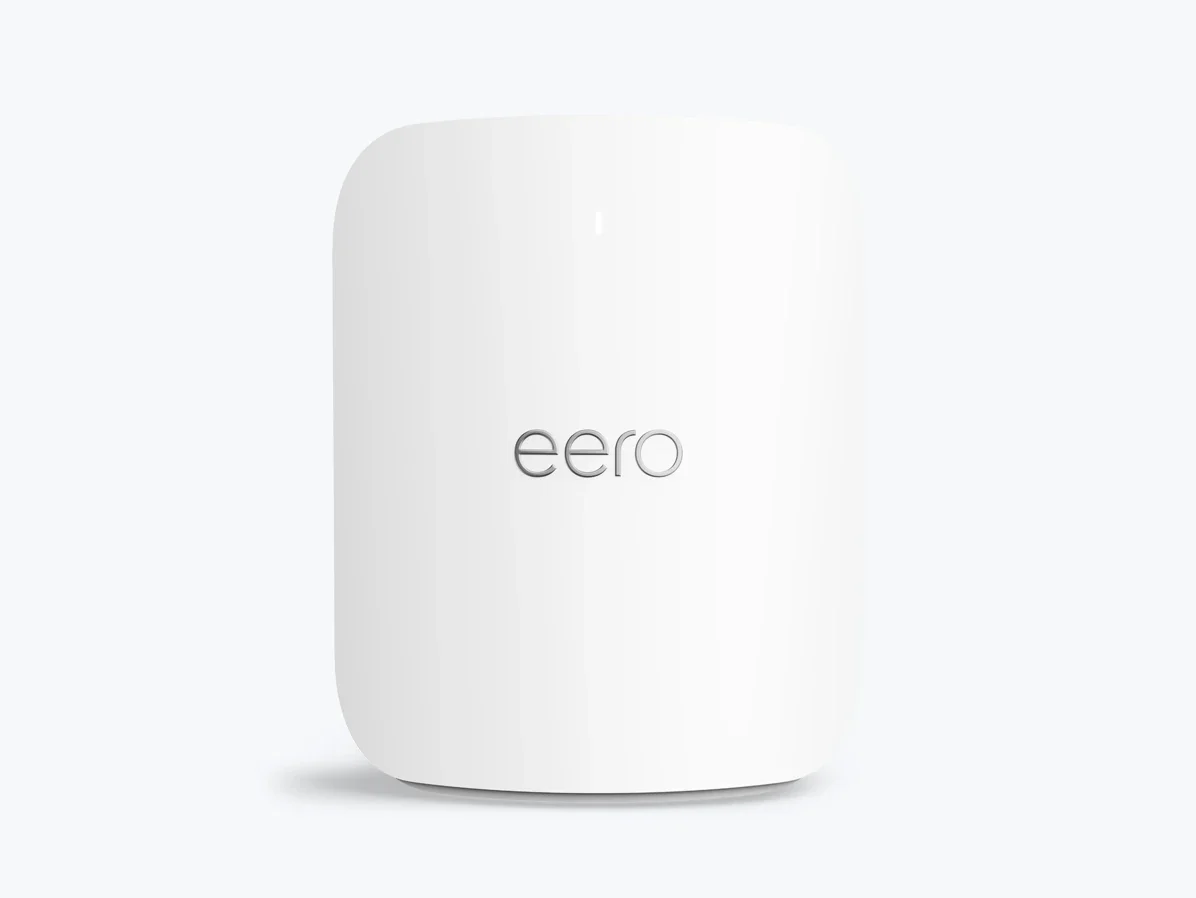
eero Pro 7
One tri-band Wi-Fi 7 unit; mesh packs cost extra
- 4.0 / 5PCMag
- 4.5 / 5Reviews.org
- RecommendedTom's Guide
Fast multi-gig Wi-Fi 7 in a tidy package, tempered by sparse ports and subscription fees
The eero Pro 7 is an appealing mesh solution for households with multi-gigabit broadband who want seamless Wi-Fi 7 performance without complex networking setup. Its greatest asset is close- and mid-range throughput, delivering near-gigabit speeds at 50 feet in professional testing. The main drawback is hardware frugality: each node features only two Ethernet ports and no USB connections, while advanced security and parental controls require an ongoing eero Plus subscription. Compared with the TP-Link Deco BE65 Pro, the eero Pro 7 offers a sleeker physical profile and cleaner software, but yields fewer ports and slower 2.4 GHz transfer rates.
Buy it if
- Homes with 1 Gbps to 5 Gbps internet connections wanting multi-gigabit wireless backhaul
- Smart home users needing an integrated Thread border router, Matter controller, and Zigbee hub
- Buyers who prioritize a simple app-guided setup over granular network tweaking
Skip it if
- You need more than two wired Ethernet connections per room without buying an external network switch
- You want advanced router controls, manual Wi-Fi channel selection, or a local browser interface
- You object to paying monthly or annual subscription fees for parental controls and security tools
Where to buy
We may earn a commission from purchases or qualifying sign-ups through our links. Affiliate links explained
What reviewers liked
- Reached 1,905 Mbps at 15 feet and 994.4 Mbps at 50 feet in Tom's Guide testing
- Dual 5 Gbps auto-sensing Ethernet ports on each unit support multi-gigabit fiber
- Full tri-band Wi-Fi 7 architecture with 320 MHz channel support on 6 GHz
- Built-in smart home hub supports Thread, Matter, and Zigbee devices
- Substantially more compact footprint than rival Wi-Fi 7 desktop units
What they didn’t
- Only two Ethernet ports per unit and no USB data ports for external storage
- 2.4 GHz speeds and long-range 6 GHz throughput fell behind rivals in Tom's Hardware testing
- Key tools including parental controls, ad blocking, and internet backup require eero Plus
- No web browser management interface or separate network SSIDs per frequency band
Key specs
- Launch price
- $299.99 (1-pack), $549.99 (2-pack), $699.99 (3-pack)
- Reported price
- $224.99 to $299.99 (1-pack), $599.99 to $699.99 (3-pack)
- Wi-Fi Standard
- Wi-Fi 7 (802.11be), Tri-Band
- Speed Rating
- BE10800 (theoretical maximum wireless throughput 3.9 Gbps)
- Frequency Bands
- 2.4 GHz (2x2), 5 GHz (2x2), 6 GHz (2x2)
- Wired Ports
- Two auto-sensing 5 GbE ports per unit
- USB Ports
- None (USB-C is dedicated to power input only)
- Rated Coverage
- Up to 2,000 sq ft per unit (6,000 sq ft for a 3-pack)
- Smart Home Integration
- Thread border router, Matter controller, Zigbee hub, Amazon Alexa
- Dimensions
- 7.10 x 5.77 x 3.10 inches (180.4 x 146.6 x 78.7 mm)
In depth
Speed and range in tests
Wireless performance varies notably between testing environments and frequency bands. In Tom's Guide testing, the eero Pro 7 demonstrated class-leading mid-range speed, recording 1.905 Gbps at 15 feet and 994.4 Mbps at 50 feet, which surpassed the TP-Link Deco BE85 (790.4 Mbps). At 75 feet, it retained a usable 234.7 Mbps. Tom's Hardware observed strong close-range 6 GHz throughput at 1,607 Mbps (6 feet), but documented a steeper drop-off over distance, falling over 60 percent to 585 Mbps at 25 feet. Tom's Hardware also found 2.4 GHz speeds underwhelming, measuring 83 Mbps at 6 feet and 55 Mbps at 25 feet uncongested, lagging behind both the Netgear Orbi 770 and the dual-band eero 7. RTINGS verified excellent 6 GHz throughput and low latency, but noted the 5 GHz band has slightly shorter effective range than the older Wi-Fi 6 eero Pro 6.
Coverage for larger homes / mesh
A single eero Pro 7 node provides up to 2,000 square feet of coverage, while a three-pack extends that rating up to 6,000 square feet. Outlets including PCMag and Tech Guide found that multi-node setups blanketed multi-story homes effectively, removing persistent dead spots. Mesh units communicate via dedicated wireless backhaul or over wired connections using either of the 5 Gbps Ethernet jacks. Reviews.org noted that while mesh expansion is simple, client handoff between nodes can occasionally be sluggish when moving through a home, with devices clinging to an upstairs node longer than ideal.
Wi-Fi standard and ports
The Pro 7 implements tri-band Wi-Fi 7 with 2.4 GHz, 5 GHz, and 6 GHz radios, incorporating 320 MHz channels, 4K-QAM, and Multi-Link Operation (MLO). Both onboard Ethernet ports support auto-sensing 5 Gbps speeds, providing headroom for symmetrical multi-gig fiber connections. However, reviewers universally pointed out that two ports per node is restrictive. Once one port is plugged into a fiber ONT or modem, only a single wired jack remains, meaning any setup with multiple wired consoles, desktop PCs, or NAS drives requires an unmanaged switch. There is also no USB port for sharing external hard drives.
App, setup and security features
Setup is handled exclusively through the eero mobile app and takes roughly 15 to 20 minutes. Reviewers at PCMag praised the installation wizard, which pairs nodes and verifies signal health smoothly over Bluetooth. The router serves as a smart home hub with integrated Thread, Matter, and Zigbee radios, linking compatible smart home devices directly. However, power users will find the platform limiting: there is no local web browser dashboard, no support for third-party firmware, no manual Wi-Fi channel selection, and no way to split the 2.4 GHz and 5 GHz networks into discrete SSIDs.
Subscriptions
While basic network controls, device pausing, and WPA3 encryption are included free, Amazon places many features behind a paywall. The eero Plus subscription costs $9.99 per month or $99.99 per year. PCMag, Tom's Hardware, and RTINGS noted that capabilities commonly provided at no charge by competitors—such as content filtering, historical bandwidth analytics, ad blocking, dynamic DNS, and automated mobile backup—are locked behind this tier. The subscription bundles consumer security software, including 1Password and Malwarebytes, but remains a recurring cost for standard router features.
Price
The eero Pro 7 carries a launch price of $299.99 for a standalone unit, $549.99 for a two-pack, and $699.99 for a three-pack. It frequently sells on sale for around $224.99 for a single node and $599.99 for three units. Reviewers consider it a far more sensible purchase than the $1,359.99 eero Max 7 three-pack, but emphasize that competing tri-band Wi-Fi 7 systems from TP-Link undercut its pricing while including more physical ports.
Is it worth the money?
The Pro 7 offers tri-band Wi-Fi 7 at roughly half the cost of the eero Max 7, with frequent 20% to 25% discounts during promotional sales events, though competitors offer more wired ports for the money.
Benchmarks
PERFORMANCE
Benchmarks
Wi-Fi throughput at 15 feet
Higher is better · GbpsTom’s Guide · full test results ↗Published 2025-03-06 · checked 2026-10-10
One tri-band Wi-Fi 7 unit; mesh packs cost extra · Tom’s Guide uses Keysight IxChariot with an Acer Swift Edge 16 in its review home. This is local-network throughput at 15 feet, not an internet-speed guarantee or a whole-home coverage result.
Result for this review’s tested model and settings. Other configurations and test setups can produce different results.
Test data and methodology
| Product | Result | Test scope |
|---|---|---|
| eero Pro 7 | 1.905 | Reviewed model only |
Bars start at zero. Results apply to the tested configuration and settings. Missing products are never assigned zero.
Also consider
- TP-Link Deco BE65 Pro
Provides four multi-gig ports per node and free basic security software at a lower overall pack price.
- Amazon eero Max 7
Adds two 10 GbE and two 2.5 GbE ports per unit with faster theoretical peak throughput for extreme networks.
- Netgear Orbi 770
Delivers superior long-range 6 GHz throughput and faster 2.4 GHz transfer rates, albeit at a higher cost.
Reviews we read
This roundup summarizes professional reviews and published specifications; Next Interrupt did not test the product. Roundup updated October 29, 2026. How we work
- RTINGS — eero Pro 7 Router Review
- PCMag — eero Pro 7 Review: A Solid Wi-Fi 7 Mesh System at a Down-to-Earth Price
- Tom’s Guide — eero Pro 7 review
- Tom’s Hardware — eero Pro 7 review