Wi-Fi & networking / Review roundup
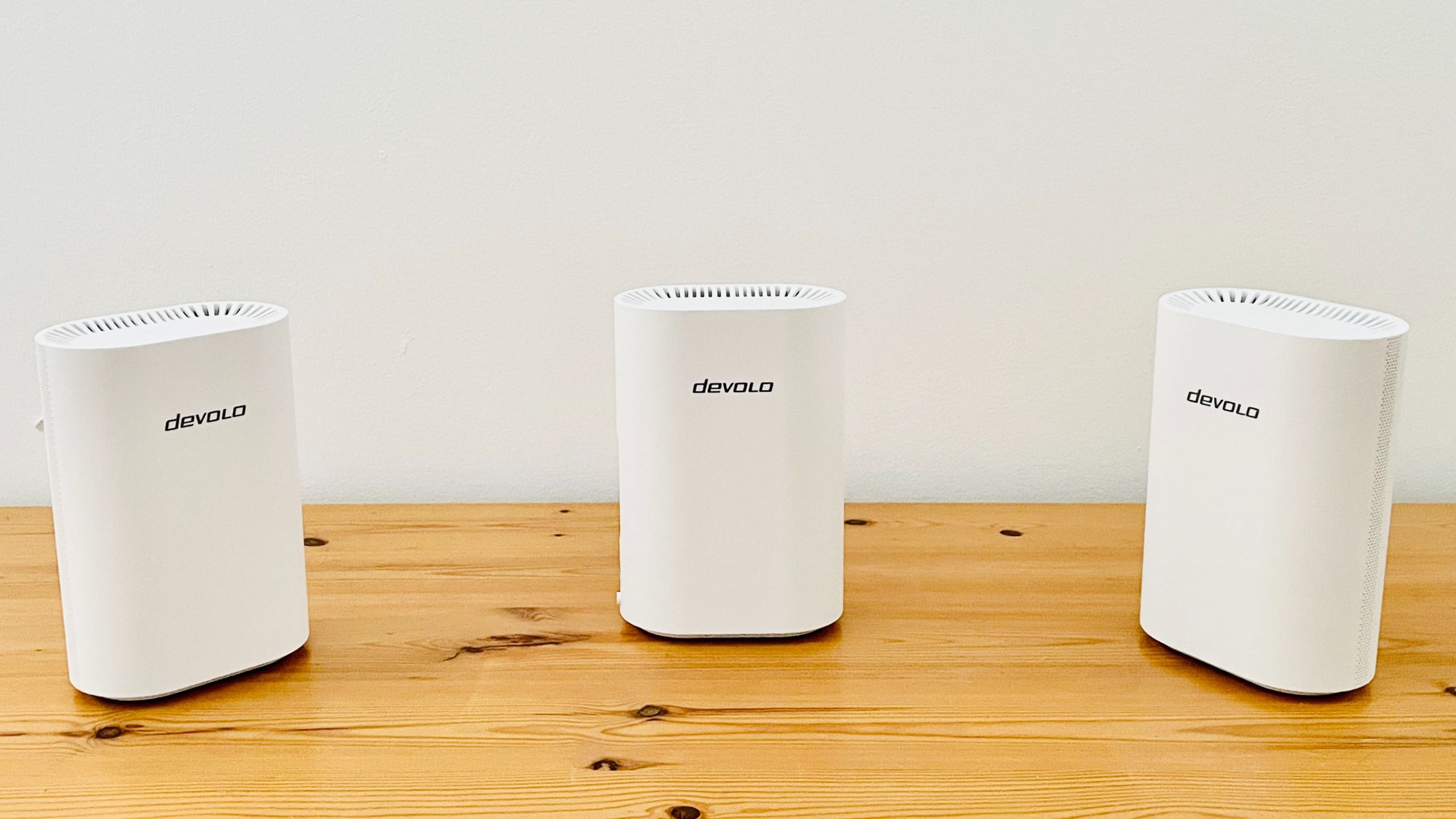
Devolo WiFi 7 Mesh BE6500
three-pack option
- 4 / 5TechRadar
- 3 / 5Expert Reviews
Devolo WiFi 7 Mesh BE6500 review: Budget-friendly multi-room Wi-Fi 7 with a dual-band catch
The Devolo WiFi 7 Mesh BE6500 three-pack is best suited for homeowners looking to eliminate Wi-Fi dead spots across large properties without paying high-tier mesh prices. Its biggest asset is delivering reliable whole-home coverage with a 2.5 Gbps wired backhaul port and the flexibility to access either the 5 GHz or 6 GHz band. However, its major compromise is that it is strictly dual-band, meaning you cannot run 5 GHz and 6 GHz bands simultaneously, and key configuration settings require digging into a web browser. Compared to rivals like the TP-Link Deco BE65, which broadcast three bands simultaneously, Devolo trades simultaneous tri-band flexibility for a lower entry price.
Buy it if
- Multi-story or sprawling homes suffering from stubborn Wi-Fi dead spots
- Households wanting fast 2.5 Gbps wired backhaul to link consoles or PCs
- Shoppers seeking entry-level Wi-Fi 7 mesh without paying tri-band premiums
Skip it if
- You need simultaneous 5 GHz and 6 GHz wireless bands running together
- You prefer app-only network configuration without using a web browser
- You need USB storage sharing directly from your mesh nodes
Where to buy
We may earn a commission from purchases or qualifying sign-ups through our links. Affiliate links explained
What reviewers liked
- Generous port selection with 2.5 Gbps WAN/LAN and three 1 Gbps LAN ports per node
- Flexible dual-band architecture lets you choose between 2.4/5 GHz or 2.4/6 GHz
- Reliable throughput and coverage that successfully clears distant dead zones
- No recurring software subscriptions or paywalled security tiers
What they didn’t
- Cannot broadcast both 5 GHz and 6 GHz bands concurrently
- Crucial network settings like band switching require entering the web browser GUI
- No USB ports on any node for attached network storage
Key specs
- Launch price
- €399.90 (approx. $430 / £349) for the three-pack
- Reported price
- $399 - $430 (imported) / €370 - €400 in Europe
- Wi-Fi Standard
- Wi-Fi 7 (IEEE 802.11be)
- Wireless Bands
- Dual-band selectable (2.4 GHz + 5 GHz OR 2.4 GHz + 6 GHz)
- Theoretical Speed
- Up to 6,500 Mbps (688 Mbps on 2.4 GHz, 2,882 Mbps on 5 GHz, 5,765 Mbps on 6 GHz)
- Ports Per Node
- 1 x 2.5 Gbps RJ-45 WAN/LAN, 3 x 1 Gbps RJ-45 LAN
- USB Ports
- None
- Dimensions
- 175 x 118 x 72 mm per unit
- Pack Size
- Three identical mesh units (1 Controller + 2 Extensions)
- Security
- WPA2 / WPA3 encryption, guest network, client isolation
In depth
Speed and range in tests
TechRadar tested the three-pack system on a 150 Mbps broadband connection and found that at close range (5 feet away), the BE6500 fully saturated the line with 150 Mbps download and upload speeds across both the 2.4 GHz/5.0 GHz and 2.4 GHz/6.0 GHz modes. During a 20 GB Steam download test, speeds briefly dipped to 130 Mbps while moving between rooms in 5 GHz mode, but held steady at 150 Mbps once settled; in 6 GHz mode, speeds remained at an unbroken 150 Mbps even when traversing walls. In local network throughput testing, Expert Reviews recorded close-range download transfers of 84.9 MB/s (roughly 679 Mbps) from a single unit, and maintained 35 MB/s (approximately 280 Mbps) at the farthest reaches of a home. Expert Reviews noted, however, that switching to 6 GHz yielded negligible real-world throughput gains over the 5 GHz band in their test environment.
Coverage for larger homes / mesh
The three-pack kit includes one designated Controller router that links to your broadband modem and two satellite Extension units. In TechRadar's tests, placing one extension halfway down a corridor and a second in an isolated back office completely eliminated a longstanding Wi-Fi dead spot that previously necessitated Powerline adapters. Devolo claims the modular setup can connect up to five nodes in a single system, allowing owners of expansive multi-floor houses to add extra plug-in units if needed. Both TechRadar and Expert Reviews observed stable seamless roaming as client devices transitioned between nodes without dropped connections.
Wi-Fi standard and ports
The BE6500 supports Wi-Fi 7 features including 320 MHz channel widths and 4096-QAM modulation, achieving aggregate theoretical ratings up to 6,500 Mbps. However, unlike premium tri-band mesh systems, the hardware houses only two physical radios. Users must choose between running 2.4 GHz alongside 5.0 GHz (for broad compatibility with Wi-Fi 5 and Wi-Fi 6 gear) or paired with 6.0 GHz (for newer Wi-Fi 6E and Wi-Fi 7 devices). For physical connectivity, each node is well equipped, providing one multi-gigabit 2.5 Gbps Ethernet port and three 1 Gbps Ethernet ports. Expert Reviews observed that while the 2.5 Gbps port is welcome for high-speed fiber or wired backhaul, the system lacks any USB ports for networked printer or storage sharing.
App, setup and security features
Initial setup uses the Devolo Home Network app for Android and iOS via QR code pairing. Both TechRadar and Expert Reviews criticized the software experience as clunky. TechRadar noted that extensions must be paired one at a time and that the mobile app fails to prompt users for their preferred radio frequency configuration during setup. Crucial administrative tasks—including toggling between the 5 GHz and 6 GHz bands, configuring Quality of Service (QoS), and tweaking advanced settings—require logging into the router's browser-based web interface. On the security front, the system provides standard WPA2/WPA3 wireless encryption, guest network isolation, and basic scheduling, but lacks deep malware filtering or automated threat defenses found on some rivals.
Subscriptions
Unlike mesh platforms from Netgear (Netgear Armor) or Amazon (Eero Plus), Devolo imposes no recurring subscription fees. All router features, guest network controls, firmware updates, and basic management options in both the mobile app and the web portal remain completely free to use out of the box.
Price
The Devolo WiFi 7 Mesh BE6500 three-pack carries an official European launch price of €399.90 (around £349 in the UK), while the two-pack sells for €279.90 and individual extension units retail for €149.90 (£130). In the United States, where Devolo primarily sells via specialized importers and online storefronts, the three-pack typically retails around $400 to $430. Reviewers consider it an accessible entry point for whole-home Wi-Fi 7 coverage, though it sits uncomfortably close in cost to true tri-band alternatives that eliminate its dual-band switching restriction.
Is it worth the money?
Significantly cheaper than flagship Wi-Fi 7 systems, but shoppers must weigh the savings against dual-band compromises and the lack of concurrent 5 GHz and 6 GHz operation.
Also consider
- TP-Link Deco BE65
Offers simultaneous tri-band Wi-Fi 7 (2.4 GHz, 5 GHz, and 6 GHz together) with smoother app onboarding at a comparable price point.
- Amazon Eero 7
Delivers a more streamlined mobile app setup and broader US retail availability, though advanced network security requires an optional monthly subscription.
- Netgear Nighthawk RS300
A strong standalone router alternative with concurrent tri-band capabilities if your home layout does not strictly require multi-node mesh coverage.
Reviews we read
This roundup summarizes professional reviews and published specifications; Next Interrupt did not test the product. Roundup updated November 11, 2026. How we work
- TechRadar — Devolo WiFi 7 Mesh BE6500: an affordable mesh Wi-Fi system let down by its app
- Expert Reviews — Devolo BE6500 review: A cheap 6GHz Wi-Fi 7 router with some shortcomings