Keyboards & peripherals / Review roundup
Cherry XTRFY K63W Pro Compact
Cherry XTRFY K63W Pro Compact
- 3.5 / 5TechRadar
- 8 / 10GameRevolution
- 87 / 100Basic Tutorials
Groundbreaking Ultra-Wideband wireless gaming in a slim build, but burdened by steep compromises
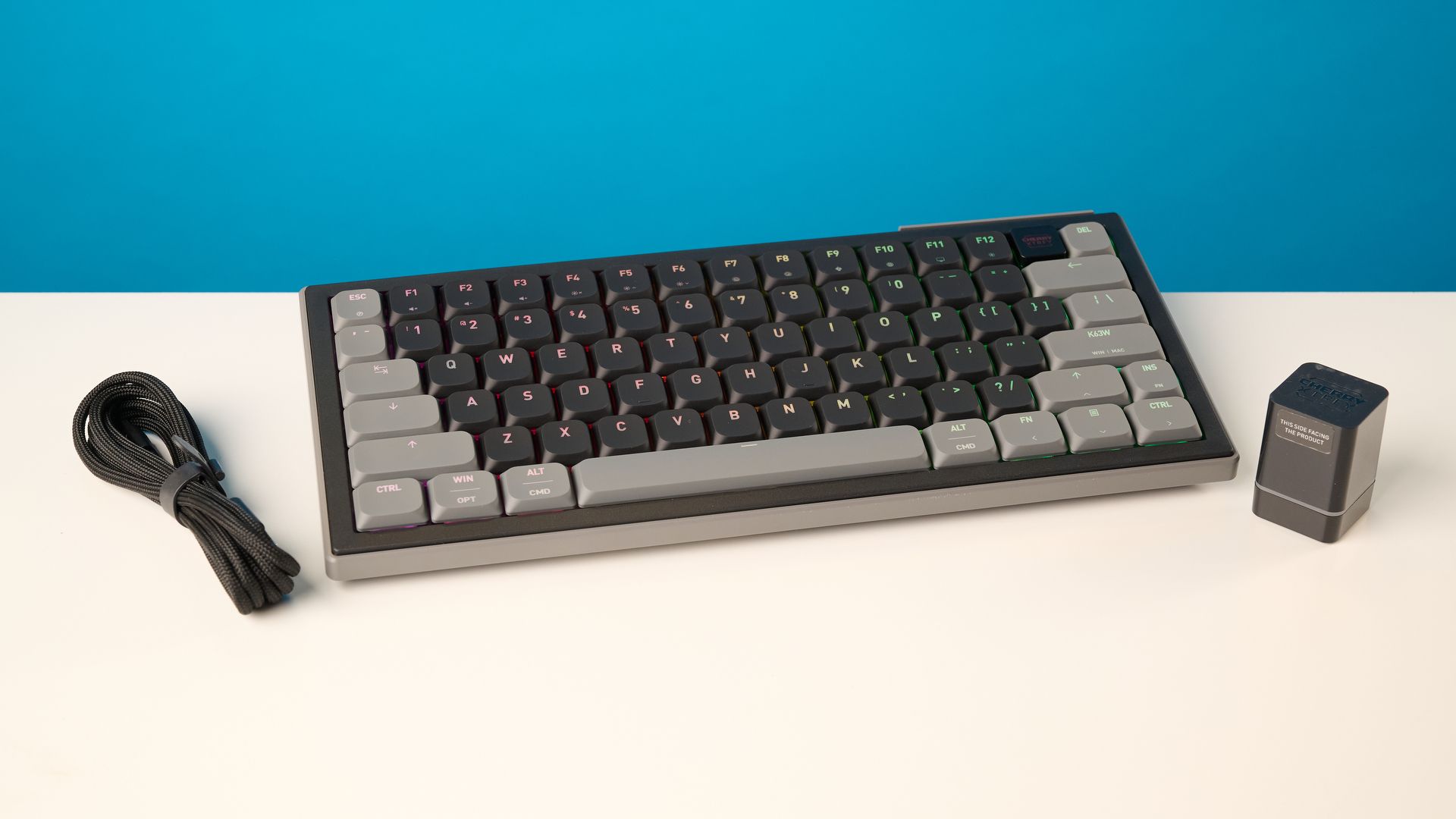
The Cherry XTRFY K63W Pro Compact is best suited for competitive esports players operating in crowded wireless environments who want interference-free 8,000 Hz wireless reporting and exceptional battery life in a low-profile layout. Its standout strength is its groundbreaking Low Energy Ultra-Wideband connection paired with a cushioned gasket mount that gives it an unusually full, pleasant acoustic signature for a slim mechanical keyboard. However, its soldered switches, ABS keycaps, all-plastic housing, and complete lack of Bluetooth make its premium price difficult to swallow. Compared to rivals like the NuPhy Air75 V2 or Keychron wireless offerings, the K63W Pro Compact provides faster wireless reporting tech but lags noticeably in everyday versatility and enthusiast-grade build materials.
Buy it if
- Esports gamers playing in interference-heavy environments who demand true 8,000 Hz wireless polling
- Users who want a cushioned, low-profile mechanical keyboard with immense battery endurance
- Desk minimalists who want a compact 70 percent footprint without sacrificing function keys
Skip it if
- You need Bluetooth to quickly toggle between a gaming PC, laptop, or mobile tablet
- You want hot-swappable switches, PBT keycaps, or an aluminum chassis at a premium price point
- You rely heavily on standard dedicated arrow keys and dislike dual-function modifier tapping
Where to buy
We may earn a commission from purchases or qualifying sign-ups through our links. Affiliate links explained
What reviewers liked
- Ultra-Wideband wireless provides exceptionally fast, interference-free 8,000 Hz polling
- Enormous 6,000 mAh battery delivers up to 1,100 hours of runtime between charges
- Gasket-mounted assembly delivers a softer, deeper sound than typical low-profile boards
- Slim, low-profile case design is inherently comfortable without requiring a wrist rest
- Smooth, pre-lubricated Cherry MX Low Profile 2.0 linear switches
What they didn’t
- All-plastic chassis, ABS keycaps, and soldered switches feel cheap for the premium asking price
- No Bluetooth connectivity limits multi-device productivity
- Bulky standalone desktop wireless puck transmitter is awkward for travel
- Dual-function Mod Tap arrow keys require a steep learning curve and cause accidental inputs
Key specs
- Launch price
- $169.99 - $179.99
- Reported price
- $170 - $180
- Form factor
- 70% compact layout (76 keys)
- Switches
- Cherry MX Low Profile 2.0 Linear (soldered, 1.2 mm pre-travel)
- Connectivity
- Ultra-Wideband (LE-UWB wireless via puck) and wired USB-C
- Polling rate
- Up to 8,000 Hz (wired and wireless)
- Battery capacity
- 6,000 mAh (rated up to 1,100 hours with RGB disabled)
- Mounting style
- Gasket mount with sound dampening
- Keycaps
- Shine-through ABS
- Weight
- Approx. 590 g
In depth
Feel and build quality
The Cherry XTRFY K63W Pro Compact pairs a slim 70 percent form factor with an internal gasket-mount structure, an enthusiast feature rarely seen in low-profile gaming keyboards. Reviewers across the board praise the keyboard's acoustics: Basic Tutorials, Digital Foundry, and GameRevolution all noted that the combination of gasket mounting, sound-dampening materials, and pre-lubed switches produces a surprisingly deep, pleasant 'thock' rather than the thin clatter usual to low-profile decks. However, exterior build materials drew sharp criticism. Tom's Guide pointed out noticeable chassis flex in the all-plastic body, while both Tom's Guide and TechRadar lamented that a deck commanding this price still uses ABS keycaps that attract finger grease rather than durable PBT. Additionally, the switches are permanently soldered to the circuit board, eliminating any option for hot-swapping down the road.
Performance (sensor, switches, latency)
The headline feature of the K63W Pro Compact is its Low Energy Ultra-Wideband (LE-UWB) wireless link, which operates in the uncongested 6 to 8 GHz spectrum alongside a true 8,000 Hz polling rate in both wired and wireless modes. Digital Foundry observed that the UWB transmitter provided flawless input stability even alongside heavy 2.4 GHz interference, while Tom's Guide described gaming responsiveness in fast-paced shooters as superb, helped by Cherry's Last Key Prioritization (LKP) input resolution. The factory-lubricated Cherry MX Low Profile 2.0 switches feature a shallow 1.2 mm actuation point and smooth travel. However, experiences during pure typing were more divided: Tom's Guide found that certain keys felt surprisingly mushy during extended writing sessions, and TechRadar noted that the unique 'Mod Tap' arrow cluster—where tapping acts as arrow keys and holding acts as modifier keys like Shift and Control—frequently triggered accidental inputs until users developed precise finger discipline.
Battery life and connectivity
Cherry fitted the K63W Pro Compact with a massive 6,000 mAh battery, claiming up to 1,100 hours of continuous wireless use with RGB backlighting turned off. While enabling per-key lighting and maximum 8,000 Hz polling pulls that figure down dramatically, reviewers at Digital Foundry, GameRevolution, and Tom's Guide confirmed the board possesses class-leading endurance that allows days of heavy gaming between recharges. Connectivity, on the other hand, is the keyboard's most polarizing attribute. The UWB signal requires a dedicated, oversized desktop receiver puck plugged in via USB-C cable, which TechRadar felt negated the portability of an otherwise travel-friendly compact board. More critically, Tom's Guide, TechRadar, and GameRevolution highlighted the total absence of Bluetooth, making it impossible to quickly switch between a gaming desktop and a laptop or tablet without moving cables or receiver hardware.
Software and customization
Customization is handled through the downloadable Cherry Utility application, which is currently limited to Windows systems. Tom's Guide appreciated the clean, bloat-free design of the interface, which avoids the resource hogging common to competing gaming suites. Within the software, users can fine-tune RGB lighting effects, adjust the wireless polling rate anywhere between 1,000 Hz and 8,000 Hz, remap key assignments, and alter the tap-versus-hold timing threshold for the Mod Tap keys. Even so, TechRadar and Basic Tutorials characterized the software suite as somewhat limited, lacking the granular macro customization or cloud-free web-based ease offered by VIA/QMK web configurators or mature suites like Razer Synapse.
Comfort for long use
Because of its slim chassis and low-profile keys, the K63W Pro Compact keeps the user's wrists at a neutral, near-flat angle to the desk surface. TechRadar noted that the typing angle and subtle keycap slant allow for hours of comfortable gaming and productivity without the need for an external palm rest. Basic Tutorials also highlighted its ergonomics as one of its strongest day-to-day traits, comparing its comfortable feel favorably to benchmark boards like the NuPhy Air75. The main comfort obstacle remains muscle memory: adapting to the tightly packed 70 percent layout and the dual-behavior modifier keys can create hand fatigue during the initial transition period.
Price
With a launch price of $169.99 to $179.99 (£155 in the UK), the K63W Pro Compact commands a noticeable premium in the compact keyboard market. Reviewers broadly agree that while its cutting-edge Ultra-Wideband wireless hardware and massive battery represent genuine technological milestones, the rest of the package does not fully reflect that price tag. Tom's Guide specifically emphasized that an all-plastic build, ABS caps, non-swappable switches, and the absence of Bluetooth make it a tough value sell compared to cheaper alternatives offering full aluminum frames, hot-swap flexibility, and tri-mode wireless connections.
Is it worth the money?
Expensive for a board with an ABS plastic case, non-hot-swappable switches, and no Bluetooth, though competitive if you strictly value interference-proof UWB wireless and 8,000 Hz polling.
Benchmarks
PERFORMANCE
Benchmarks
Reviewer typing accuracy
Higher is better · %Tom’s Guide · full test results ↗Published 2026-10-09 · checked 2026-10-09
Nikita Achanta’s 10fastfingers typing test; possible faulty sample. This is personal test accuracy, not general product accuracy.
Results apply to this publication’s tested models and settings. Check those details before comparing another review.
Test data and methodology
| Product | Result | Test scope |
|---|---|---|
| Cherry XTRFY K63W Pro Compact | 88 | Reviewed model only |
Bars start at zero. Results apply to the tested configuration and settings. Missing products are never assigned zero.
Also consider
- NuPhy Air75 V2
Provides hot-swappable low-profile switches, PBT keycaps, and tri-mode wireless with Bluetooth for a much lower price.
- Razer BlackWidow V4 Pro 75
Offers hot-swappable mechanical switches, richer macro software, and higher build quality, though in a traditional full-height layout.
- Keychron V1 Max
Delivers versatile 2.4 GHz and Bluetooth wireless, QMK web configuration, and hot-swap sockets in a 75 percent format at a significantly lower cost.
Reviews we read
This roundup summarizes professional reviews and published specifications; Next Interrupt did not test the product. Roundup updated November 1, 2026. How we work
- Tom's Guide — The Cherry XTRFY K63W Pro Compact is the world’s first ultra-wideband mechanical gaming keyboard — and it’s as powerful as it’s flawed
- TechRadar — Cherry XTRFY K63W Pro Compact Ultra-Wideband review: a unique keyboard that may prove divisive