Wi-Fi & networking / Review roundup
Asus ROG Rapture GT-BN98
Asus ROG Rapture GT-BN98
- 92%PC Gamer
- 4.9/5HighSpeedInternet.com
- Editor's ChoiceTom's Guide
A draft Wi-Fi 8 router delivering unmatched long-range throughput and dual 10 Gbps ports at a steep price
The Asus ROG Rapture GT-BN98 is built for enthusiast gamers and power users who want the extended range and interference handling of draft Wi-Fi 8 alongside dual 10 Gbps wired ports. Its biggest strength is class-leading signal retention and speed at medium and long distances, easily outperforming previous hardware through walls. The main catch is the steep $899 to $999 price tag and the current absence of native Wi-Fi 8 client devices. Compared to Asus's own Wi-Fi 7 flagship GT-BE19000AI, it trades away a fraction of close-range burst speed in exchange for far stronger multi-room consistency.
Buy it if
- Gamers and power users with multi-gigabit fiber connections needing dual 10 Gbps ports
- Large homes where existing Wi-Fi signals degrade sharply through walls and floors
- Enthusiasts who want advanced networking tools like Docker hosting and free lifetime security
Skip it if
- Shoppers looking for a sensible price-to-performance ratio on standard internet plans
- Users who expect immediate benefits from native Wi-Fi 8 client hardware
- Households wanting a small, discreet piece of home networking gear
Where to buy
We may earn a commission from purchases or qualifying sign-ups through our links. Affiliate links explained
What reviewers liked
- Exceptional throughput at medium to long distances and through interior walls
- Two 10 Gbps Ethernet ports and four 2.5 Gbps Ethernet ports
- Commercial-grade security and parental controls with no recurring subscription fees
- Extensive firmware tools including Docker container support and granular gaming QoS
- Backward compatibility delivers noticeable stability gains to Wi-Fi 7 and 6E clients
What they didn’t
- High price tag between $899 and $999
- No client devices with native Wi-Fi 8 support are currently available
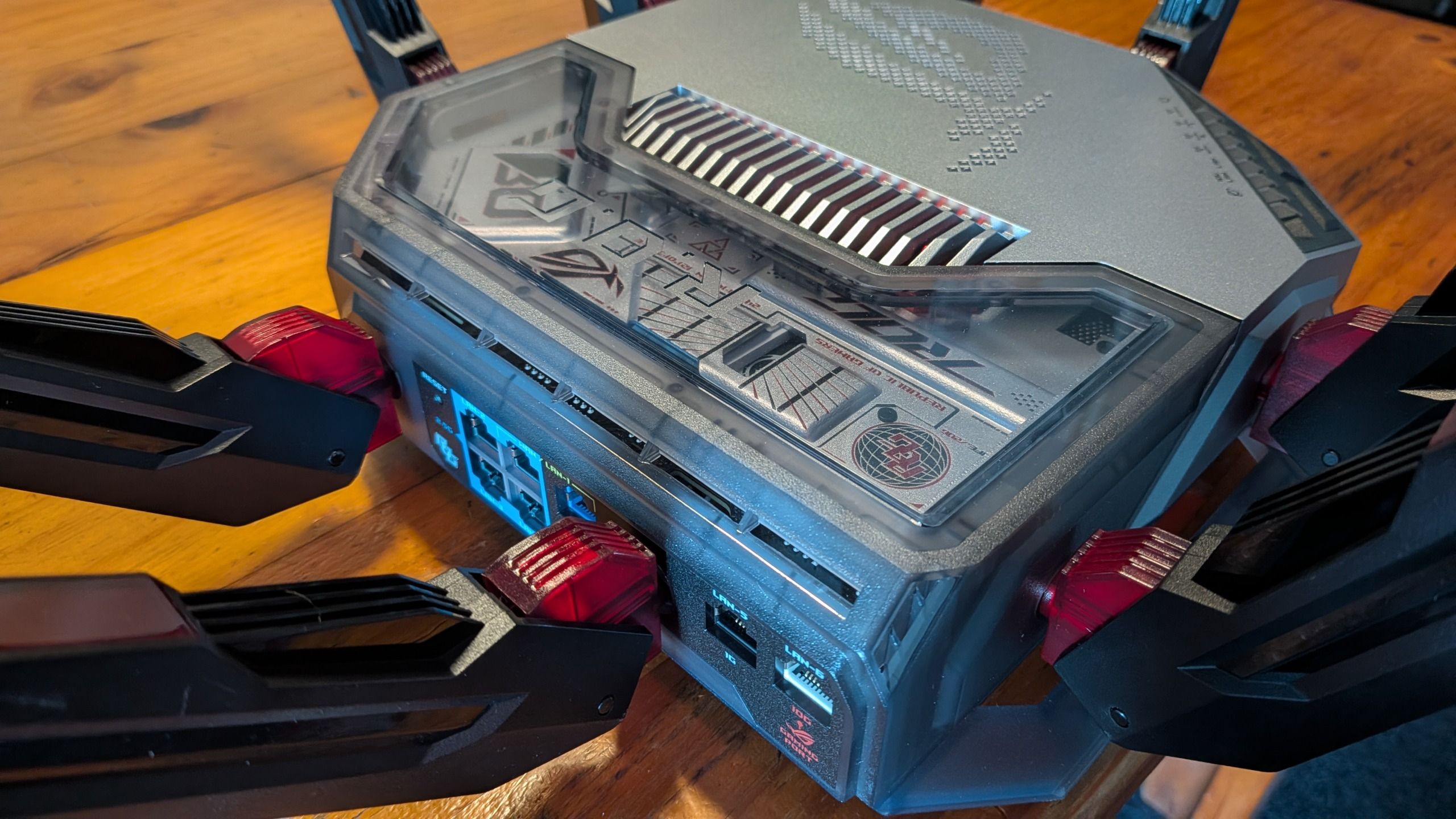
- Bulky footprint with eight non-detachable external antennas
- Relies on proprietary AiMesh rather than open EasyMesh standards
Key specs
- Launch price
- $899.99 to $999.00
- Reported price
- $899.99
- Wi-Fi Standard
- Wi-Fi 8 (IEEE 802.11bn draft), Quad-band
- Total Theoretical Speed
- Up to 24,433 Mbps (BN25000 class)
- Processor
- 2.6 GHz quad-core 64-bit CPU with NPU
- Memory & Storage
- 2 GB DDR4 RAM, 256 MB flash storage
- Multi-Gig Ports
- 2x 10 Gbps (1 WAN/LAN, 1 LAN), 4x 2.5 Gbps (1 WAN/LAN, 3 LAN)
- USB Ports
- 1x USB 3.2 Gen 1, 1x USB 2.0
- Antennas
- 8 external adjustable antennas
- Dimensions
- 350.4 x 350.4 x 220.6 mm (13.8 x 13.8 x 8.7 in with antennas up)
- Peak Power Consumption
- 28 W (measured by Tom's Guide)
In depth
Speed and range in tests
While Wi-Fi 8 is often discussed as a standard focused on reliability over sheer link speeds, reviewers found clear real-world performance gains, especially as distance increases. In Tom's Guide's testing with a Wi-Fi 7 client, the GT-BN98 Pro posted 2.300 Gbps at 15 feet and sustained 2.122 Gbps across 20 feet through an interior wall, more than doubling the through-wall throughput of the TP-Link Archer GE650 (954.9 Mbps). At 75 feet, Tom's Guide recorded 799.7 Mbps, substantially outpacing the Wi-Fi 7 GT-BE19000AI (528.3 Mbps) and Netgear's Nighthawk RS700S (187.6 Mbps). In PC Gamer's tests, the router hit 1,788 Mbps up close. While that sat behind the 3,052 Mbps peak of the mature GT-BE19000AI, the GT-BN98 took a commanding lead two rooms away at 894 Mbps (where Wi-Fi 7 rivals dropped below 500 Mbps) and held 120 Mbps out in the garden compared to 12 Mbps for previous-generation hardware.
Coverage for larger homes and mesh
Standalone wireless coverage is broad, with Tom's Guide verifying reliable connectivity at distances up to 135 feet. However, tester Brian Nadel noted that in a 3,500-square-foot multi-story layout, a couple of dead spots lingered in the basement, indicating that the largest or dense-walled homes may still need mesh support. The router supports Asus AiMesh, allowing users to pair older Asus routers as secondary nodes rather than buying a separate mesh system. HighSpeedInternet.com cautioned, however, that it does not support the vendor-neutral EasyMesh standard, meaning expansion is locked into Asus hardware.
Wi-Fi standard and ports
The router adopts the draft IEEE 802.11bn specification across four frequency bands: 2.4 GHz, two distinct 5 GHz channels, and 6 GHz, using 320 MHz channels, 4096-QAM, and Non-Primary Channel Access (NPCA) to avoid congested channels. Wired multi-gig connectivity is extensive. The back panel provides two 10 Gbps Ethernet ports (one WAN/LAN and one dedicated LAN) alongside four 2.5 Gbps Ethernet ports. USB connectivity consists of one USB 3.2 Gen 1 port and one USB 2.0 port, supporting external hard drives for local storage sharing and 4G/5G mobile phone tethering as WAN backup. Tom's Guide measured peak energy consumption at 28 watts and noted the absence of an idle low-power state.
App, setup and security features
Setup and management can be handled through either the Asus Router mobile app or the AsusWRT 6.0 web console. Reviewers across the board praised the depth of the interface. HighSpeedInternet.com awarded its ease of use a top score, while PC Gamer highlighted features rare on consumer routers, such as Docker and Portainer container support, multi-SSID options, SMB-level VPN tools, and custom network tuning. For gamers, Asus includes Triple-Level Game Acceleration, a dedicated gaming port, packet prioritization, and live ping and packet loss analysis tools to streamline traffic before launching an online match.
Subscriptions and price
A recurring positive across reviews is the absence of recurring subscription fees. Network security and parental controls are handled through AiProtection Pro powered by Trend Micro, which provides malicious site blocking, intrusion prevention, and device-level content controls for free over the life of the router. This stands in contrast to competitors like TP-Link and Netgear, which charge yearly subscriptions for equivalent features. The retail launch price is steep, listing at $899.99 in North America and around $999 (£790 / AU$1,999) in international markets.
Is it worth the money?
The upfront cost is among the highest in consumer networking, but the absence of ongoing subscription fees for security and parental controls offsets long-term ownership costs compared to rival premium brands.
Also consider
- Asus ROG Rapture GT-BE19000AI
Offers faster short-range burst speeds on mature Wi-Fi 7 hardware while costing roughly $560 less.
- TP-Link Archer GE800
A Wi-Fi 7 gaming router featuring dual 10 Gbps ports and dedicated game acceleration at a lower launch price.
- TP-Link Deco BE85
A multi-node Wi-Fi 7 mesh system better suited for eliminating dead zones throughout sprawling, multi-story residences.
Reviews we read
This roundup summarizes professional reviews and published specifications; Next Interrupt did not test the product. Roundup updated October 26, 2026. How we work