CPUs & PC components / Review roundup
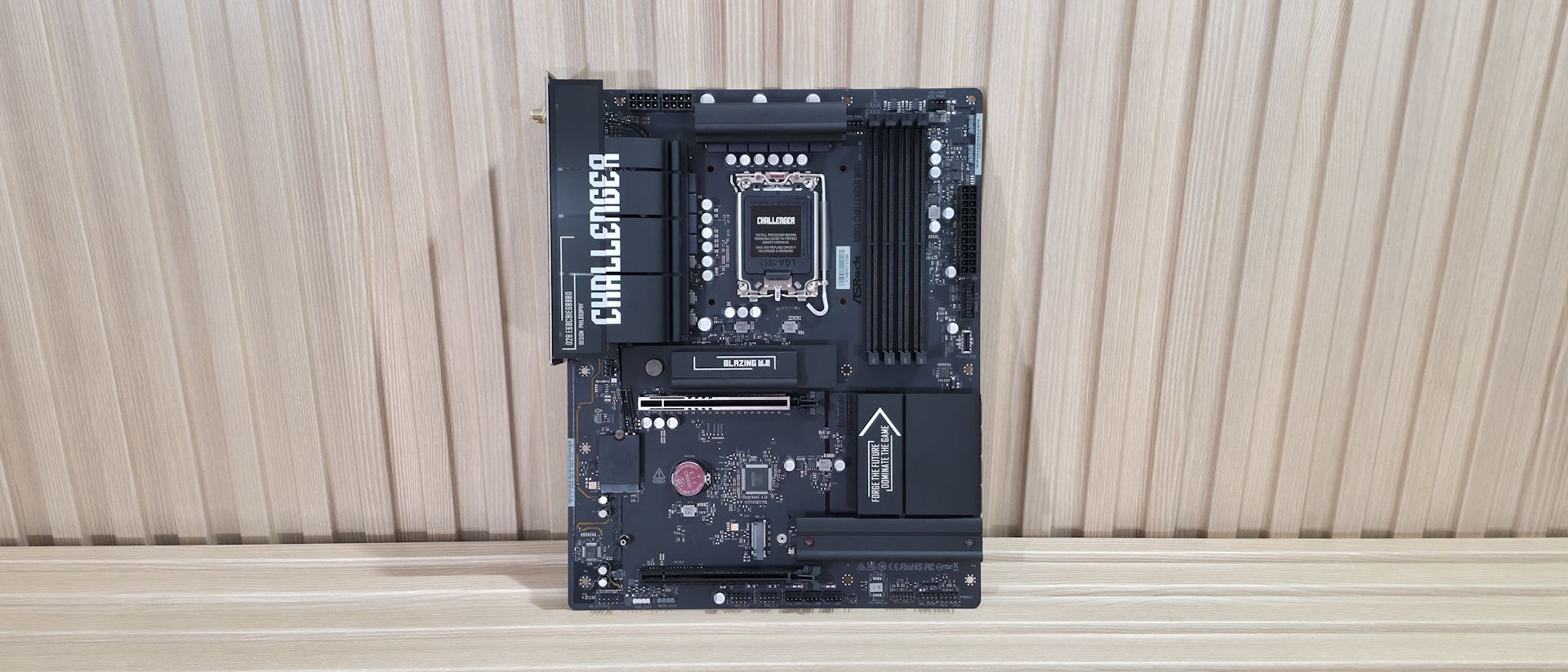
ASRock B860 Challenger Wifi
ASRock B860 Challenger Wifi
- Recommended (Budget)TechPowerUp
A capable entry-level ATX board with PCIe 5.0 and Wi-Fi 7, held back by 5 Gbps USB limits
The ASRock B860 Challenger Wifi is built for budget-conscious builders assembling an Intel Core Ultra system without paying for excess cosmetic features. Its primary advantage is delivering platform essentials—including a PCIe 5.0 graphics slot, a PCIe 5.0 M.2 slot, and Wi-Fi 7—at an entry price around $130 to $150 with zero lane sharing. The main catch is heavy cost-cutting on peripheral connectivity, capping all USB ports and headers at just 5 Gbps while using an entry-level audio codec. Compared to close rivals like ASRock's own B860 Steel Legend or Gigabyte's B860 Gaming X, which add 10 Gbps or 20 Gbps USB ports for $10 to $20 more, the Challenger makes sense only for those watching every dollar.
Buy it if
- Builders seeking the lowest-priced ATX entry point for Intel Core Ultra Series 2 processors
- Gamers wanting both a PCIe 5.0 GPU slot and a PCIe 5.0 NVMe SSD without lane-sharing penalties
- Systems needing modern Wi-Fi 7 networking and abundant fan headers on a tight budget
Skip it if
- You regularly transfer large video files to external SSDs requiring 10 Gbps or 20 Gbps USB speeds
- You want high-grade onboard audio or an optical S/PDIF output for your sound setup
- You intend to overclock your processor, which the B860 chipset does not support
Where to buy
We may earn a commission from purchases or qualifying sign-ups through our links. Affiliate links explained
What reviewers liked
- Low entry price for a full-sized ATX motherboard on the Intel LGA 1851 socket
- Supports PCIe 5.0 on both the primary graphics slot and the main M.2 NVMe slot
- No bandwidth sharing between PCIe slots, M.2 drives, and SATA ports
- Integrated Wi-Fi 7 and 2.5 Gbps Ethernet
- Seven 4-pin fan headers, including high-output 36W headers for liquid cooling pumps
What they didn’t
- All rear and front-panel USB ports are capped at 5 Gbps speeds
- Basic Realtek ALC897 audio codec with only three analog audio jacks
- Firmware interface looks dated compared to competing motherboard brands
- Primary M.2 heatsink can cause double-sided PCIe 5.0 SSDs to throttle under prolonged heavy writes
Key specs
- Launch price
- $149.99
- Reported price
- $129.99 to $139.99
- Form factor
- ATX (305 x 244 mm)
- CPU socket
- Intel LGA 1851
- Chipset
- Intel B860
- Power delivery
- 10+1+1+1 phases with 60A DrMOS power stages
- Memory support
- 4x DDR5 DIMMs, up to 256 GB, up to DDR5-8666+ (OC), CUDIMM supported
- Expansion slots
- 1x PCIe 5.0 x16, 1x PCIe 4.0 x16 (wired x4)
- Storage slots
- 1x M.2 PCIe 5.0 x4, 2x M.2 PCIe 4.0 x4, 4x SATA 6 Gb/s
- Networking
- Realtek RTL8922AE Wi-Fi 7, Bluetooth 5.4, Realtek RTL8125BG 2.5 GbE LAN
- Rear USB connectivity
- 1x USB 3.2 Gen 1 Type-C (5 Gbps), 5x USB 3.2 Gen 1 Type-A (5 Gbps), 2x USB 2.0
- Audio codec
- Realtek ALC897 7.1 HD Audio (3x 3.5 mm analog jacks)
In depth
Gaming performance
Motherboards have minimal direct impact on gaming frame rates, and professional benchmarks show the B860 Challenger Wifi performs on par with higher-end models. In Tom's Hardware testing across titles like Cyberpunk 2077 and F1 25 at 1080p Ultra, frame rates were average to slightly above average compared with other LGA 1851 boards. TechPowerUp observed identical results when evaluating the board against premium Z890 options with a high-end graphics card. The primary PCIe 5.0 x16 slot runs directly off the CPU lanes, guaranteeing that graphics cards receive full theoretical bandwidth without bottlenecking gaming performance.
Productivity and multi-core performance
Despite its entry-level positioning, the board delivers stable processing power during demanding multi-threaded tasks. Tom's Hardware ran the Intel Core Ultra 7 270K Plus through a battery of content-creation and rendering workloads, noting that the board maintained stock turbo frequencies without performance degradation. TechPowerUp tested the flagship 24-core Intel Core Ultra 9 285K and found that rendering and memory scores tracked closely with full-priced Z890 motherboards. Because the Intel B860 chipset locks down CPU multiplier adjustments, manual processor overclocking is not supported, though memory overclocking remains fully accessible.
Power consumption and cooling needs
Power delivery relies on a 10+1+1+1-phase VRM equipped with 60A Vishay DrMOS stages. In TechPowerUp's thermal torture testing, running an Intel Core Ultra 9 285K under continuous full load for over 30 minutes, VRM heatsink temperatures peaked below 75°C in low-airflow conditions. Tom's Hardware noted the VRMs ran warmer than those on thicker, multi-heatpipe boards, but remained safely within acceptable limits. For drive cooling, the board includes toolless heatsinks on two M.2 slots. TechPowerUp found that while PCIe 4.0 SSDs stayed cool, a double-sided PCIe 5.0 SSD exceeded 80°C and began thermal throttling under heavy, sustained writes, making single-sided drives a safer pairing.
Platform: socket, motherboard and memory costs
The board utilizes Intel's LGA 1851 socket, which supports Intel Core Ultra 200 Series desktop processors and requires DDR5 memory. The four DIMM slots support capacities up to 256 GB, CUDIMM memory modules, and speeds exceeding DDR5-8666. Tom's Hardware successfully validated a G.Skill DDR5-8200 kit running stably via XMP. A significant structural plus noted by both Tom's Hardware and TechPowerUp is the complete absence of lane sharing: installing drives in all three M.2 sockets and populating the four SATA ports will not drop the primary GPU slot from x16 to x8 lanes.
Upgrade value versus previous generation
Builders upgrading from an older LGA 1700 or AM4 platform gain modern foundational standards, notably Wi-Fi 7, 2.5 Gbps Ethernet, and native PCIe 5.0 for both graphics and primary storage. However, ASRock reached the board's entry-level price point through substantial connectivity compromises. Tom's Hardware and TechPowerUp both criticized the total omission of USB 3.2 Gen 2 (10 Gbps) and Gen 2x2 (20 Gbps) controllers; every single USB port and front header is capped at 5 Gbps. The audio section also sticks to the basic Realtek ALC897 codec without an optical connection, and the BIOS interface lacks the modern search tools seen on rival platforms.
Price
The ASRock B860 Challenger Wifi carries an official MSRP of $149.99 and frequently sells for $129.99 to $139.99 at retailers like Amazon and Newegg. That makes it one of the most affordable ATX boards on the LGA 1851 platform. However, reviewers caution that small price steps buy meaningful improvements: spending roughly $10 more for ASRock's B860 Steel Legend or around $160 for Gigabyte's B860 Gaming X adds 10 Gbps or 20 Gbps USB ports, higher-grade audio hardware, and more substantial VRM heatsinks.
Is it worth the money?
One of the least expensive full-sized ATX LGA 1851 motherboards available, but stepping up $10 to $20 to competing models buys substantially faster USB ports and better audio.
Also consider
- ASRock B860 Steel Legend WiFi
Costs about $10 to $15 more while providing a 20 Gbps Type-C header, upgraded Realtek ALC1220 audio, and beefier heatsinks, though it downgrades to Wi-Fi 6.
- Gigabyte B860 Gaming X Wifi 6E
Priced around $160 and includes native 10 Gbps USB ports for builders who regularly transfer files via external storage.
- Asus TUF Gaming B860-Plus Wifi
Retails around $200 and brings more robust power stages, 20 Gbps USB-C connectivity, and expanded DIY hardware-latching features.
Reviews we read
This roundup summarizes professional reviews and published specifications; Next Interrupt did not test the product. Roundup updated November 1, 2026. How we work