Monitors & TVs / Review roundup
Alienware AW3226Q
Alienware AW3226Q
- 90%PC Gamer
- 4.0/5PCMag
A flat 4K Tandem OLED that delivers clean text and stellar contrast at an approachable price
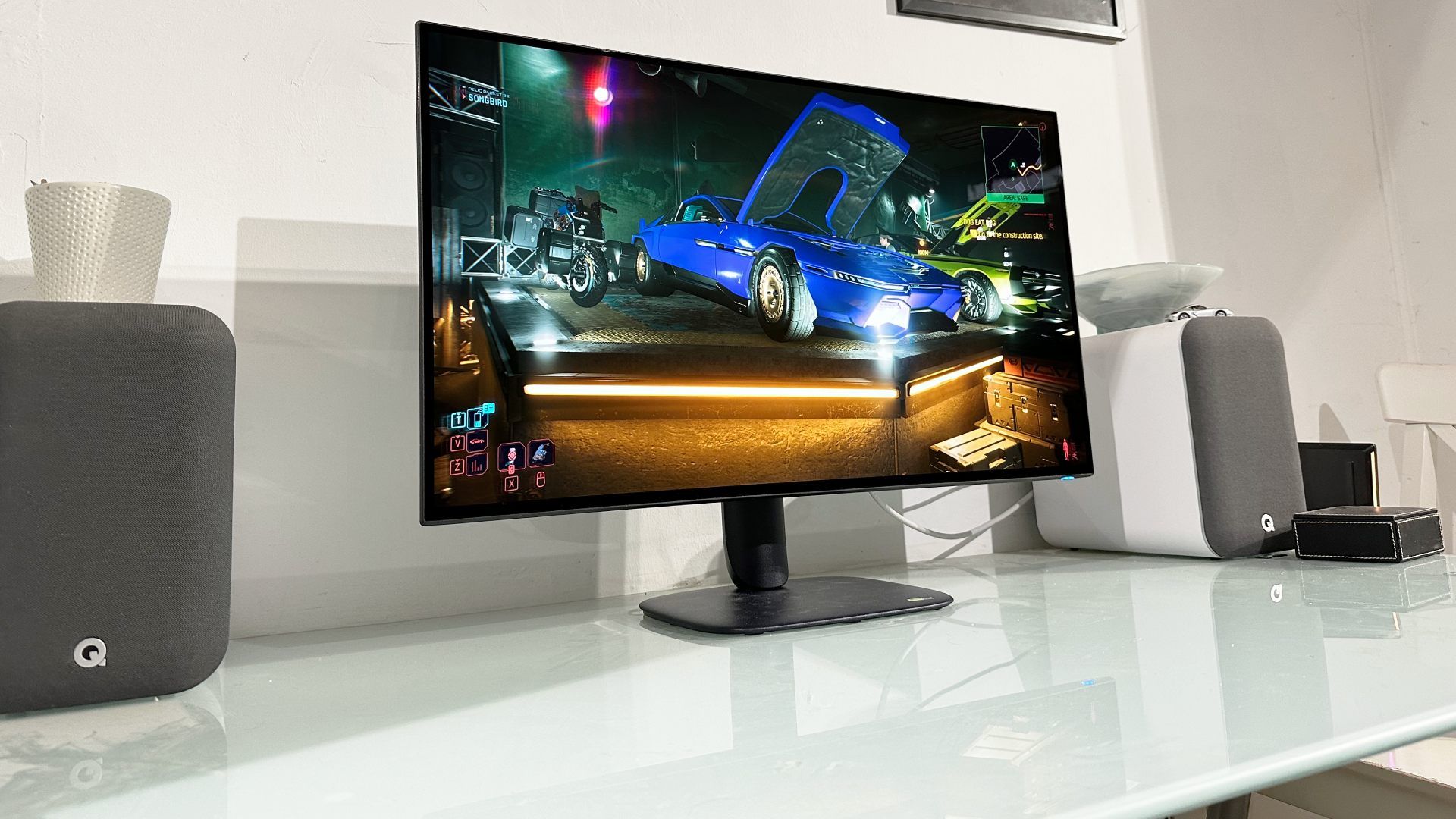
The Alienware AW3226Q is an ideal display for gamers who spend substantial working hours reading and writing at the same desk. Its standout strength is LG's flat Tandem WOLED panel with an RGB-stripe layout, which eliminates the color fringing on text that plagued earlier OLED displays while maintaining infinite contrast. The main compromise is speed, as the refresh rate tops out at 165Hz instead of the 240Hz common among competitors, and there is no USB-C display input. Compared to Alienware's curved AW3225QF, the AW3226Q trades away 240Hz motion for a flat profile, crisper typography, deeper blacks under room lighting, and a lower price tag.
Buy it if
- Gamers seeking a 32-inch 4K OLED that doubles as a comfortable text-based work monitor
- Players who prefer a traditional flat screen over aggressive curves
- Buyers wanting OLED contrast without paying four-figure flagship prices
Skip it if
- Competitive esports players who require 240Hz or higher refresh rates
- Laptop users looking for single-cable USB-C display input with high-wattage charging
Where to buy
We may earn a commission from purchases or qualifying sign-ups through our links. Affiliate links explained
What reviewers liked
- RGB-stripe tandem panel eliminates color fringing on desktop text
- Glossy screen preserves deep black levels in brightly lit rooms
- Near-instantaneous 0.03ms pixel response time eliminates ghosting
- Factory calibrated with wide 99% DCI-P3 coverage and infinite contrast
- Three-year warranty includes burn-in coverage
What they didn’t
- 165Hz refresh rate falls short of 240Hz rivals
- No USB-C DisplayPort Alt Mode or high-power laptop charging
- Factory gamma tracks slightly light with limited simultaneous OSD adjustments
Key specs
- Launch price
- $699.99
- Reported price
- $699.99
- Screen Size
- 31.5 inches (flat)
- Resolution
- 3840 x 2160 (4K UHD)
- Panel Type
- Tandem WOLED (RGB-stripe subpixel layout)
- Refresh Rate
- 165Hz
- Response Time
- 0.03ms GtG
- Peak Brightness
- 250 nits typical SDR; 1,000 nits peak HDR (3% window)
- Variable Refresh Rate
- AMD FreeSync Premium Pro, Nvidia G-Sync Compatible, VESA AdaptiveSync
- Video Ports
- 2x HDMI 2.1 (FRL), 1x DisplayPort 1.4
- USB Ports
- 1x USB-B upstream, 3x USB-A downstream, 1x USB-C downstream (15W)
- Warranty
- 3 years (includes OLED burn-in coverage)
In depth
Picture quality: brightness, contrast, colour
Reviewers highlight the transition from QD-OLED to LG Display's Tandem WOLED panel featuring a standard RGB-stripe subpixel arrangement. PCWorld and TFTCentral note that this structure solves OLED text fringing, producing crisp fonts comparable to standard LCDs. In Tom's Hardware bench testing, the display registered 276 nits on both a full-white SDR field and a 25% window, exhibiting solid full-field stability without aggressive automatic dimming. Tom's Hardware also measured 100% coverage of the DCI-P3 color gamut with hue points landing accurately on target, though reviewer Christian Eberle observed that factory gamma tracked slightly light at 2.02 to 2.05 against the 2.2 standard. Eberle noted that while Custom Color mode lowered grayscale errors to a negligible 0.55 Delta-E, the OSD lacks simultaneous RGB gain and gamma preset tuning.
Motion, refresh rate and gaming features
The AW3226Q pairs a 165Hz refresh rate with a rated 0.03ms gray-to-gray response time. Reviewers at PC Gamer and PCMag found motion handling exceptionally clean, with imperceptible ghosting and swift input latency. Adaptive sync support is comprehensive, carrying Nvidia G-Sync Compatible, AMD FreeSync Premium Pro, and VESA AdaptiveSync certifications. While 165Hz is more than fast enough for demanding 4K AAA titles, PC Gamer pointed out that competitive shooter enthusiasts may miss the fluid motion of rival 240Hz 4K panels. The monitor also includes an esports scaling mode that crops the active display area down to 25 or 27 inches, though it remains capped at 165Hz rather than offering a higher frame rate dual-mode toggle.
HDR performance
Bearing VESA DisplayHDR True Black 400 and Dolby Vision certifications, the monitor leverages per-pixel self-emissive dimming to provide zero haloing and true blacks. Tom's Hardware recorded a brightness of 402 nits across a 25% HDR window in Peak 1000 Bright mode, while small 3% specular highlights reach the panel's rated 1,000-nit threshold. PC Gamer noted that full-screen HDR brightness is somewhat lower than Alienware's 39-inch tandem OLED model, but emphasized that the absence of a dedicated white subpixel maintains rich color saturation in bright scenes. Both Tom's Hardware and PCMag found HDR gaming and video playback deeply immersive, praising the balanced tonemapping and clean shadow detail.
Design, stand and ports
The AW3226Q features a flat display surface with minimal four-sided bezels and a sturdy stand offering height, tilt, and swivel adjustments, though it lacks portrait pivot. Video connectivity comprises two HDMI 2.1 ports and one DisplayPort 1.4 connection. For peripherals, there is a USB-B upstream port feeding three USB-A ports and a bottom-mounted USB-C port. Reviewers across the board, including PC Gamer and PCWorld, expressed frustration that the USB-C port is downstream-only, providing 15W charging without DisplayPort Alt Mode video input or KVM switching, meaning laptop owners cannot rely on a single-cable workstation setup.
Viewing angles, reflections and burn-in risk
Unlike QD-OLED monitors whose black levels can turn dark purplish when exposed to ambient room light, TFTCentral and TechSpot reported that the AW3226Q's Tandem WOLED panel maintains true ink-black contrast in illuminated spaces. The screen uses a glossy finish, which delivers vibrant clarity but can reflect sharp light sources positioned directly behind the viewer. Off-axis viewing angles remain broad, though reviewers noted subtle edge dimming attributed to the monitor's power-regulation circuitry. To mitigate long-term burn-in concerns, Dell includes automated pixel refresh cycles, machine-learning panel protection algorithms, and a standard three-year warranty that covers burn-in.
Price
Dell launched the Alienware AW3226Q at $699.99 in the United States and £649 in the United Kingdom. Professional reviewers universally emphasize value as the monitor's defining attribute. At launch, competing 32-inch 4K OLED screens typically commanded $900 to $1,300, making the AW3226Q one of the least expensive ways to put a premium 4K OLED on a desk. Both PC Gamer and PCMag judged the drop from 240Hz to 165Hz and the omitted USB-C display input as sensible, well-calculated compromises that allow everyday buyers to access cutting-edge tandem OLED picture quality.
Is it worth the money?
At $699.99, the AW3226Q undercuts most competing 32-inch 4K OLED monitors by several hundred dollars, making it one of the strongest values in its class despite the lower 165Hz ceiling.
Also consider
- Alienware AW3225QF
Offers a faster 240Hz refresh rate and a 1700R curved QD-OLED screen, but costs more and suffers from slight text fringing and raised blacks in bright rooms.
- MSI MPG 321URX
Provides 240Hz gaming, a built-in KVM switch, and 90W USB-C power delivery, though at a significantly higher retail price.
- Asus ROG Swift OLED PG32UCWM
Features a similar RGB-stripe Tandem WOLED panel with a faster 240Hz refresh rate and DisplayPort 2.1, but retails near $1,299.
Reviews we read
This roundup summarizes professional reviews and published specifications; Next Interrupt did not test the product. Roundup updated November 11, 2026. How we work