Monitors & TVs / Review roundup
Alienware AW3226Q
AW3226Q
- 90/100PC Gamer
- 4/5Tom's Hardware
- 4/5PCMag
A flat 4K OLED monitor that nails text clarity and price by scaling back refresh rate
The Alienware AW3226Q is built for mixed-use setups where everyday desktop work matters just as much as immersive gaming. Its primary asset is the tandem WOLED panel with a standard RGB stripe subpixel structure, which banishes the text fringing seen on earlier OLEDs. The catch is that refresh rate tops out at 165Hz and the USB-C port does not carry video or charge a laptop. Buyers seeking maximum competitive speed can step up to 240Hz models like the curved Alienware AW3225QF or Asus ROG Swift PG32UCDM, but the AW3226Q undercuts them significantly while offering a cleaner desktop picture.
Buy it if
- Gamers who also spend full workdays reading text, writing code, or browsing
- Console and PC gamers looking for deep 4K OLED contrast under $750
- Users who dislike curved panels and prefer a standard flat 32-inch screen
Skip it if
- Competitive esports players who need 240Hz or higher refresh rates
- Laptop users who want single-cable USB-C display input and 90W charging
- Users in extremely sunlit rooms who require sustained full-screen brightness above 350 nits
Where to buy
We may earn a commission from purchases or qualifying sign-ups through our links. Affiliate links explained
What reviewers liked
- Standard RGB stripe layout eliminates color fringing on fine desktop text
- Excellent value for a flat 32-inch 4K OLED display
- Flawless black levels and infinite native contrast
- Glossy anti-reflective panel avoids the magenta tint of QD-OLED under ambient light
- Three-year warranty covering burn-in with advance replacement
What they didn’t
- Refresh rate maxes out at 165Hz rather than 240Hz
- USB-C port is data and 15W power only, with no DisplayPort Alt Mode
- Sustained full-field brightness is modest at roughly 250 to 275 nits
Key specs
- Launch price
- $699.99
- Reported price
- $699.99
- Screen Size
- 31.5 inches (flat)
- Panel Type
- LG Tandem WOLED with RGB stripe subpixel structure
- Resolution
- 3840 x 2160 (4K UHD, 140 ppi)
- Refresh Rate
- 165Hz
- Response Time
- 0.03 ms GtG
- Variable Refresh Rate
- Nvidia G-Sync Compatible, AMD FreeSync Premium Pro, VESA AdaptiveSync
- Brightness
- 250 nits typical SDR, 1,000 nits peak HDR (3% window)
- HDR Certification
- VESA DisplayHDR True Black 400, Dolby Vision, HDR10
- Ports
- 2x HDMI 2.1 (one with eARC), 1x DisplayPort 1.4, 1x USB-B 5Gbps upstream, 2x USB-A 5Gbps, 1x USB-C 5Gbps (15W), 3.5mm audio out
- Stand Adjustability
- 110 mm height, -5° to 21° tilt, -20° to 20° swivel, 100 x 100 mm VESA
- Weight
- Approx. 13.7 lb without stand (22.5 lb with stand and packaging)
- Warranty
- 3 years with advance exchange and burn-in coverage
In depth
Picture quality: brightness, contrast, colour
The core talking point across reviews is the panel architecture: LG Display's tandem WOLED technology arranged in a standard RGB stripe subpixel layout. Unlike older QD-OLED and WRGB displays that produced slight color fringing around small typography, PC Gamer and TFTCentral noted that text on the AW3226Q looks as crisp as on an LCD. In SDR testing, Tom's Hardware recorded 276 nits on both full-screen white fields and 25% windows, while PC Gamer highlighted true zero-nit black levels and neutral color balance without the greenish cast that troubled early WOLED generations. Color coverage reaches 99% of DCI-P3 with factory-calibrated Delta E numbers below 2, though Tom's Hardware noted the lack of deep manual gamma calibration controls in the menu.
Motion, refresh rate and gaming features
Alienware chose a 165Hz refresh rate instead of the 240Hz rate typical of pricier 32-inch 4K OLED screens. Reviewers at PC Gamer and Tom's Hardware agree that this compromise is sensible for the vast majority of PC and console setups, where reaching 165 fps at native 4K already requires flagship graphics hardware. Motion clarity remains sharp due to the 0.03 ms pixel response time, which completely prevents ghosting. Variable refresh rate synchronization is certified across Nvidia G-Sync Compatible, AMD FreeSync Premium Pro, and VESA AdaptiveSync. For competitive sessions, reviewers observed an esports mode that crops the active image to standard 24.5-inch or 27-inch frames.
HDR performance
The monitor carries VESA DisplayHDR True Black 400 certification and supports both HDR10 and Dolby Vision. PC Gamer and Tom's Hardware both found HDR highlights punchy, with small specular elements reaching 1,000 nits on a 3% test window. Tom's Hardware measured 402 nits on a 25% HDR window. While broad, daylight-heavy scenes are visibly held back by automatic brightness limiting compared to high-end Mini LED monitors, dark games like Control Resonant and Gears of War benefit from infinite contrast and absence of backlight blooming around highlights.
Design, stand and ports
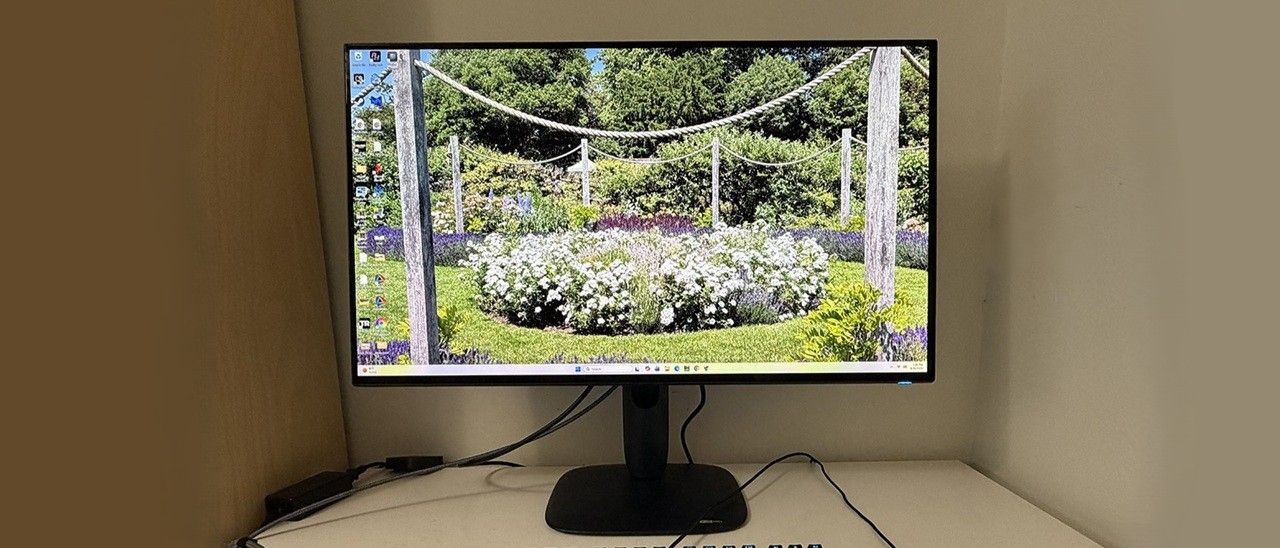
The AW3226Q features a flat display surface with thin bezels on all four sides, abandoning the 1700R curvature of the AW3225QF. The included stand offers 110 mm of height travel, 26 degrees of tilt, and 40 degrees of swivel, with a 100 x 100 mm VESA mounting pattern. Port selection includes two HDMI 2.1 ports (one supporting eARC for soundbars), one DisplayPort 1.4 connection, and a USB hub. The prominent drawback noted by PCMag and Silikode is the lack of full USB-C DisplayPort Alt Mode: the front USB-C port supplies only data and 15W of charging, meaning single-cable video and power delivery for laptops is unsupported. The monitor also lacks built-in speakers.
Viewing angles, reflections and burn-in risk
The panel uses a glossy anti-reflective treatment. PC Gamer appreciated that, unlike first- and second-generation QD-OLED screens that turned purplish and lifted black levels in bright lighting, the AW3226Q maintains true black tones under room ambient light. Viewing angles are wide with minimal luminance drop-off. Early firmware units exhibited subtle edge dimming due to LG's Constant Power Control algorithm, but Alienware addressed this behavior via firmware updates that introduce an edge-dimming toggle. Dell includes a three-year warranty that directly covers OLED pixel burn-in with replacement shipping.
Price
Dell launched the Alienware AW3226Q at $699.99 in the US, with international pricing at £649 in the UK and €749 in Europe. Because 32-inch 4K OLED gaming monitors originally debuted around $1,000 to $1,300, reviewers at PC Gamer, Tom's Hardware, and PCMag consistently cited the $699 sticker as the monitor's strongest market argument.
Is it worth the money?
Positions standard-layout 4K OLED well below the $900-to-$1,200 tier by trading 240Hz speed down to 165Hz.
Also consider
- Alienware AW3225QF
Provides a curved 1700R QD-OLED screen with a 240Hz refresh rate, suited for fast-action gaming if you do not mind text fringing on desktop work.
- MSI MPG 321URX
A 32-inch 4K 240Hz QD-OLED that includes a USB-C connection with 90W power delivery and a built-in KVM switch.
- Asus ROG Swift OLED PG32UCWM
Features a similar RGB-stripe tandem WOLED panel but adds dual-mode switching to 480Hz at 1080p and high-wattage laptop charging for a higher price.
Reviews we read
This roundup summarizes professional reviews and published specifications; Next Interrupt did not test the product. Roundup updated November 10, 2026. How we work
- Tom's Hardware — Alienware AW3226Q 32-inch 4K OLED gaming monitor review: Sleek design with performance and value to match
- PC Gamer — Alienware AW3226Q OLED gaming monitor review
- PCMag — Alienware 32 4K OLED (AW3226Q) Review: Premium OLED, Not-So-Premium Price
- TFTCentral — Alienware AW3226Q Review