Consoles & handhelds / Review roundup
Acer Predator Atlas 8
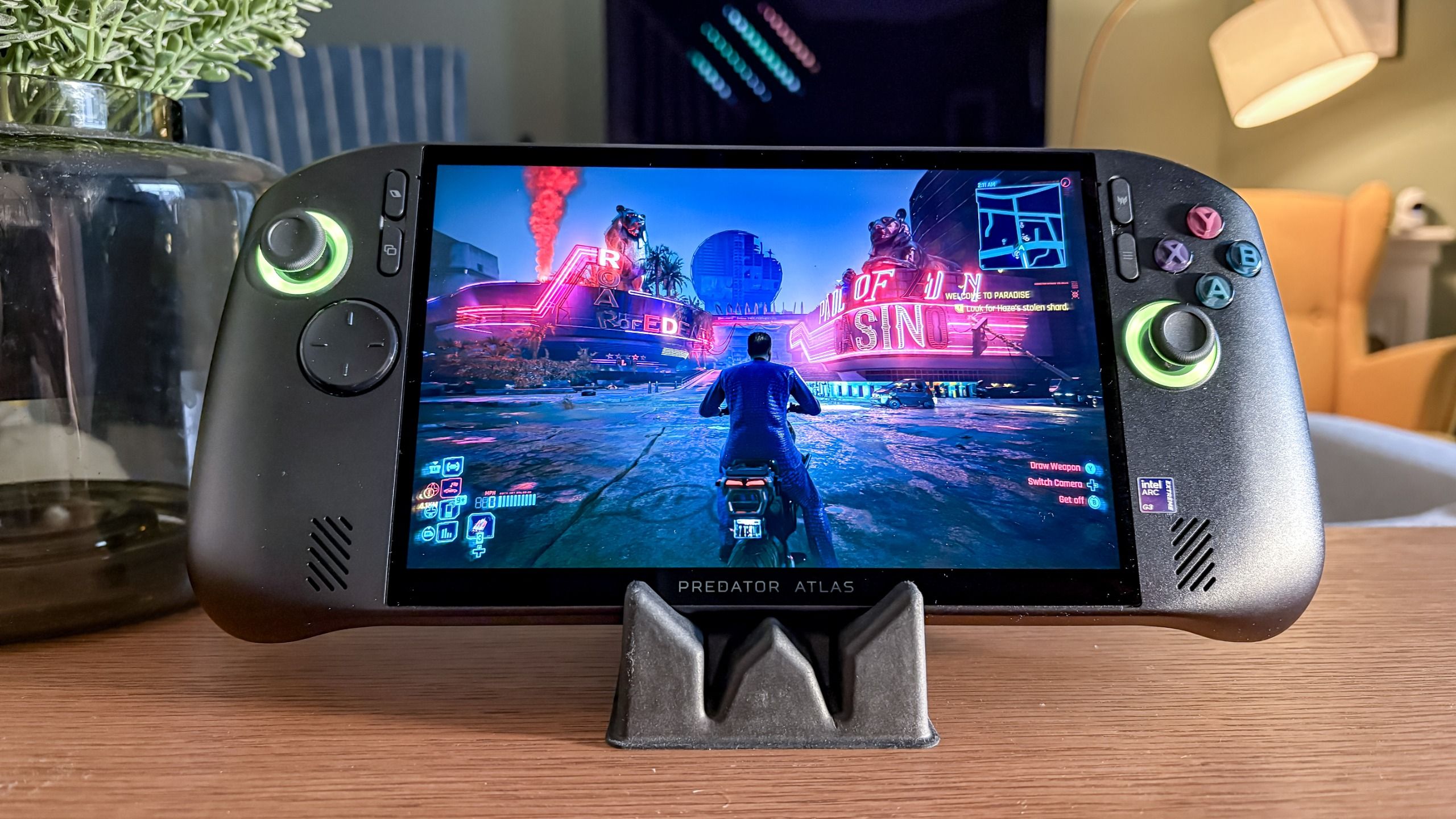
Acer Predator Atlas 8 (tested)
- 4.5/5PC Guide
A fast, large-screen Windows handheld with strong graphical speed, let down by hefty bulk and spongy controls
The Acer Predator Atlas 8 is a compelling option for portable PC players who prioritize desktop-class frame rates and a roomy 8-inch screen over compact travel dimensions. Its chief advantage is the Intel Arc G3 Extreme processor, which delivers substantial frame-rate leads over older AMD-based portables while drawing from an 80Wh battery. The biggest trade-offs are an 810-gram carrying weight, unrefined haptics, and recurring Windows navigation friction. Compared to the MSI Claw 8 EX AI+, the Atlas 8 offers matching core hardware at a noticeably lower introductory price point.
Buy it if
- Gamers seeking high frame rates and a spacious 8-inch 120Hz VRR panel
- Players running multi-store libraries across Steam, PC Game Pass, and Epic
- Handheld gamers who mostly play seated on a couch or with arm support
Skip it if
- You need a compact, lightweight handheld for one-handed commute play
- You prefer the seamless suspend-and-resume simplicity of SteamOS
- You demand true OLED contrast and deep black levels
Where to buy
We may earn a commission from purchases or qualifying sign-ups through our links. Affiliate links explained
What reviewers liked
- Intel Arc G3 Extreme delivers substantial frame-rate advantages over prior handheld chips
- Smooth 8-inch 1920x1200 IPS display with 120Hz refresh and VRR support
- Large 80Wh battery provides up to 4 hours in lighter workloads
- Durable TMR thumbsticks and dual-mode trigger stops for shooters
- Includes a hard carrying case and tempered glass screen protector
What they didn’t
- Heavy 810-gram chassis causes wrist fatigue during unsupported sessions
- Vague D-pad actuation and harsh, buzzy vibration motors
- 512GB base storage on the US SKU fills up quickly with modern releases
- Windows 11 navigation and sleep state remain finicky on a handheld
Key specs
- Launch price
- $1,299.99
- Reported price
- $1,299.99
- Processor
- Intel Arc G3 Extreme (14-core, up to 4.7GHz)
- Graphics
- Intel Arc B390 (12 Xe3 cores @ 2.3GHz)
- Display
- 8.0-inch IPS, 1920x1200, 120Hz VRR, 500 nits, Gorilla Glass Victus
- Memory
- 24GB LPDDR5X
- Storage
- 512GB PCIe 4.0 NVMe SSD, microSD card slot
- Battery
- 80Wh (65W USB-C charger included)
- Dimensions
- 11.7 x 5.0 x 2.2 inches (299 x 127 x 56 mm)
- Weight
- 1.79 lbs (810 g)
- Ports
- 2x Thunderbolt 4 (USB-C), 3.5mm audio jack, microSD reader
In depth
Performance and game compatibility
The centerpiece of the Predator Atlas 8 is Intel's Arc G3 Extreme processor with Arc B390 graphics. Digital Foundry found that at a matched 35W TDP, the Atlas 8 outperformed the Asus ROG Xbox Ally X by roughly 50% to 70%, lifting games that previously lingered below 60 fps into the 80 fps to 90 fps range. In synthetic testing, Digital Foundry recorded a 3DMark Time Spy score of 6,607 at 35W, compared to 4,091 on the Ally X. Tom's Guide noted stable performance across current titles at native 1200p resolution, seeing over 70 fps in Star Wars: Galactic Racer with balanced scaling and between 60 fps and 90 fps in Gears of War: E-Day. Game compatibility on Windows 11 spans all major PC launchers, and Intel XeSS upscaling alongside AI frame generation helps push heavier releases smoothly without requiring bottom-tier graphical presets.
Display and controls
The front is dominated by an 8-inch 1920x1200 IPS touchscreen running at 120Hz with Variable Refresh Rate (VRR). Digital Foundry praised its motion clarity, wide horizontal viewing angles, and effective VRR implementation that eliminates screen tearing, though noted it cannot match the contrast or black levels of the Steam Deck OLED. The controls utilize modern tunneling magnetoresistive (TMR) thumbsticks and Hall-effect triggers equipped with physical switches to toggle between deep analog travel and instant clicky hair-triggers. However, Tom's Guide found that the shortened trigger mode occasionally failed to register fire inputs in action games. Both Tom's Guide and Digital Foundry criticized the mushy D-pad, and Digital Foundry noted the haptic vibration feels harsh and buzzy rather than refined. The front-facing stereo speakers were universally praised as among the loudest available on any handheld.
Battery life
Acer fits the Atlas 8 with a substantial 80Wh battery. In lower-wattage testing, Tom's Guide logged nearly 4 hours of endurance, noting it lasted almost an hour longer than the ROG Xbox Ally X under equivalent workloads. Heavy 35W AAA gaming naturally drains the cell much quicker: Tom's Guide recorded 1 hour 35 minutes in Gears of War: E-Day and 1 hour 41 minutes in Cyberpunk 2077. PC Guide saw similar figures, recording around 1 hour 30 minutes in Turbo mode and 1 hour 40 minutes in Quiet mode while running Cyberpunk 2077. While these runtimes sit slightly behind the MSI Claw 8 EX AI+ under matched power profiles, they represent competitive longevity for a high-wattage Windows gaming system.
Comfort and portability
At 11.7 x 5.0 x 2.2 inches and 810 grams (1.79 pounds), the Atlas 8 is one of the heaviest portable gaming machines available. By comparison, the Steam Deck weighs 640 grams and the Nintendo Switch 2 weighs 540 grams. Tom's Guide found the textured, sculpted grips comfortable when seated on a couch or resting wrists on an armrest, but reported that hand fatigue set in during unsupported transit. Digital Foundry described the rear contours as somewhat blocky compared to the rounded profiles on Asus and Valve handhelds. Acer includes a fitted hard-shell travel case and a tempered glass screen protector in the box, which offsets the bulk when packing it into a backpack.
Library, storage and software
Because it runs Windows 11 Home, the Atlas 8 supports virtually any PC platform, including Steam, PC Game Pass, Battle.net, and Epic Games Store, with full anti-cheat support. Acer provides its PredatorSense overlay alongside a dedicated Xbox handheld interface to streamline launch navigation. Digital Foundry also noted the benefit of Intel's cloud-precompiled shader system, which reduces the stutter often seen during first runs of PC titles. Nevertheless, reviewers observed typical Windows annoyances: desktop menus require occasional touch gymnastics, and system sleep behavior remains prone to waking unexpectedly. The 512GB internal SSD on the US retail unit is on the small side for modern games that frequently exceed 100GB, though two Thunderbolt 4 ports and a high-speed microSD slot offer straightforward expansion paths.
Price and total cost
The Acer Predator Atlas 8 launched exclusively at Best Buy in the United States for $1,299.99 for the Arc G3 Extreme model with 24GB of RAM and a 512GB SSD. While expensive compared to mainstream handhelds, it undercuts rival Intel-based units like the MSI Claw 8 EX AI+ and boutique imports while delivering similar processing muscle. Shoppers should factor in the cost of immediate storage expansion, as replacing the 512GB M.2 SSD or buying a 1TB microSD card is nearly a necessity given the size of modern game installations.
Is it worth the money?
The $1,299.99 price tags the Atlas 8 as an investment, but it undercuts comparable Intel Arc G3 Extreme handhelds while delivering a massive frame-rate leap over older AMD handhelds. Factor in an extra $80 to $150 to upgrade the modest 512GB base storage.
Also consider
- MSI Claw 8 EX AI+
Shares the same Intel Arc G3 Extreme platform with refined handgrips, though it carries a higher price tag.
- Asus ROG Xbox Ally X
Lighter chassis and more mature software integration, but trails the Atlas 8 by up to 50% to 70% in raw graphical output.
- Valve Steam Deck OLED
Offers superior OLED contrast, lower weight, and seamless sleep-and-resume software, but lacks the raw processing headroom and native Windows library access.
Reviews we read
This roundup summarizes professional reviews and published specifications; Next Interrupt did not test the product. Roundup updated November 8, 2026. How we work