Laptops & desktops / Review roundup
Acer Googlebook 14
Intel Core Ultra 5 325 processor, 16GB of RAM, and a 512GB SSD
- 4.0 / 5PCMag
- 6 / 10SlashGear
- RecommendedTom's Guide
- RecommendedTechRadar
A slick 2-in-1 OLED convertible whose sharp hardware outpaces early Googlebook OS growing pains
The Acer Googlebook 14 is the entry point to Google's new operating system, pairing a 2.8K 120Hz OLED display with a versatile 360-degree convertible chassis for $899. It suits Android power users seeking seamless cross-device synchronization and handy Gemini shortcuts. However, battery endurance falls short of rival ultrabooks under active web browsing, and early software bugs can cause friction. Against the entry-level MacBook Air, it offers tablet flexibility and an OLED screen, but yields on battery life and processing muscle.
Buy it if
- Android and Pixel phone owners wanting native phone streaming and cross-device sync
- Users who want an ultraportable 2-in-1 convertible with an OLED touch screen under $1,000
- Everyday productivity tasks centered on web apps, media playback, and Google Gemini AI
Skip it if
- You need all-day battery life away from an outlet without bringing a charger
- Your daily workflow requires specialized Windows or macOS desktop software
- You frequently use legacy USB-A peripherals without USB-C adapters
Where to buy
We may earn a commission from purchases or qualifying sign-ups through our links. Affiliate links explained
What reviewers liked
- Lowest entry price among initial Googlebook laptops at $899
- Vibrant 14-inch 2.8K OLED 120Hz touchscreen with 360-degree convertible hinge
- Lightweight aluminum-magnesium chassis weighing 2.51 pounds
- Modern connectivity including Thunderbolt 4 and Wi-Fi 7
- Includes one year of Google AI Pro cloud storage and Gemini features
What they didn’t
- Web browsing battery life drops to roughly 10.5 hours in active testing
- Googlebook OS exhibits first-generation software glitches and app-sync friction
- Integrated Intel graphics trail Qualcomm Snapdragon X Elite counterparts
- Lacks legacy USB-A ports and internal memory upgradeability
Key specs
- Launch price
- $899
- Reported price
- $899
- Starting Price
- $899
- Processor
- Intel Core Ultra 5 325 (Panther Lake, up to 87 total platform AI TOPS)
- Display
- 14.0-inch 2.8K OLED touchscreen (2880 x 1800), 16:10, 120Hz
- RAM & Storage
- 16GB LPDDR5X, 512GB NVMe SSD
- Weight
- 2.51 lbs (1.14 kg)
- Dimensions
- 12.28 x 8.78 x 0.55 inches (312 x 223 x 13.9 mm)
- Battery
- 71 Wh with 100W USB-C fast charging
- Connectivity
- Intel Wi-Fi 7 (802.11be), Bluetooth 6.0
In depth
Design, build and portability
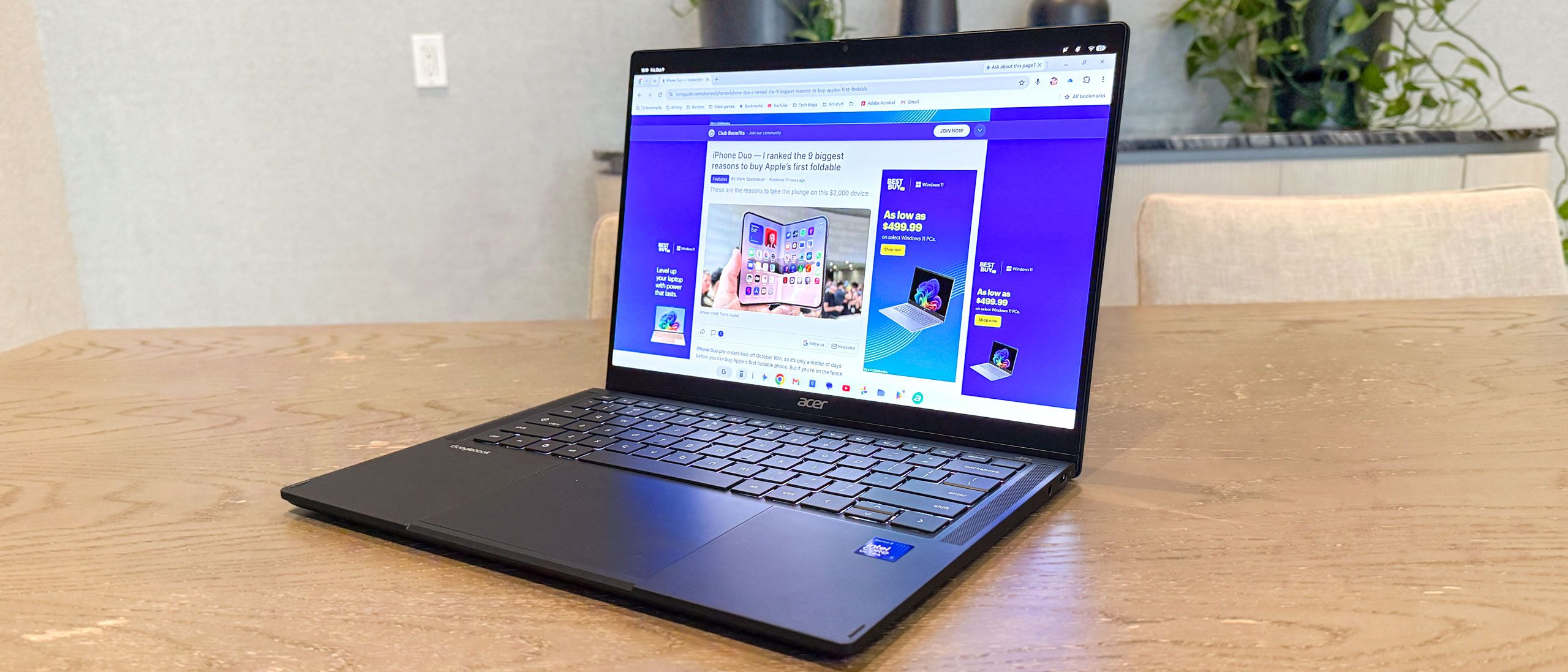
The Acer Googlebook 14 measures 0.55 inches thick and weighs 2.51 pounds (1.14 kg), making it an easy fit for messenger bags and backpacks. Built from an aluminum-magnesium alloy in an Elemental Blue finish, Acer notes that 49 percent of the chassis uses circular, recycled materials. Reviewers praised the sturdy 360-degree dual-gear hinge, which allows the laptop to transition cleanly into tent, display, and tablet modes—a feature unique to Acer within the launch lineup of Googlebooks. The exterior lid features a distinctive LED Glowbar that pulses during Gemini interactions and displays battery charge status at a glance. SlashGear observed a minor amount of deck flex when pressing firmly on the chassis and noted that the darker finish attracts finger smudges, but testers across outlets agreed the construction feels appropriately premium for an ultraportable.
Display
The display is a standout feature of the laptop. Acer equips the machine with a 14-inch 2.8K OLED panel running at a 2880 x 1800 resolution with a 16:10 aspect ratio and a 120Hz refresh rate. In Tom's Guide display testing, the screen registered 459 nits of brightness in standard dynamic range and peaked at 700 nits in HDR. Color reproduction tested exceptionally rich, covering 126.6 percent of the sRGB gamut and 89.7 percent of DCI-P3, accompanied by a precise Delta-E accuracy score of 0.24. Protected by edge-to-edge Corning Gorilla Glass, the screen supports ten-point touch and USI 2.0 styluses. PCMag and SlashGear noted that while colors pop and black levels are ink-deep, the glossy glass reflects indoor ambient lighting and outdoor sun quite heavily.
Performance in everyday and demanding work
Powering the laptop is an Intel Core Ultra 5 325 processor paired with 16GB of LPDDR5X RAM. In Tom's Guide CPU benchmarking, the unit notched a single-core score of 2,465 and a multi-core score of 9,960 in Geekbench 6. That slightly edged out the Intel-based Dell XPS 13, though it trailed the Apple M5 MacBook Air as well as Snapdragon X Elite-equipped competitors in raw processing and 3DMark Wild Life Extreme graphics tests. In real-world daily productivity, reviewers reported fast, fluid performance while cycling through dozens of active Chrome tabs, running side-by-side Android mobile applications, and invoking Gemini tools. Teething troubles surfaced mainly in Googlebook OS software: SlashGear, Android Authority, and PCMag pointed to early synchronization glitches when setting up phone tethering, occasional app scaling quirks, and transfer hiccups in the native Files application.
Battery life
Acer claims up to 16 hours of web browsing and 14 hours of video playback from the 71 Wh battery, but real-world lab results vary dramatically based on the workload. In PCMag's video rundown test, the laptop fulfilled expectations by lasting 16 hours and 22 minutes. However, in Tom's Guide's stricter automated Wi-Fi test—which continually refreshes 30 live websites at 150 nits with the display left at its native 120Hz—the laptop managed 10 hours and 25 minutes. That trails the M5 MacBook Air (15 hours and 37 minutes) and Dell XPS 13 (14 hours and 57 minutes). In everyday workplace usage, SlashGear reported barely finishing an eight-hour shift on a single charge. On the upside, the bundled 100W USB-C brick replenishes the battery swiftly, reaching roughly 85 percent charge in 60 minutes.
Keyboard, trackpad, speakers and webcam
The illuminated keyboard features well-spaced chiclet keys that PCMag praised for comfortable travel and tactile feedback during extended typing sessions. Navigation is handled by a Corning Gorilla Glass touchpad that provides smooth scrolling and reliable multi-finger gestures. A fingerprint reader is integrated into the power button; SlashGear reported it felt finicky and only registered clean reads about 70 percent of the time. For remote meetings, the 5-megapixel webcam delivers sharp picture quality alongside a three-microphone array with background noise suppression, and Acer includes a physical privacy shutter slider. Audio is driven by dual stereo speakers with DTS tuning, which reviewers found clear enough for spoken dialogue and web video, though lacking low-end bass presence for music.
Ports and upgradeability
Physical connectivity consists of three USB Type-C ports and a 3.5mm headphone/microphone jack. The port array is modern: the left side houses one 40Gbps Thunderbolt 4 connection (supporting DisplayPort 2.1 and 100W Power Delivery), while two 10Gbps USB 3.2 Gen 2 Type-C ports are split between each flank to allow charging from either side. There are no USB Type-A ports, nor is there a built-in HDMI port or SD card slot, meaning users must rely on dongles for legacy accessories. Wireless connectivity is future-proofed with Intel Wi-Fi 7 and Bluetooth 6.0. Teardowns note that upgrade options are virtually nonexistent: the 16GB of LPDDR5X memory is soldered to the motherboard, and reviewers found no secondary M.2 slot for storage expansion, making it essential to choose the capacity you require from the start.
Price and configurations
The Acer Googlebook 14 launched at $899, which makes it the least expensive model in the entire introductory Googlebook family. That baseline configuration features the Intel Core Ultra 5 325 processor, 16GB of RAM, and a 512GB NVMe SSD. While competitors like the Asus Googlebook 14 and HP Googlebook 14 push pricing to $1,299, Acer includes 12 months of Google AI Pro (offering Gemini Advanced and 5TB of cloud storage) alongside brief trials of Adobe Photoshop and NVIDIA GeForce NOW to sweeten the purchase.
Is it worth the money?
Represents the lowest entry price of any launch Googlebook model, delivering an OLED touchscreen, 16GB of RAM, and 512GB of storage below comparable $1,000 to $1,299 competitors.
Benchmarks
PERFORMANCE
Benchmarks
sRGB
Higher is better · %Tom’s Guide · full test results ↗Published 2026-10-10 · checked 2026-10-11
sRGB · Acer Googlebook 14: Intel Core Ultra 5 325 processor, 16GB of RAM, and a 512GB SSD
Results apply to this publication’s tested models and settings. Check those details before comparing another review.
Test data and methodology
| Product | Result | Test scope |
|---|---|---|
| Acer Googlebook 14 | 126.6 | Reviewed model only |
Bars start at zero. Results apply to the tested configuration and settings. Missing products are never assigned zero.
Also consider
- Apple MacBook Air 13-inch (M3 / M5)
Provides significantly longer battery life and faster raw processor performance, though it lacks a touchscreen and 360-degree convertible hinge.
- Dell XPS Googlebook
Offers a premium Snapdragon X Elite chipset with superior multi-core compute in a traditional clamshell body starting at $999.
- Acer Chromebook Plus Spin 714
A more budget-conscious 2-in-1 option running established ChromeOS for users who only require browser-based tasks.
Reviews we read
This roundup summarizes professional reviews and published specifications; Next Interrupt did not test the product. Roundup updated October 27, 2026. How we work
- Tom's Guide — The Acer Googlebook 14 is a fantastic 2-in-1 laptop — but this one thing holds it back
- PCMag — Acer Googlebook 14 Review: The Lowest-Cost Ticket Into Google's New Era
- TechRadar — Acer Googlebook 14 review: not just a super-powered Chromebook