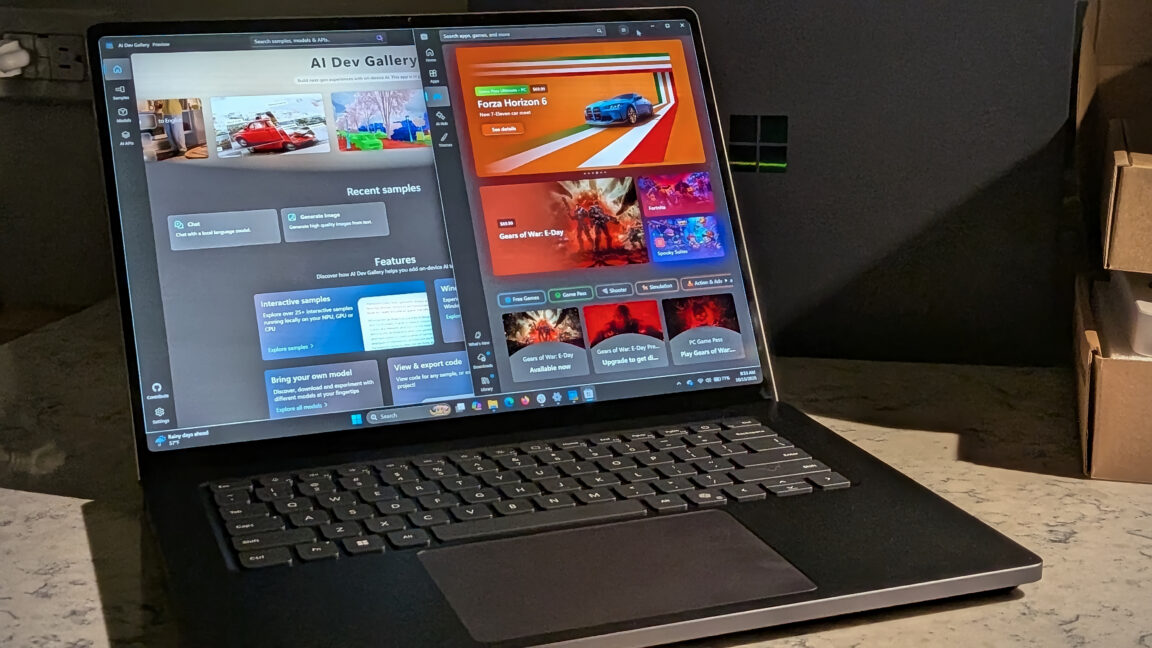
The Surface Laptop Ultra delivers on most of Microsoft's promises
Microsoft promises one machine for dev, AI, and gaming, and mostly gets there.
via Ars TechnicaReported by 4 outlets
The story so far
AI summary of the reporting below · Updated · How we work
Microsoft has launched the Surface Laptop Ultra, a premium notebook built around the new Arm-based Nvidia RTX Spark platform developed with MediaTek. Pricing starts at $2,599.99 for an 18-core N1X processor and climbs past $3,699 for higher-tier variants. Available memory configurations span from 24GB up to 128GB of shared memory, paired with up to 2TB of solid-state storage. [1][4]
Because the system shares memory between the CPU and its RTX graphics core, buyers opting for lower memory tiers will face limits on running the most demanding artificial intelligence models locally. Reviewers observed that the machine effortlessly handles major creative tasks and AAA gaming, but flagged trade-offs including mediocre single-core performance, underwhelming battery life, and substantial chassis weight. [2][3][4]
The release pits Microsoft squarely against Apple's MacBook Pro lineup as it attempts to sell demanding professionals a single machine for both high-end productivity and gaming. However, with total PC shipments falling 20 percent year over year in the third quarter of 2026 amid rising component costs, the device enters a market where high price tags may deter mainstream buyers. [2][3][4]
Microsoft promises one machine for dev, AI, and gaming, and mostly gets there.
via Ars Technica
At a glance Expert's Rating Pros Excellent multicore, RTX Spark graphics performance Rock-solid construction Power-efficient Great display Cons Even the base model is extremely expensive Surprisingly average webcam Slow single-core performance may slow down UI Initial bugginess which went away Heavier than you’d expect Our Verdict Microsoft’s Surface Laptop Ultra is a new class of device, combining efficient productivity, powerful RTX Spark graphics, plus AI capabilities,…
via PCWorld
We review the Microsoft Surface Ultra to see how the NVIDIA RTX Spark powered laptop fares and try to answer who the platform is for
via ServeTheHome
The Surface Laptop Ultra is a true MacBook Pro competitor for Windows, and Microsoft has never been so close to dethroning Apple—if only it weren't for the lack of battery life.
via WIRED