Laptops & desktops / Review roundup
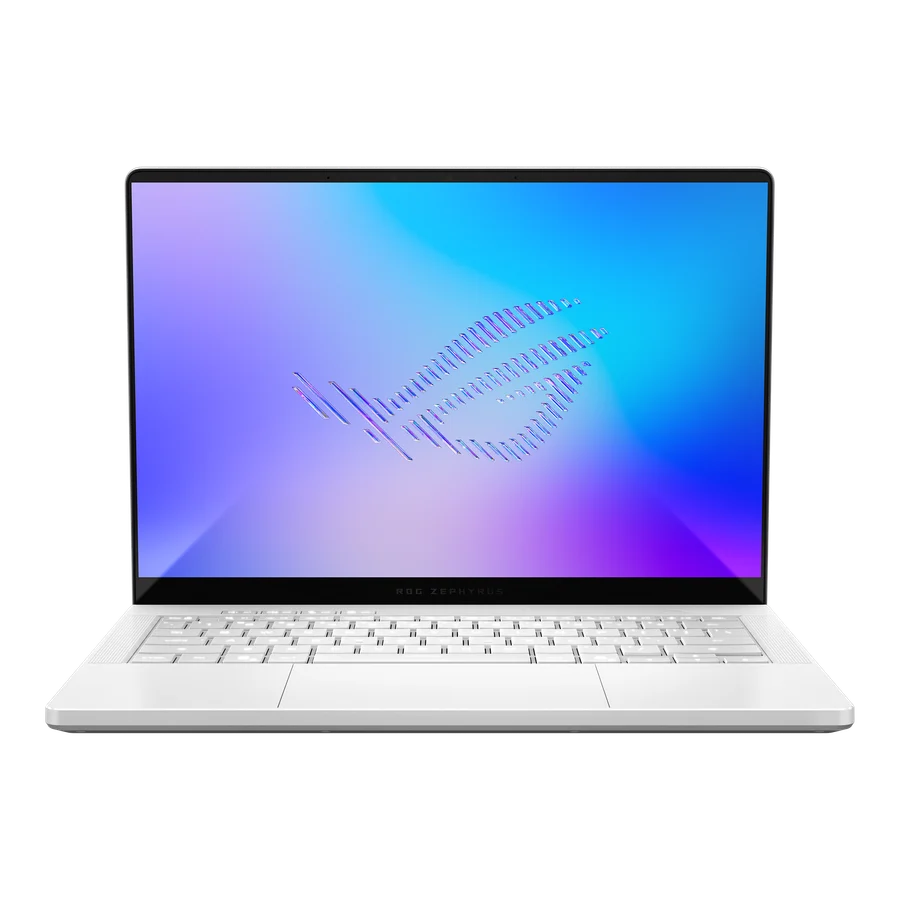
ASUS ROG Zephyrus G14 (2026)
GU405, Core Ultra 9 386H / RTX 5070 Ti; RAM and SSD vary by region
- 4 / 5Tom's Guide
- 85%Notebookcheck
A refined 14-inch gaming laptop pairing upgraded OLED brightness with strong graphics and steep pricing
The Zephyrus G14 GU405 is built for mobile creators, STEM students, and gamers who need high graphics performance in an ultraportable package. Its biggest strengths are the 1,100-nit peak HDR OLED display and strong everyday efficiency from Intel Panther Lake silicon. The main drawback is intrusive fan noise under heavy loads, alongside soldered memory and a elevated price tag. Against the Razer Blade 14, it offers richer contrast and HDR imagery, while Apple's MacBook Pro 14 remains quieter and faster in sustained CPU tasks but lacks native PC gaming compatibility.
Buy it if
- Gamers and creative professionals looking for portable 14-inch graphics performance under 3.5 pounds
- Users who prioritize deep black levels and up to 1,100 nits peak HDR on an OLED screen
- Mobile workers who need more than eight hours of runtime away from an outlet for office tasks
Skip it if
- You require near-silent acoustic operation while running demanding 3D rendering or gaming
- You require expandable system memory, as the LPDDR5X RAM is permanently soldered
- You are shopping on a tight budget, as upper configurations exceed $3,000
Where to buy
We may earn a commission from purchases or qualifying sign-ups through our links. Affiliate links explained
What reviewers liked
- Sharp 3K 120Hz OLED screen with 1,100 nits peak HDR brightness and Nvidia G-Sync
- Strong gaming, local AI, and rendering output from the Core Ultra 9 386H and RTX 5070 Ti
- Tom's Guide recorded 8 hours and 32 minutes in its web browsing battery test
- Sturdy CNC-milled aluminum chassis weighing 3.48 pounds
- Full-size UHS-II SD card slot and clear six-speaker Dolby Atmos sound
What they didn’t
- Cooling fans produce noticeable noise under Turbo and Manual performance profiles
- LPDDR5X RAM is soldered to the board with no option for user upgrades
- Substantial price increases place premium configurations well above $3,000
- Display hinge angle is limited to approximately 130 degrees
Key specs
- Launch price
- $3,599 list price for Core Ultra 9 / RTX 5070 Ti / 32GB RAM
- Reported price
- $3,199 to $3,599 depending on retailer and RAM configuration
- Starting weight
- 3.48 lbs (1.58 kg)
- Dimensions
- 12.24 x 8.66 x 0.72 inches (311 x 220 x 18.3 mm)
- Processor
- Intel Core Ultra 9 386H (16 cores, 16 threads, up to 4.9 GHz, 50 TOPS NPU)
- Graphics
- Nvidia GeForce RTX 5070 Ti Laptop GPU (12GB GDDR7)
- Display
- 14-inch 3K (2880 x 1800) OLED, 16:10, 120Hz, 0.2ms, up to 1,100 nits peak HDR, G-Sync
- Memory
- 32GB or 64GB LPDDR5X 8533 MT/s (soldered)
- Storage
- 1TB or 2TB PCIe 4.0 NVMe M.2 SSD
- Battery
- 73 Wh lithium-ion
- Connectivity
- Wi-Fi 7, Bluetooth 6.0
In depth
Design, build and portability
The Zephyrus G14 GU405 maintains the CNC-milled aluminum unibody introduced in prior revisions, preserving a rigid shell with minimal deck flex. It measures 0.72 inches (18.3 mm) thick and weighs 3.48 pounds (1.58 kg), making it convenient to slip into standard backpacks. Reviewers note that the lid retains the slash lighting element across the exterior, now upgraded from 7 to 35 customizable zones for smoother animation sequences. ASUS also implemented an updated hinge mechanism that improves stability while opening the lid with one hand. However, Ultrabookreview pointed out that the hinge rotation remains restricted to roughly 130 degrees, precluding full flat-desk deployment.
Display
The display is a 14-inch 16:10 OLED panel running at a 3K resolution of 2880 x 1800 with a 120Hz refresh rate and a 0.2ms response time. Ultrabookreview and Tom's Guide highlighted the upgraded panel luminosity, which achieves up to 1,100 nits in peak HDR highlights alongside VESA DisplayHDR True Black 1000 certification, noticeably improving HDR impact over earlier 500-nit panels. Color coverage spans 100% of the DCI-P3 space with calibrated Delta E below 1. The presence of Nvidia G-Sync prevents tearing during erratic frame rates. The only consistent criticism is the glossy screen coating, which produces reflections in brightly lit office or outdoor settings.
Performance in everyday and demanding work
Equipped with the 16-core Intel Core Ultra 9 386H and an Nvidia GeForce RTX 5070 Ti, the GU405 delivers fast processing for both computing and 3D rendering. Ultrabookreview observed sustained crossload power limits between 57W and 70W, allowing the Blackwell GPU and its 12GB GDDR7 memory to maintain reliable clock speeds in high-resolution modern gaming. Tom's Guide tested local AI workflows, including running a Hermes Agent model, and noted the 50 TOPS NPU and Nvidia Tensor cores handled local pipelines effortlessly alongside fast project exports in Premiere Pro and Blender. When pushed in Turbo and Manual modes, however, fan noise rises sharply, requiring headphones for comfortable extended gaming.
Battery life
With a 73 Wh battery pack inside, the transition to Intel Panther Lake architecture yields noticeable efficiency gains during mixed light workloads. Tom's Guide measured 8 hours and 32 minutes in its continuous web-browsing battery test conducted over Wi-Fi, which represents a clear step forward from previous AMD generations that frequently drained in under seven hours. Ultrabookreview noted that the hardware sips minimal power during routine desktop tasks and streaming video playback. Naturally, launching high-end games on battery power pulls substantial wattage and cuts total runtime down to around one to one-and-a-half hours.
Keyboard, trackpad, speakers and webcam
The keyboard retains dedicated audio and utility macro keys on the top left, responsive 1.7mm key travel, and quiet actuation. Ultrabookreview found keypress feedback tactile and reliable, though notes the surface key coating feels slightly textured. The glass trackpad is spacious, smooth, and tracks multi-finger Windows gestures without lag. Sound quality from the six-speaker Dolby Atmos system earned strong marks across reviews, with newly upgraded woofers delivering bass response that stands near the top of the compact Windows market. The 1080p webcam includes an IR sensor for fast Windows Hello facial recognition logins.
Ports and upgradeability
Port selection includes one USB4 / Thunderbolt 4 Type-C port, one USB-C 3.2 Gen 2 port with DisplayPort and 100W Power Delivery support, two USB-A 3.2 Gen 2 ports, an HDMI 2.1 port, a 3.5mm audio jack, and a full-size UHS-II SD card reader. ASUS ships both a high-wattage primary AC adapter and supports travel charging over USB-C. Internal upgradeability is restricted: the fast LPDDR5X 8533 MT/s memory is permanently soldered to the motherboard, so buyers must choose their capacity upfront. Only the single M.2 2280 NVMe SSD slot and the Wi-Fi 7 wireless module remain user-accessible.
Price and configurations
The Zephyrus G14 GU405 with Core Ultra 9, RTX 5070 Ti, and 32GB RAM carries a list price of $3,599, with some retailer configurations available around $3,199. Engadget highlighted that while the original 2020 G14 debuted near $1,450, cumulative inflation and transitions to CNC unibody construction, 3K OLED panels, and premium mobile GPUs have pushed high-tier Zephyrus models firmly into premium territory. Buyers seeking entry-level configs will find 16GB RAM models with lower-tier graphics closer to $2,500, though soldered memory makes the 32GB configuration the safer long-term investment.
Is it worth the money?
Significant price increases across successive hardware generations mean this G14 now competes directly with elite boutique ultrabooks rather than midrange gaming machines.
Also consider
- Razer Blade 14
Offers an equally compact aluminum chassis with high-end graphics, but lacks the 1,100-nit HDR OLED panel.
- Apple MacBook Pro 14
Provides longer battery life and quieter sustained CPU productivity, but cannot match Windows gaming compatibility.
- ASUS ROG Zephyrus G16
Provides higher-tier GPU options such as the RTX 5080 and more thermal headroom if you can carry a larger 16-inch chassis.
Reviews we read
This roundup summarizes professional reviews and published specifications; Next Interrupt did not test the product. Roundup updated November 15, 2026. How we work
- Tom's Guide — I tested the Asus ROG Zephyrus G14 (2026) like I was a student — its gaming, creator and AI performance is huge, but it comes at a cost
- Ultrabookreview — Asus ROG Zephyrus G14 review (GU405 2026 gen, Intel Panther Lake, RTX 5070Ti)
- Engadget — How much did the ASUS ROG Zephyrus G14 cost in 2020 vs 2026?