Storage & NAS / Review roundup
Sandisk Optimus GX Pro 850P
Sandisk Optimus GX Pro 850P 2TB
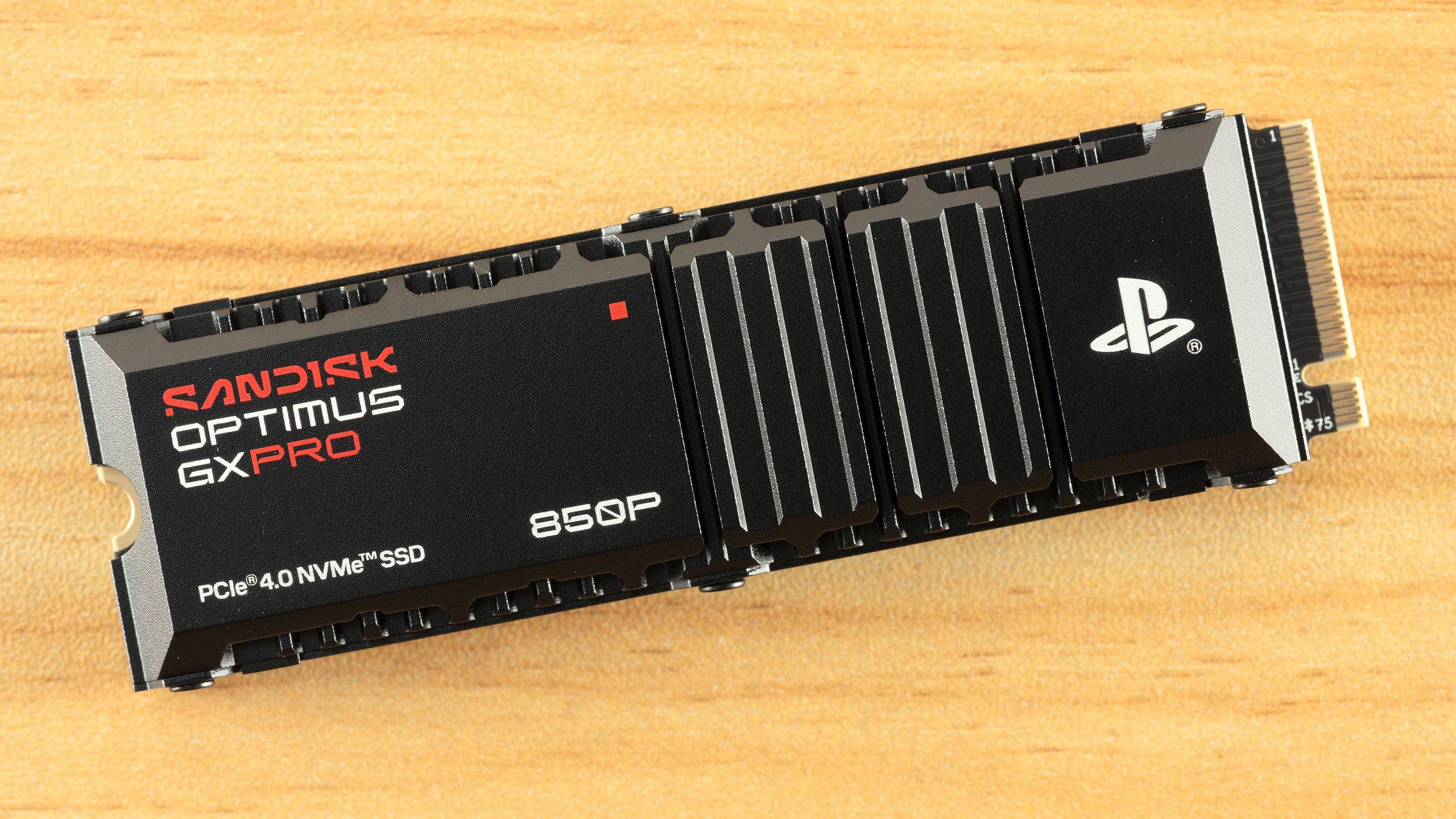
A dependable PS5-ready SSD with top-tier Gen 4 speeds that struggles to justify its hefty licensing premium
PlayStation 5 and PC gamers who want plug-and-play installation backed by official Sony licensing will appreciate the SanDisk Optimus GX Pro 850P. Its strongest attribute is proven hardware reliability, pairing an eight-channel controller and dedicated DRAM cache with a custom-fitted heatsink. However, its high asking price creates a massive barrier to entry. Compared with the virtually identical WD Black SN850X or the Samsung 990 Pro, you pay a steep surcharge solely for branding without gaining any noticeable real-world gaming advantage.
Buy it if
- PS5 and PS5 Pro owners wanting an officially licensed, guaranteed-fit M.2 drive with a pre-installed heatsink
- Users demanding proven eight-channel PCIe 4.0 reliability with dedicated DDR4 DRAM caching
Skip it if
- Value-conscious gamers looking for the best performance per dollar
- Shoppers willing to install a third-party heatsink onto standard Gen 4 SSDs
- Laptop users who cannot accommodate a pre-installed heatsink
Where to buy
We may earn a commission from purchases or qualifying sign-ups through our links. Affiliate links explained
What reviewers liked
- Saturates PCIe 4.0 bandwidth with up to 7,300 MB/s reads and 6,600 MB/s writes
- Dedicated 2GB DDR4 DRAM cache ensures consistent performance under sustained loads
- Factory-installed low-profile heatsink fits easily into PS5 and PS5 Pro console bays
- Standard five-year warranty paired with 1,200 TBW endurance on the 2TB model
What they didn’t
- Steep official PlayStation licensing price premium over equivalent hardware
- Higher power draw compared to newer four-channel DRAM-less drives
- Uses older BiCS5 TLC flash that trails newer NAND in random read latency
Key specs
- Launch price
- $609.99
- Reported price
- $569.99
- Form Factor
- M.2 2280 (with integrated heatsink)
- Interface
- PCIe 4.0 x4, NVMe 1.4
- Controller
- SanDisk 8-channel proprietary controller
- NAND Flash
- BiCS5 112-layer 3D TLC
- DRAM Cache
- 2GB DDR4
- Sequential Read
- Up to 7,300 MB/s
- Sequential Write
- Up to 6,600 MB/s
- Random Read
- Up to 1,200,000 IOPS
- Random Write
- Up to 1,100,000 IOPS
- Endurance (TBW)
- 1,200 TBW (2TB model)
- Dimensions
- 80 x 24.4 x 9.89 mm (3.15 x 0.96 x 0.39 in)
- Weight
- 30.4 grams
In depth
Sequential and random speeds in tests
Tom's Hardware confirmed that the Optimus GX Pro 850P 2TB operates at the upper boundary of the PCIe 4.0 interface, reaching its rated maximum sequential speeds of 7,300 MB/s read and 6,600 MB/s write. Random input/output operations are rated at up to 1.2 million read IOPS and 1.1 million write IOPS. In synthetic testing, Tom's Hardware noted that random access latency was solid at under 45 microseconds, but the drive landed in the middle of the pack against rival flagship SSDs. It lagged behind drives equipped with newer BiCS8 flash, such as the DRAM-less SN7100, showing that the 850P relies on older BiCS5 TLC NAND, which lacks the tightest latency edge found in recent flash generations.
Real-world load and transfer times
In gaming workloads, the Optimus GX Pro 850P delivers dependable performance, though without distinguishing itself from older or cheaper peers. Tom's Hardware recorded strong results in 3DMark Storage and DiskBench benchmarks, easily outpacing budget DRAM-less drives on consistency. However, in PlayStation 5 console testing, game loading times and internal file copies showed virtually no discernible difference between the 850P and other quality Gen 4 drives. Tom's Hardware observed that internal PS5 storage bottlenecks tend to equalize high-speed SSDs, meaning the theoretical sequential advantages over entry-level PCIe 4.0 drives rarely translate into noticeably faster game boots.
Sustained writes and thermals
The drive relies on a mature platform combining an eight-channel controller, 2GB of DDR4 memory, and a dynamic pseudo-SLC cache. Tom's Hardware found that sustained writes remain steady even after the cache fills, avoiding the steep throughput cliffs common to DRAM-less or QLC competitors. On the thermal front, the integrated low-profile aluminum heatsink is purpose-built to fit flush inside the PS5 and PS5 Pro expansion bay. Under maximum workload, the drive draws up to approximately 9W (rated at 3.3V and 2.8A), which is higher than the roughly 5W drawn by four-channel alternatives. However, Tom's Hardware found that the heatsink dissipates heat effectively, preventing thermal throttling in both PC enclosures and console bays.
Endurance and warranty
SanDisk backs the 2TB Optimus GX Pro 850P with an industry-standard five-year limited warranty and an endurance rating of 1,200 terabytes written (TBW), which equates to 600 TBW per terabyte across the capacity lineup. Hardware security is bolstered by data-at-rest protection through TCG Opal v2.01 encryption support. For console gamers who install and delete games periodically, exhausting 1,200 TBW before the five-year warranty period expires is virtually impossible under normal usage patterns.
Price per terabyte
Value is the 850P's most contentious aspect. The 2TB drive debuted at an MSRP of $609.99 and typically sells for around $569.99, working out to roughly $285 to $305 per terabyte. Tom's Hardware emphasized that these figures sit far above existing market alternatives, noting that the identical WD Black SN850P commanded $494.99 and regular SN850X drives paired with third-party heatsinks sell for even less. Unless retailers offer deep discounts on the Optimus GX Pro 850P, buyers are paying a steep licensing premium simply for the official PlayStation logo printed on the heatsink.
Is it worth the money?
At around $285 to $305 per terabyte, the 850P commands a hefty price premium over equivalent Gen 4 SSDs like the WD Black SN850X and Samsung 990 Pro, primarily driven by official PlayStation licensing.
Also consider
- WD Black SN850X (2TB with Heatsink)
Shares the identical hardware platform and speed while usually selling at a substantially lower price.
- Samsung 990 Pro with Heatsink (2TB)
Delivers faster raw sequential and random speeds with lower power consumption for a lower street price.
- WD Black SN7100 / SanDisk Optimus GX 7100 (2TB)
A newer DRAM-less drive using fast BiCS8 flash that runs cooler and costs significantly less if paired with a separate heatsink.
Reviews we read
This roundup summarizes professional reviews and published specifications; Next Interrupt did not test the product. Roundup updated November 13, 2026. How we work