Storage & NAS / Review roundup
Sandisk NAS 800
1.92TB
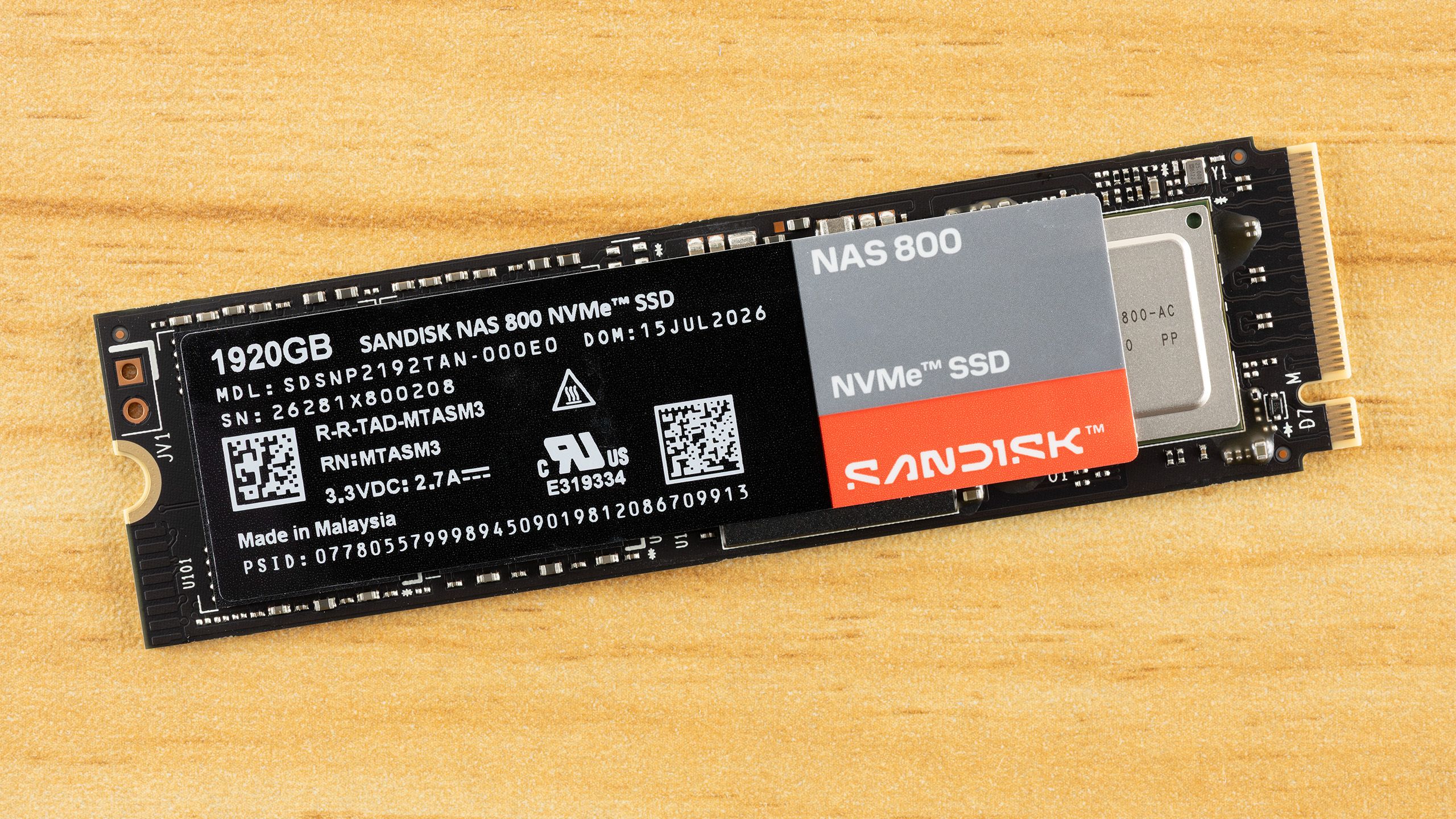
- 8.5 / 10Dong Knows Tech
High-endurance PCIe 5.0 storage designed for heavy write servers at a steep cost
The SanDisk NAS 800 1.92TB is built for home-lab enthusiasts, creative media servers, and write-heavy NAS systems running continuous ingest or caching operations around the clock. Its biggest strength is industrial longevity, delivering 3,500 TBW of write endurance alongside a remarkably steady 4 GB/s sustained write rate and cool operating temperatures. The primary catch is its steep price tag, which commands several times the cost per gigabyte of typical desktop drives without including hardware power-loss protection capacitors. Compared to conventional high-speed Gen 5 drives like the Crucial T705 or parent WD Black SN8100, it gives up burst transfer speed in everyday consumer tasks in exchange for durability that will outlast relentless write cycles.
Buy it if
- High-traffic all-flash NAS setups requiring continuous caching or database write operations
- Video editing servers handling non-stop multi-stream 8K footage ingest and file movement
- Systems needing PCIe 5.0 throughput with manageable thermals that resist throttling
Skip it if
- You need an everyday operating system or gaming drive where burst speeds matter more than write endurance
- You require onboard power-loss protection capacitors to guard in-flight data against sudden outages
- You are shopping on a standard consumer budget looking for typical price-per-gigabyte value
Where to buy
We may earn a commission from purchases or qualifying sign-ups through our links. Affiliate links explained
What reviewers liked
- Massive 3,500 TBW endurance rating, roughly triple that of standard consumer SSDs
- Maintains about 4 GB/s in sustained write operations for hours without throttling
- Runs unusually cool for a PCIe 5.0 drive, peaking below 70°C in testing
- Excellent low-queue-depth 4KB random read and write latency
- Single-sided M.2 2280 form factor fits compact NAS enclosures and standard motherboards
What they didn’t
- Substantial price premium over standard PCIe 5.0 consumer drives
- Lacks hardware power-loss protection capacitors for sudden power-loss events
- Slower in short burst file copy tests than performance-oriented desktop SSDs
Key specs
- Launch price
- $699.99
- Reported price
- $559.99 to $699.99
- Form Factor
- M.2 2280 (Single-sided)
- Interface
- PCIe 5.0 x4, NVMe 2.0
- Controller
- Silicon Motion SM2508 (TSMC 6nm)
- Flash Memory
- SanDisk / Kioxia 218-layer BiCS8 TLC NAND
- DRAM Cache
- 2GB LPDDR4
- Usable Capacity
- 1.92TB (overprovisioned)
- Rated Sequential Read
- Up to 14,900 MB/s
- Rated Sequential Write
- Up to 13,200 MB/s
- Rated Random Performance
- Up to 2,300,000 IOPS read / 1,500,000 IOPS write
- Endurance Rating
- 3,500 TBW (5-year limited warranty)
In depth
Sequential and random speeds in tests
The SanDisk NAS 800 is rated for sequential speeds up to 14,900 MB/s read and 13,200 MB/s write, alongside 2.3 million random read and 1.5 million random write IOPS. In testing, Tom's Hardware found that the drive delivered top-tier 4KB random read latency and nearly unmatched random write latency at a queue depth of 1, resulting in immediate responsiveness for transactional workloads. At high queue depths such as QD8, sequential reads effectively matched the fastest PCIe 5.0 drives on the market. However, because the controller firmware is calibrated for long-term consistency over dynamic burst speeds, synthetic sequential write scores settled roughly 20% behind consumer-oriented Gen 5 drives.
Real-world load and transfer times
In typical desktop transfer benchmarks, the NAS 800 reveals its specific design priorities. Tom's Hardware recorded a write score roughly 20% below standard PCIe 5.0 drives in its 50GB DiskBench file transfer test, lagging 36% behind the mechanically similar WD Black SN8100 during direct file copy operations. By contrast, Dong Knows Tech transferred single files exceeding 500GB and reported completely flat, unwavering transfer rates with zero stuttering. In trace-based evaluations like PCMark 10, the drive held up well for primary OS duty, but consumer drives with oversized burst caches will load games and desktop apps marginally faster.
Sustained writes and thermals
Heavy write scenarios reveal the main performance benefit of the NAS 800. SanDisk purposely uses a small pseudo-SLC cache so that writes do not suffer from the severe folding slowdowns common on client SSDs. In testing, Tom's Hardware recorded steady sequential write speeds of approximately 4 GB/s maintained continuously for an entire hour once the initial cache was saturated. Despite running on PCIe 5.0, thermal output remained controlled. Dong Knows Tech observed operating temperatures staying around 65°C under sustained load without thermal throttling, while Tom's Hardware measured peak temperatures under 70°C in a 22°C ambient environment.
Endurance and warranty
Endurance is where the NAS 800 separates itself from standard hardware. While common 2TB consumer SSDs carry ratings around 1,200 TBW, the 1.92TB NAS 800 is rated for 3,500 TBW, allowing nearly one full drive write per day across its five-year warranty period. It incorporates hardware-based TCG Opal 2.0 self-encryption and pairs with the SanDisk Dashboard utility for health monitoring. The notable omission highlighted by Tom's Hardware is the absence of discrete power-loss protection (PLP) capacitors, meaning enterprise deployments will still depend on an external uninterruptible power supply to protect uncommitted in-flight data against sudden outages.
Price per terabyte
At its $699.99 launch price (and street prices around $559.99), the 1.92TB NAS 800 costs between $290 and $365 per terabyte. For comparison, mainstream PCIe 5.0 consumer drives typically hover between $120 and $180 per terabyte, while fast PCIe 4.0 drives often sell well under $100 per terabyte. Buyers are paying a heavy premium strictly for the 3,500 TBW endurance rating and sustained 4 GB/s write baseline. Unless your storage server regularly ingests hundreds of gigabytes per session, standard client NVMe alternatives offer significantly more capacity for the money.
Is it worth the money?
The NAS 800 carries a substantial premium over standard consumer PCIe 5.0 drives, commanding roughly $290 to $365 per terabyte. The expense is justified for write-intensive servers needing 3,500 TBW endurance, but it is an expensive luxury for everyday PC storage.
Also consider
- Addlink NAS D60
A dedicated PCIe 4.0 NAS SSD that features onboard hardware power-loss protection capacitors for enterprise data safety at a lower cost.
- WD Black SN850X
A proven PCIe 4.0 SSD offering significantly lower cost per terabyte for workstations and gaming PCs that do not require 24/7 write endurance.
- Crucial T705
A mainstream PCIe 5.0 SSD that provides faster burst file transfers and lower pricing for general desktop usage.
Reviews we read
This roundup summarizes professional reviews and published specifications; Next Interrupt did not test the product. Roundup updated October 23, 2026. How we work
- Tom's Hardware — Sandisk NAS 800 1.92TB SSD Review: Endurance at a premium
- Dong Knows Tech — SANDISK NAS 800 Review: PCIe Gen 5 Performance Meets Top Endurance