Laptops & desktops / Review roundup
PixelMob Portable AI Workstation
PixelMob Portable AI Workstation
- 4/5TechRadar
A versatile all-in-one field backup and editing slate let down by cheap casing and workflow quirks
The PixelMob Portable AI Workstation is built for photographers and filmmakers who want to leave their laptop behind and handle card backups, culling, and tethering on a single handheld device. Its greatest asset is an exhaustive feature set, pairing up to 24TB of internal NVMe storage and fast card slots with an ultra-bright OLED display. The biggest compromise is its plasticky exterior and software quirks, including occasional compatibility hiccups with high-capacity CFexpress cards. While an Apple MacBook Pro remains far superior for complex timeline editing and desktop application support, the PixelMob provides an unmatched all-in-one rig for field offloading and triage.
Buy it if
- Photographers and drone pilots needing automated, verified card backups without carrying a laptop
- Field videographers wanting an integrated high-brightness on-camera monitor and fast storage drive
- Production teams managing massive multi-terabyte shoots who already carry Sony NP-F batteries
Skip it if
- You need a full desktop operating system for multitrack editing in Premiere Pro or DaVinci Resolve
- You demand rugged all-metal construction and seamless, unfragmented software out of the box
- You rely heavily on ultra-large 1TB or 2TB CFexpress Type B cards without carrying a USB backup reader
Where to buy
We may earn a commission from purchases or qualifying sign-ups through our links. Affiliate links explained
What reviewers liked
- Eliminates laptops in the field by combining verified backup, tethering, and external monitoring
- Enormous storage expansion supporting up to 24TB across three internal M.2 NVMe slots
- Vibrant 1,100-nit OLED touchscreen offers excellent visibility in direct sunlight
- Built-in slot for standard Sony NP-F camera batteries doubles as a convenient kickstand
- Integrated CFexpress Type B, UHS-II SD, and microSD slots cut down on dongles
What they didn’t
- Plasticky exterior feels inexpensive and unfinished for a four-figure device
- Internal battery drains in roughly two hours under continuous heavy workloads
- TechRadar noted recognition failures with certain 1TB and 2TB CFexpress cards
- Android workflow feels fragmented, requiring frequent switching between separate apps
Key specs
- Launch price
- $1,299 MSRP ($899 early Kickstarter pledge)
- Reported price
- $1,199 pre-order
- Starting price
- $1,199 pre-order ($1,299 MSRP for Pro model)
- Display
- 7.0-inch AMOLED touchscreen, 1,100 nits
- Weight
- 550 g (1.21 lbs)
- Dimensions
- 195 x 104 x 25 mm (7.68 x 4.09 x 0.98 in)
- Operating system
- Customized Android
- Memory
- 12GB LPDDR5 RAM
- Storage capacity
- 256GB internal, expandable up to 24TB via 3x M.2 NVMe slots
- Card readers
- CFexpress Type B (up to 800MB/s), UHS-II SD, microSD
- Ports
- USB4 40Gbps Type-C, USB-A 3.2, HDMI In, HDMI Out, Gigabit LAN, 3.5mm audio
- Battery
- 11,600 mAh internal, plus external Sony NP-F battery plate
In depth
Design, build and portability
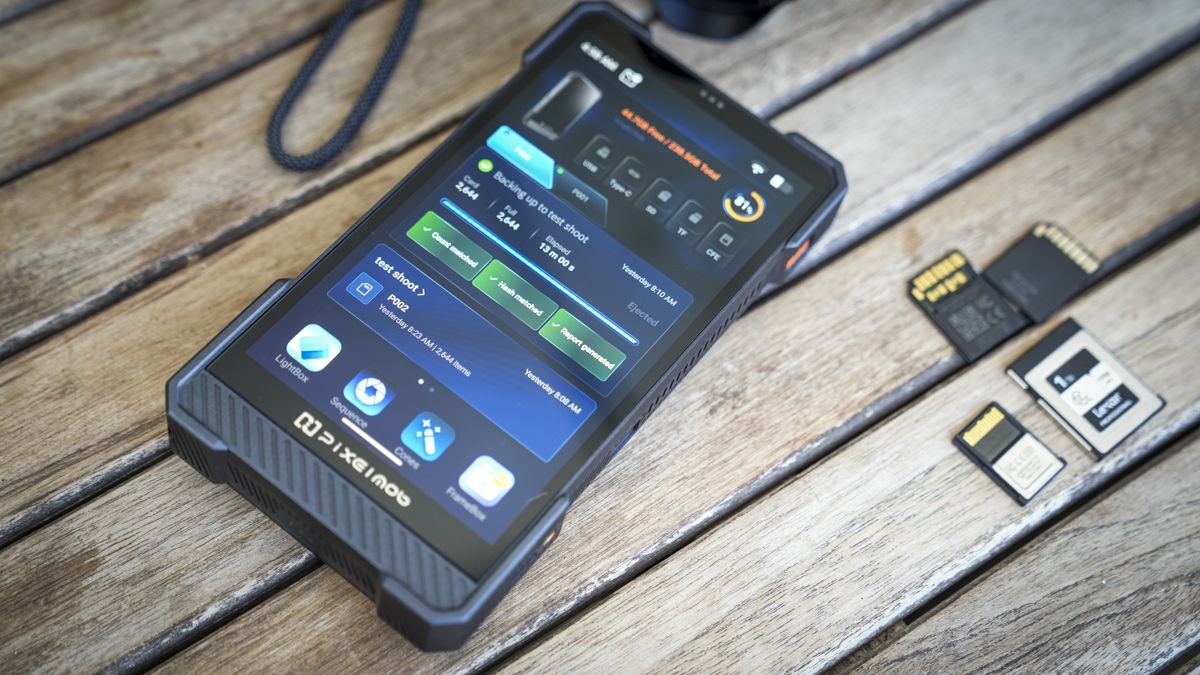
The PixelMob is styled like an oversized rugged smartphone or a compact slate tablet, measuring 195 x 104 x 25 mm and weighing 550 grams. Reviewers found it light enough to pack into a standard camera bag without adding the bulk of a laptop setup. However, physical finish received criticism: TechRadar observed that the exterior plastic feels cheap and resembles an early prototype rather than a finished premium production piece. While the housing held up during outdoor testing in backpacks, it lacked the ruggedized, confidence-inspiring touch expected at this price point. On the back, a dedicated mount accepts Sony NP-F batteries, which TechRadar noted handily doubles as a built-in angled desktop stand, though the battery latch felt somewhat loose rather than snapping firmly into place.
Display
The front face is dominated by a 7-inch AMOLED touchscreen. TechRadar highlighted its rated peak brightness of 1,100 nits, which kept the panel legible even during bright daylight field testing. Because the unit features full HDMI input and output ports, the display doubles as an on-camera field monitor capable of viewing real-time framing and recording incoming camera video up to 4K resolution at 30 frames per second. Color reproduction and black levels benefit from the OLED panel technology, making it well-suited for checking focus, reviewing contrast, and assessing shadow detail on location.
Performance in everyday and demanding work
Running a customized version of Android backed by 12GB of LPDDR5 RAM, the PixelMob handles multiple creator duties simultaneously. TechRadar and video creators praised its automatic backup and verification process, offloading SD UHS-II and CFexpress Type B cards at speeds up to 800MB/s. The built-in software features AI-assisted photo culling that automatically clusters continuous burst sequences, filters out blurry or improperly exposed frames, and prepares lightweight proxies. It also handles standalone RAW adjustments, generating cross-platform XMP sidecar files for Lightroom and Capture One. However, reviewers flagged several operational snags: TechRadar experienced inconsistent card recognition, noting that some 1TB and 2TB CFexpress cards were either slow to register or failed entirely, forcing the use of an external USB card reader. Furthermore, moving between tethering, media verification, and third-party tools like CapCut or DJI Fly requires jumping between separate disjointed apps rather than an integrated interface.
Battery life
Power is supplied by an integrated 11,600mAh internal battery. In TechRadar's testing, the internal battery provided approximately two hours of continuous, heavy offload and editing work before depleting. Because high-throughput NVMe writing, 1,100-nit screen illumination, and AI processing demand substantial energy, reviewers emphasize that the internal cell is best treated as a temporary reserve. Fortunately, the device integrates a hot-swappable Sony NP-F battery plate. Testers who brought standard NP-F970 packs into the field reported they could easily run the unit for a full shooting day or reverse-charge a mirrorless camera via USB-C.
Keyboard, trackpad, speakers and webcam
Unlike a traditional clamshell laptop, the PixelMob is a slate-style field device. It does not feature an integrated physical keyboard, trackpad, or built-in webcam. Navigation relies entirely on the responsive 7-inch capacitive touchscreen and standard Android on-screen keyboard. For desk-bound tasks, users can pair external Bluetooth mice and keyboards or connect peripherals through the full-size USB-A 3.2 port. Audio monitoring is handled through an integrated 3.5mm headphone jack, allowing videographers to monitor audio levels directly while using the device as an external HDMI recorder.
Ports and upgradeability
Connectivity and expansion are the workstation's strongest attributes. The chassis packs direct CFexpress Type B, SD (UHS-II), and microSD card slots, alongside a 40Gbps USB4 Type-C port, USB-A 3.2, full-size HDMI input, HDMI output, and a Gigabit Ethernet jack for connecting directly to local networks as a portable NAS. Internal storage is unusually modular: removing the rear access plate reveals three standard M.2 2280 NVMe SSD slots, which support RAID 1 mirroring and up to 24TB of user-installed storage. TechRadar noted that while swapping drives is simple, packing the device with multi-terabyte SSDs adds substantial cost beyond the initial purchase price.
Price and configurations
Following its crowdfunding debut on Kickstarter, the PixelMob line is available via pre-order on the manufacturer's web store. The base PixelMob Standard lists at $599 on pre-order ($699 MSRP) and includes a smaller 5.5-inch display, 6GB RAM, two M.2 slots (up to 8TB), and 5Gbps USB-C, lacking the NP-F mount and CFexpress slot. The reviewed PixelMob Pro configuration features the 7-inch 1,100-nit OLED display, 12GB RAM, three M.2 slots (up to 24TB), CFexpress Type B, USB4 40Gbps, HDMI input, and the NP-F battery plate. The Pro model is priced at $1,199 on pre-order against a $1,299 MSRP. Buyers should note that internal SSDs are not bundled, so high-capacity NVMe drives must be factored into the overall budget.
Is it worth the money?
The base unit includes 256GB of onboard storage and no included NVMe drives or external NP-F batteries, meaning users must budget separately for high-capacity SSDs to unlock its full multi-terabyte capability.
Also consider
- Apple 14-inch MacBook Pro
Provides full desktop software support and raw computing capability for heavy video timelines, though it is far larger and lacks direct camera-rig mounting.
- Apple 11-inch iPad Pro (M4)
Offers an exceptional OLED screen and polished mobile editing apps, but relies entirely on external dongles and hubs for multi-card offloading.
- Atomos Ninja Field Monitor + Portable SSD
A proven, mature camera-top monitoring and recording solution with rugged metal build, though it requires separate hardware for file backup and culling.
Reviews we read
This roundup summarizes professional reviews and published specifications; Next Interrupt did not test the product. Roundup updated November 5, 2026. How we work