Laptops & desktops / Review roundup
MSI Pro Max Edge AI+
AMD Ryzen AI Max+ 395, 16-core / 32-thread Zen 5
- 4 / 5TechRadar
A compact 4-liter AI workstation with 96GB allocatable VRAM, hampered only by soldered memory and an enterprise price
The MSI Pro Max Edge AI+ is tailored for AI researchers, enterprise teams, and software developers who need to run large language models offline without recurring cloud bills or privacy risks. Its biggest asset is the AMD Ryzen AI Max+ 395 paired with 128GB of unified memory, which allows up to 96GB to be allocated directly to graphics tasks for running 120-billion-parameter models. The main catches are its steep $5,499 entry cost and non-upgradeable soldered memory. Compared with the Apple Mac Studio, MSI offers an open x86 Windows and Linux environment with strong multi-core processing, though at a significantly higher initial cash outlay than entry-level Apple configurations.
Buy it if
- Running local large language models up to 120B parameters without cloud connectivity
- Workstation tasks requiring massive graphics memory within a compact 4-liter footprint
- Creative professionals and developers who need quad-monitor support and fast SD 4.0 transfers
Skip it if
- You are shopping for a budget mini PC for standard office productivity or light home use
- You want modular memory slots that can be expanded or replaced after purchase
- Your workflow relies on proprietary Nvidia CUDA software stacks
Where to buy
We may earn a commission from purchases or qualifying sign-ups through our links. Affiliate links explained
What reviewers liked
- 128GB of unified memory allows dedicating up to 96GB of VRAM to local AI models
- Compact 4-liter aluminum chassis with an integrated 300W power supply
- Solid 16-core Zen 5 performance alongside capable Radeon 8060S graphics
- Broad connectivity including dual 40Gbps USB4 ports, 2.5GbE LAN, and SD 4.0 card reader
- Front hardware switch for instant toggling between power profiles
What they didn’t
- High $5,499 retail price places it strictly in enterprise and enthusiast territory
- LPDDR5X unified memory is soldered and cannot be expanded after purchase
- Local model deployment requires familiarity with offline quantization workflows
Key specs
- Launch price
- $5,499
- Reported price
- $5,499 (US retail) / €4,799 to €5,299 (Europe)
- Processor
- AMD Ryzen AI Max+ 395 (16 cores, 32 threads, 3.0 GHz base, up to 5.1 GHz boost)
- Graphics
- AMD Radeon 8060S integrated graphics (40 RDNA 3.5 compute units)
- AI Performance
- AMD XDNA 2 NPU (50 TOPS), up to 126 total platform TOPS
- Memory
- 128GB LPDDR5X-8000 unified memory (soldered; up to 96GB allocatable to VRAM)
- Storage
- 2TB PCIe 4.0 NVMe M.2 SSD (two M.2 2280 slots total)
- Chassis Volume
- 4.0 liters
- Power Supply
- Built-in 300W internal power supply
- Ports
- 2x USB4 (40Gbps, DP Alt), USB 3.2 Gen 2 Type-A, 2x USB 2.0, HDMI 2.1, DP 1.4a, SD 4.0, 3.5mm
- Networking
- 2.5 Gbps Ethernet, Wi-Fi 7, Bluetooth 5.4
- Operating System
- Windows 11 Pro
In depth
Design, build and portability
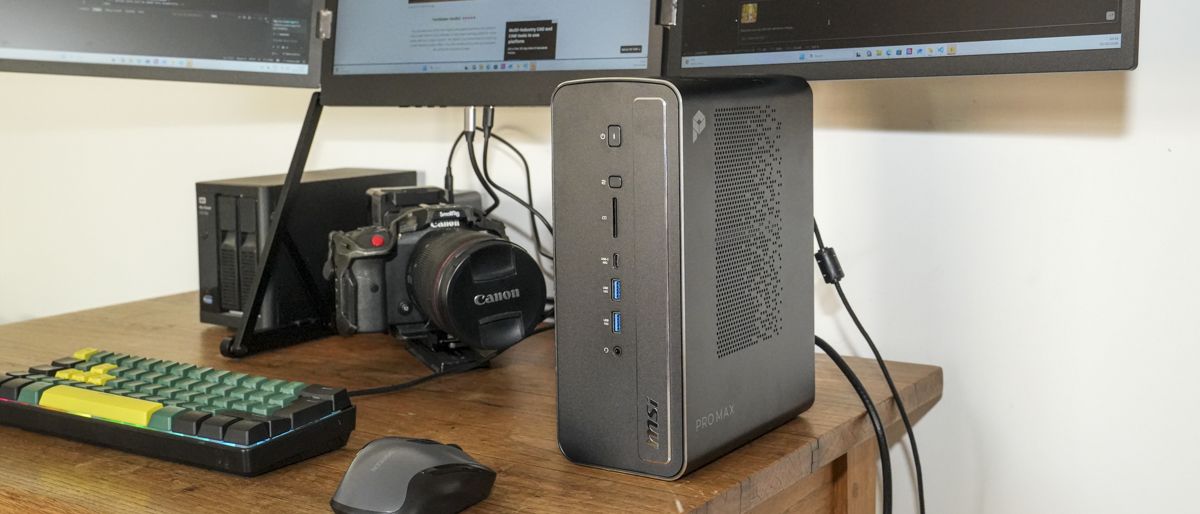
The MSI Pro Max Edge AI+ packages high-end workstation components into a compact 4.0-liter aluminum enclosure designed for neat desk setups. TechRadar highlighted the chassis build quality and noted that MSI fitted a 300-watt power supply directly inside the case, eliminating the bulky external charging brick typical of high-draw mini PCs. The front panel includes a three-stage tactile toggle switch, which allows users to switch between power profiles at the hardware level without opening companion software. While heavier than typical featherweight desktop boxes, its compact footprint makes it straightforward to relocate between testing labs or remote desks.
Display
As a dedicated compact desktop, the Pro Max Edge AI+ does not include an integrated panel, but reviewers point to its broad external display flexibility. The chassis supports up to four concurrent video streams via one HDMI 2.1 port, one DisplayPort 1.4a port, and two 40Gbps USB4 Type-C connections operating in DisplayPort Alt Mode. This arrangement allows developers and content creators to drive multiple 4K displays across complex development environments, code editors, and telemetry dashboards simultaneously.
Performance in everyday and demanding work
Equipped with AMD's 16-core, 32-thread Ryzen AI Max+ 395 processor, the system shows considerable computing strength. In testing covered by Notebookcheck, the APU posted multi-core Cinebench 2024 scores 16% ahead of Apple's M1 Ultra, alongside comparable single-core execution. For graphics and gaming, testing logged 11,958 points in 3DMark Time Spy Graphics, edging out mobile GeForce RTX 4060 GPUs and running AAA games comfortably at 1440p resolutions. Local AI inferencing is where the unit stands apart: TechRadar noted that the unified architecture allows reserving up to 96GB of system RAM for the GPU, facilitating offline execution of 120-billion-parameter language models at roughly 15 tokens per second. Furthermore, up to four units can be connected in a cluster over USB4 to run massive 671-billion-parameter models locally.
Ports and upgradeability
Connectivity is well appointed on both sides of the chassis. The front I/O features a 40Gbps USB4 Type-C port supporting 15W power delivery, a USB 3.2 Gen 2 Type-A port, a full-sized SD 4.0 UHS-II card reader, and a 3.5mm combo audio jack. The rear brings a second 40Gbps USB4 port, additional USB Type-A ports, HDMI 2.1, DisplayPort 1.4a, and a 2.5 Gbps Ethernet jack, alongside Wi-Fi 7 and Bluetooth 5.4. Internal expandability is mixed: the system provides two PCIe 4.0 NVMe M.2 slots for drive expansion, but the 128GB LPDDR5X-8000 memory is soldered directly to the board to maintain its 256 GB/s bandwidth, meaning RAM capacity cannot be upgraded down the road.
Price and configurations
The MSI Pro Max Edge AI+ commands an enterprise price point. TechRadar reports retail pricing at $5,499 in the United States (£5,999 in the UK and €5,299 in Europe), while launch pricing for the 128GB RAM and 2TB SSD configuration opened around €4,799 in continental Europe. Because memory is soldered from the factory, buyers must commit to the full 128GB configuration upfront. TechRadar noted that while this cost puts the system out of reach for general consumers, it delivers substantial economic value for enterprise teams, research labs, and privacy-sensitive agencies that need offline edge AI processing without recurring cloud inference subscriptions.
Is it worth the money?
The steep asking price is aimed at professional developers, secure labs, and enterprise edge computing rather than conventional home mini PC buyers.
Also consider
- Apple Mac Studio (M2/M4 Max/Ultra)
Provides unified memory up to 192GB on macOS with lower entry prices, but locks users into Apple Silicon.
- Minisforum MS-S1 Max
Uses the same Ryzen AI Max+ 395 processor with 128GB unified RAM while offering dual 10GbE ports and an internal PCIe x16 slot.
Reviews we read
This roundup summarizes professional reviews and published specifications; Next Interrupt did not test the product. Roundup updated October 27, 2026. How we work