Laptops & desktops / Review roundup
Mac mini M6
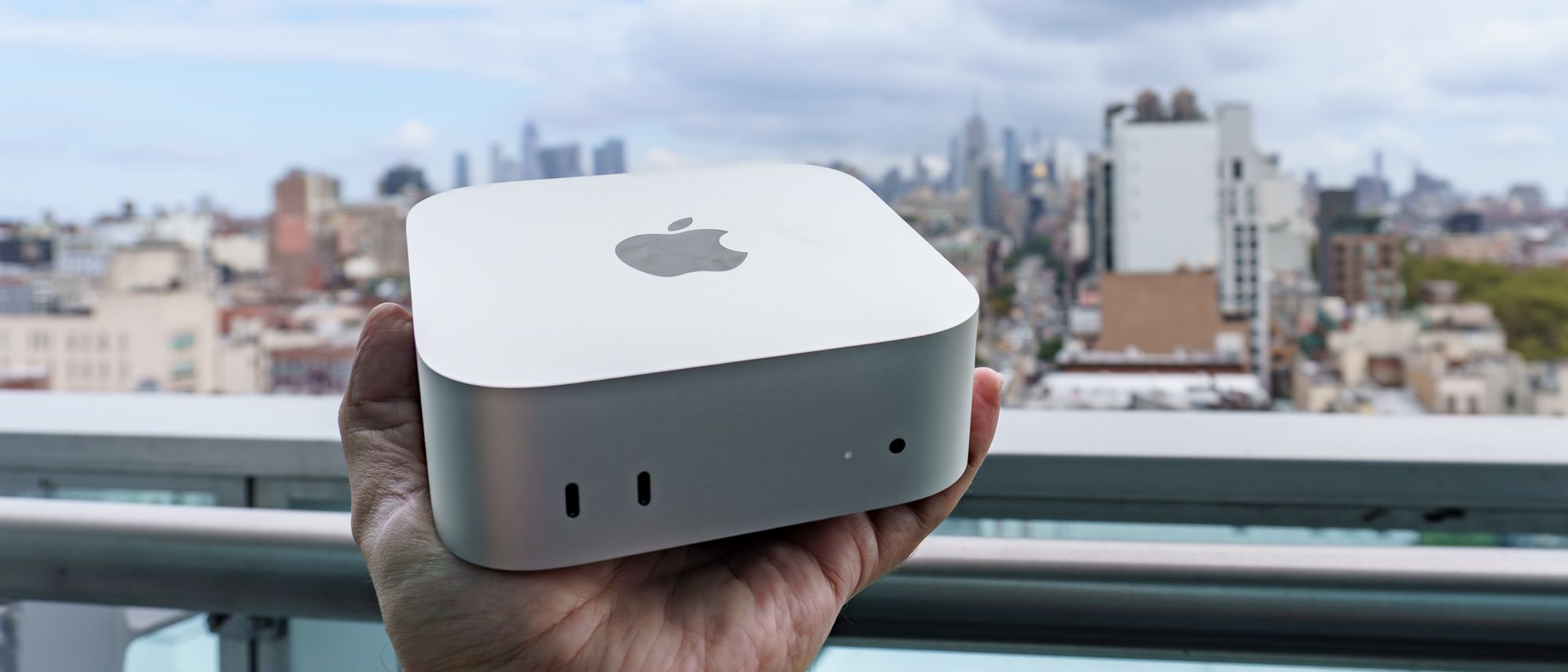
Apple provided our review unit with 24GB of unified memory rather than the base 16GB
- Editor's ChoiceTom's Guide
- 5/5The Guardian
- 8.5/10Pokde.Net
- 3.5/5AppleInsider
A blistering 2nm desktop upgrade marred by steep price jumps and soldered storage
The Mac mini M6 is an excellent choice for desktop users and creative workers who want class-leading single-core speed, silent operation, and compact efficiency in Apple's ecosystem. Its biggest strength is the 2nm M6 processor, which delivers chart-topping CPU responsiveness and capable 1080p graphics while sipping just 4W at idle. The primary catch is financial: a $300 price jump over the previous generation, paired with permanently soldered storage and aggressive upcharges for memory. Compared to rival x86 mini PCs and Apple's own iMac M6, the mini provides unmatched compute density per cubic inch, though shoppers starting without peripherals will find the all-in-one iMac a more straightforward value.
Buy it if
- Desk setups needing chart-topping single-core speed in a 5-inch footprint
- Users running local AI models and 4K video editing without fan noise
- Apple ecosystem owners who already have a high-resolution display and peripherals
Skip it if
- You require post-purchase internal RAM or SSD expandability
- You are on a tight budget and need more than 256GB of storage under $900
- Your workflow relies on legacy USB-A accessories without using adapters
Where to buy
We may earn a commission from purchases or qualifying sign-ups through our links. Affiliate links explained
What reviewers liked
- Fast 2nm M6 chip delivers class-leading single-thread performance
- Compact 5x5-inch aluminum chassis stays silent and cool under sustained load
- Modernized connectivity with Wi-Fi 7, Bluetooth 6.0, and 2.5Gb Ethernet
- Built-in power supply requires only a figure-eight AC cord
- Hardware-accelerated ray tracing enables playable 1080p gaming
What they didn’t
- Starting price increased to $899 while retaining a tight 256GB base SSD
- SSD and unified memory are completely soldered to the logic board
- Base 256GB drive read and write transfer rates are roughly half the 512GB tier
- Power button remains awkwardly situated on the bottom casing
- No USB-A ports or integrated SD card reader
Key specs
- Launch price
- $899 (base 16GB/256GB); $1,299 (tested 24GB/512GB)
- Reported price
- $779 to $899 (base); $1,149 to $1,299 (24GB/512GB)
- Starting Price
- $899
- Tested Configuration Price
- $1,299 (24GB RAM, 512GB SSD)
- Processor
- Apple M6 (12-core CPU, 12-core GPU, Dual 16-core Neural Engine, 2nm)
- Memory
- 24GB unified memory (170 GB/s bandwidth)
- Storage
- 512GB soldered NVMe SSD
- Dimensions
- 5.0 x 5.0 x 2.0 inches (12.7 x 12.7 x 5.0 cm)
- Weight
- 1.5 lbs (0.68 kg)
- Ports
- 3x Thunderbolt 4, 2x USB-C (10Gbps), HDMI 2.1, 2.5Gb Ethernet, 3.5mm audio
- Networking
- Wi-Fi 7, Bluetooth 6.0, Thread border router (Apple N1 chip)
- Power Draw
- 4W idle, ~70W maximum under full load
In depth
Design, build and portability
The Mac mini M6 retains the compact square enclosure introduced on its predecessor, measuring 5.0 by 5.0 inches and standing 2.0 inches tall (12.7 x 12.7 x 5.0 cm), with a weight of 1.5 pounds (0.68 kg). The Guardian noted that the machined aluminum chassis is smaller than a standard headphone box, making it simple to slide under a monitor stand or mount behind a display. Apple continues to integrate the power supply directly into the unit, requiring only a slim figure-eight cable rather than a cumbersome power brick. The primary physical annoyance cited by reviewers at Tom's Guide and Tom's Hardware is the power button, which remains mounted on the bottom base plate, requiring users to tilt the machine slightly to switch it on.
Display
As a headless desktop, the Mac mini does not feature an integrated screen, but reviewers praise its multi-monitor driving capabilities. The M6 platform natively supports up to three external monitors: two displays up to 6K resolution at 60Hz over rear Thunderbolt 4 ports, plus a third display up to 4K at 60Hz via the HDMI 2.1 port. Alternatively, it can power a single 8K monitor at 60Hz or a 4K panel at 240Hz over HDMI. Tom's Guide reported smooth multi-screen operation across high-DPI panels without UI lag, though pro creators seeking extreme bandwidth for quad-display arrays must look to the M5 Pro model, which upgrades the rear bus to Thunderbolt 5.
Performance in everyday and demanding work
Fabricated on TSMC's 2nm process, the 12-core M6 chip delivered substantial generational leaps across independent tests. In Tom's Guide's benchmarking, the Mac mini reached 4,708 points in Geekbench 6.7 single-core and 21,405 in multi-core, posting higher single-thread scores than desktop chips like AMD's Ryzen 9 9950X3D and outrunning the M5 MacBook Pro. Techsponential confirmed it produced the highest single-core score seen to date in both Geekbench 6 and Geekbench 7. In video transcoding, Tom's Guide clocked a 4K-to-1080p Handbrake transcode in 2 minutes and 45 seconds, shaving nearly two minutes off the previous generation. While not a dedicated gaming rig, Tom's Guide recorded 86.8 fps in Sid Meier's Civilization VI at 1080p and 56.9 fps in Cyberpunk 2077 at 1080p, while Tom's Hardware recorded approximately 37 fps at 1440p. Local AI workflows benefit from the dual 16-core Neural Engine and 170 GB/s memory bandwidth, allowing swift local prompt processing in apps like LM Studio.
Battery life
Because the Mac mini M6 is a stationary desktop powered via an AC outlet, it does not include an internal battery. Reviewers evaluated its energy draw instead, where its silicon efficiency proved exceptional. Apple Support and independent testers note that system idle power settles at around 4W, with the fan spinning at a near-inaudible 1,000 RPM. Under maximum CPU and GPU stress testing, power draw remains capped near 70W. Tom's Guide noted that the chassis remained cool to the touch and virtually silent throughout sustained rendering loops, using a fraction of the electricity drawn by equivalent x86 mini desktops.
Keyboard, trackpad, speakers and webcam
The Mac mini ships strictly with the desktop unit and an AC power cord, leaving users to supply all accessories. Reviewers at The Guardian noted that the internal speaker is strictly utilitarian; it works well enough for macOS notification chimes and voice prompts, but produces thin, hollow sound that is unsuited for music or podcast listening. There is no integrated microphone array or webcam, meaning buyers must supply external peripherals. While this allows users to pick their own mechanical keyboards and precision mice, Techsponential and The Guardian remind shoppers transitioning from Windows or laptops to factor in the secondary cost of an external webcam, audio setup, and input devices.
Ports and upgradeability
Port placement is practical, featuring two 10Gbps USB-C ports and a 3.5mm headphone jack on the front, alongside three Thunderbolt 4 (40Gbps) ports, HDMI 2.1, and an upgraded 2.5Gb Ethernet port on the back. Apple's custom N1 chip adds Wi-Fi 7, Bluetooth 6.0, and Thread border router support. However, Tom's Hardware lamented the absence of legacy USB-A ports and an SD card slot. Upgradeability is severely constrained: memory is unified within the M6 package, and AppleInsider confirmed that the internal SSD is permanently soldered to the motherboard, eliminating the modular board approach seen on the M4 mini. Furthermore, AppleInsider clocked the base 256GB drive at 3,150 MB/s, whereas the 512GB drive in our review configuration reached roughly 6,300 MB/s.
Price and configurations
Apple set the base price of the Mac mini M6 at $899 for 16GB of unified memory and a 256GB SSD—a steep $300 jump over the previous model's $599 launch price that reviewers universally criticized. Our tested configuration with 24GB of RAM and a 512GB SSD lists at $1,299, as Apple charges $200 to increase memory to 24GB and another $200 to step up from 256GB to 512GB of storage. AppleInsider noted that 256GB is difficult to live with given that macOS and local AI model caches occupy 40GB to 60GB. In retail channels, the base configuration typically sells between $779 and $899, while the 24GB/512GB tier has seen promotional pricing at $1,149.
Is it worth the money?
A 50% price increase for the base configuration and steep $200 upgrade fees dilute the value, making retail discounts below $800 crucial for budget-conscious shoppers.
Benchmarks
PERFORMANCE
Benchmarks
Geekbench 6.7 single-core
Higher is better · scoreTom’s Guide · full test results ↗Published 2026-09-21 · checked 2026-10-12
Geekbench 6.7 single-core · Mac mini M6: Apple provided our review unit with 24GB of unified memory rather than the base 16GB
Results apply to this publication’s tested models and settings. Check those details before comparing another review.
Test data and methodology
| Product | Result | Test scope |
|---|---|---|
| Mac mini M6 | 4708 | Reviewed model only |
Bars start at zero. Results apply to the tested configuration and settings. Missing products are never assigned zero.
Also consider
- Apple Mac mini (M5 Pro)
Provides Thunderbolt 5 support, 307 GB/s memory bandwidth, and additional GPU cores for intensive video and AI pipelines.
- Apple iMac M6
Offers identical M6 processor performance bundled with a 24-inch 4.5K Retina display, keyboard, mouse, and 12MP webcam.
- Minisforum G1 Pro
A competing compact Windows desktop that offers dedicated graphics, user-replaceable SODIMM memory, and dual NVMe slots.
Reviews we read
This roundup summarizes professional reviews and published specifications; Next Interrupt did not test the product. Roundup updated November 14, 2026. How we work