Laptops & desktops / Review roundup
Lenovo ThinkPad T1g Gen 9
21UG000BUS
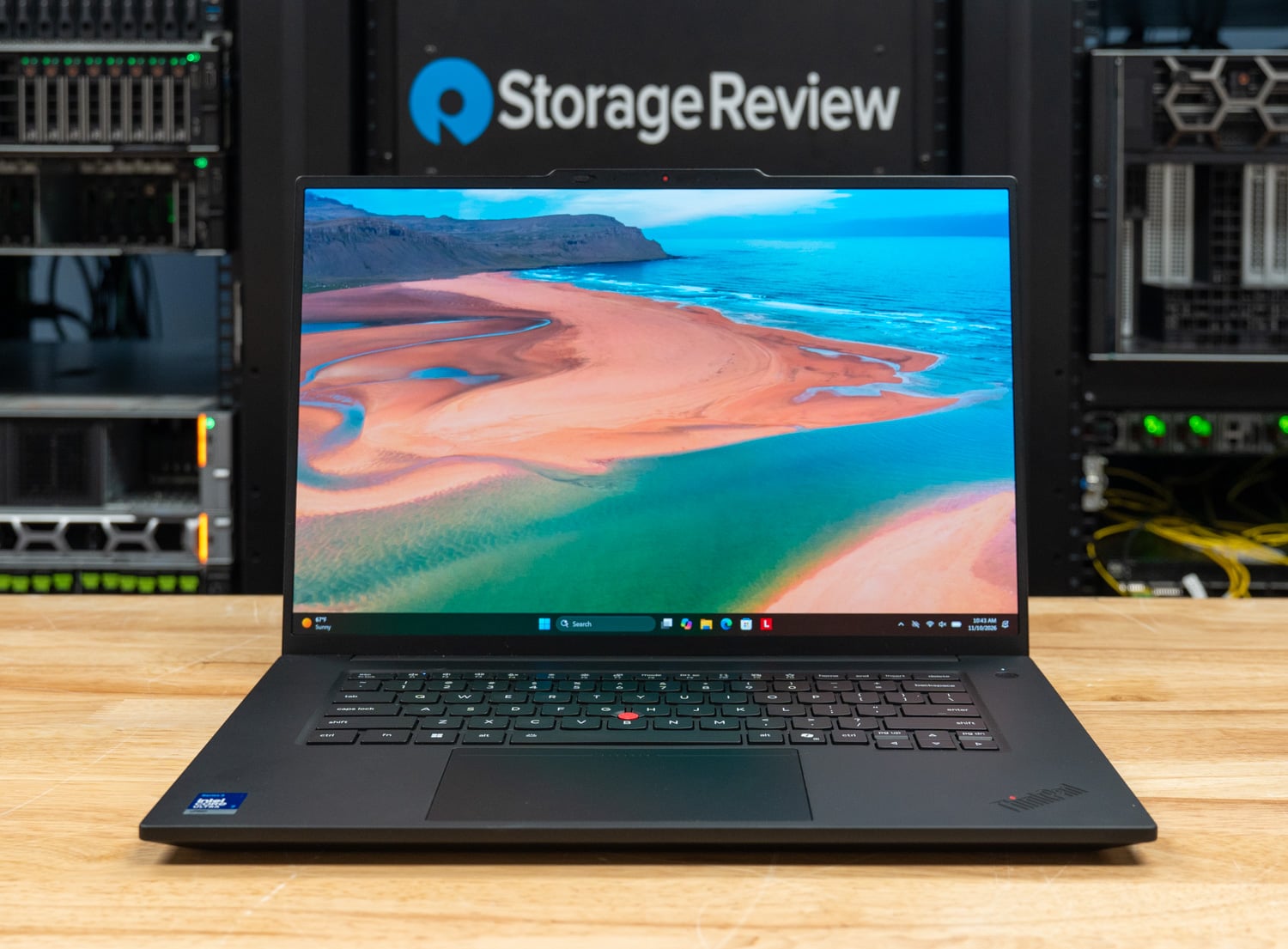
A premium business 16-inch laptop pairing 12GB RTX graphics with modular LPCAMM2 memory
The ThinkPad T1g Gen 9 is built for enterprise developers, 3D designers, and technical creatives who need business-grade manageability alongside a consumer GPU. Its greatest strength is pairing a 12GB GeForce RTX 5070 with modular LPCAMM2 memory and dual PCIe 5.0 storage slots in an aluminum chassis that stays thermally stable under prolonged load. The primary drawback is a steep price tag exceeding $5,300 for OLED configurations, alongside pending battery rundown figures. Compared to its workstation sibling, the ThinkPad P1 Gen 9, the T1g trades ISV-certified drivers for 50 percent more graphics memory, making it far more capable with local generative AI models.
Buy it if
- Engineers and developers running local AI workloads and 3D rendering who need Intel vPro security
- Enterprise users who want a durable 16-inch chassis with user-upgradeable LPCAMM2 memory and dual Gen5 SSD slots
- Creative professionals seeking a color-accurate 3.2K tandem OLED display with 120Hz refresh
Skip it if
- Your workflow relies strictly on ISV-certified enterprise GPU drivers like those on the ThinkPad P1
- You need more than 16GB of video memory for 20B+ parameter AI language models
- You are shopping on a moderate budget, where gaming laptops offer similar raw GPU power for far less
Where to buy
We may earn a commission from purchases or qualifying sign-ups through our links. Affiliate links explained
What reviewers liked
- 12GB GeForce RTX 5070 enables local AI models and generative tasks that 8GB GPUs cannot load
- Excellent sustained thermal performance, retaining 99.5 percent of multi-core CPU output in a 30-minute loop
- Rare upgradeability with a replaceable LPCAMM2 memory module and two PCIe 5.0 M.2 slots
- Vibrant 16-inch 3.2K tandem OLED touch panel rated up to 1,500 nits peak HDR
- Extensive port selection including two Thunderbolt 5 ports, HDMI 2.1, and an SD Express 7.0 slot
What they didn’t
- Extremely high list pricing, topping $5,300 for RTX 5070 and OLED configurations
- No official ISV workstation driver certifications for specialized CAD and engineering packages
- 4K random storage write and read speeds trail comparable workstations despite fast sequential Gen5 throughput
Key specs
- Launch price
- $5,349 as tested (model 21UG000BUS)
- Reported price
- $5,349 (promotions occasionally discount from a $7,639 reference list)
- Starting price
- $3,839 (RTX 5060); $5,349 as tested (21UG000BUS)
- Processor
- Intel Core Ultra 7 366H vPro (16 cores, up to 4.8GHz)
- Graphics
- NVIDIA GeForce RTX 5070 Laptop GPU (12GB GDDR7, 11.7GB usable)
- Memory
- 64GB LPDDR5X-8533 (1x LPCAMM2 socket, upgradeable to 96GB)
- Storage
- 2TB Micron M.2 2280 PCIe Gen5 TLC SSD (2x Gen5 slots, up to 8TB)
- Display
- 16-inch 16:10 3.2K (3200x2000) Tandem OLED touch, 600 nits SDR / 1,500 nits HDR, 40-120Hz VRR
- Battery and charging
- 90Wh battery, 140W USB-C charging (80% in 60 minutes)
- Dimensions
- 354.4 x 241.2 x 9.87-15.8 mm (13.95 x 9.50 x 0.39-0.62 in)
- Weight
- Starts at 1.84 kg (4.06 lb)
In depth
Design, build and portability
The ThinkPad T1g Gen 9 shares its chassis blueprint with Lenovo's thin mobile workstation flagship, the ThinkPad P1 Gen 9. Built with aluminum top and bottom covers, the machine measures 354.4 by 241.2 mm and tapers from a thin 9.87 mm front edge up to 15.8 mm at the rear hinge. Starting weight is 1.84 kg (4.06 lb), keeping it manageable for a 16-inch professional laptop. The exterior features Lenovo's matte black finish, the traditional illuminated red dot on the lid logo, and full MIL-STD-810H durability qualification alongside a discrete TPM 2.0 module and self-healing BIOS.
Display
The configuration tested carries a 16-inch 16:10 tandem OLED touch display running at 3200 by 2000 pixels. The panel is factory-rated for 600 nits of typical SDR brightness and up to 1,500 nits peak in HDR, with full 100 percent DCI-P3 gamut coverage, DisplayHDR 600 True Black, and Dolby Vision support. Motion handling is assisted by a variable refresh rate ranging from 40 Hz to 120 Hz. Buyers seeking lower power draw or matte finishes can configure IPS alternatives: an 800-nit WQUXGA (3840x2400) option or a 500-nit WUXGA (1920x1200) low-power panel.
Performance in everyday and demanding work
In Cinebench 2026, StorageReview recorded a single-core score of 510 and a multi-core score of 4,928 for the Core Ultra 7 366H, landing within 3 percent of the Core Ultra 9 386H in the P1 Gen 9. Sustained cooling proved stable: over a continuous 30-minute stress loop, the processor held 99.5 percent of its initial pass (4,924 opening points to 4,901 steady state). The 12GB GeForce RTX 5070 provides a clear advantage over 8GB workstation GPUs for local AI, generating FLUX.2 klein images at 9.36 per minute, processing Ministral 3 8B at 49.9 tokens per second, and hitting 66.2 tokens per second in MLPerf Client on Llama 3.1 8B. However, with 11.7GB of usable VRAM, models requiring 16GB or more could not be loaded. The 2TB Micron PCIe Gen5 SSD reached sequential speeds of 13,525 MB/s read and 9,238 MB/s write, though random 4K IOPS at QD32 trailed behind comparable Gen5 drives.
Battery life
The system incorporates a 90Wh internal battery paired with a 140W USB-C power adapter that supports rapid charging up to 80 percent in one hour. StorageReview noted that formal battery rundown benchmark numbers will follow in a subsequent lab update. Lenovo advises that the 3.2K tandem OLED panel draws substantially more energy than the lower-resolution 500-nit WUXGA IPS option, making panel selection an important factor for users prioritizing unplugged working time.
Keyboard, trackpad, speakers and webcam
The keyboard uses Lenovo's traditional six-row backlit, spill-resistant layout flanked by the iconic red TrackPoint nub. New for this generation is a large 85 by 135 mm haptic glass touchpad that eliminates mechanical switches. Biometric authentication is handled by a match-on-chip fingerprint reader in the power button alongside a 5MP webcam with an infrared sensor for Windows Hello and human presence detection. The camera is accompanied by a physical privacy shutter. Audio is produced by dual 2W downward-firing speakers tuned with Dolby Atmos, supported by dual far-field microphones running Dolby Voice noise suppression.
Ports and upgradeability
Peripheral connectivity is broad: the chassis offers two Thunderbolt 5 ports and one Thunderbolt 4 port (all supporting DisplayPort 2.1 and USB Power Delivery 3.1 up to 140W input), one 10Gbps USB-A port with always-on charging, an HDMI 2.1 video output, a 3.5mm combo audio jack, a Kensington Nano lock slot, and a full-size SD Express 7.0 card reader. Upgrades are straightforward under the removable bottom plate. Rather than soldered memory, the T1g features a single LPCAMM2 module supporting up to 96GB of LPDDR5X-8533. Internal storage provides two M.2 2280 slots wired for PCIe Gen5 x4 speeds, accommodating up to 8TB in total. Networking is handled by Intel Wi-Fi 7 BE211 with Bluetooth 5.4, with optional WWAN cellular support.
Price and configurations
The evaluated 21UG000BUS configuration—equipped with the Core Ultra 7 366H, 12GB RTX 5070, 64GB of LPCAMM2 RAM, a 2TB Gen5 SSD, and the 3.2K tandem OLED touch panel—lists at $5,349 on Lenovo.com. Stepping up to the Core Ultra 9 386H with identical secondary specs brings the price to $5,449. For buyers who do not need the OLED panel or the top-tier GPU, an alternative configuration pairing the same Core Ultra 7 366H with an 8GB RTX 5060, 64GB of RAM, a 2TB SSD, and an 800-nit WQUXGA IPS display sells for $3,839.
Is it worth the money?
The RTX 5070 and 3.2K tandem OLED combination carries a steep $1,510 premium over the base RTX 5060 configuration with an IPS display. It offers high build quality and upgradeability, but corporate buyers pay heavily for enterprise chassis traits compared to standard creative laptops.
Also consider
- Lenovo ThinkPad P1 Gen 9
Shares the same chassis and cooling platform but uses ISV-certified NVIDIA RTX PRO Blackwell graphics for CAD and workstation stability.
- Dell XPS 16 Creator Edition
Offers unified high-bandwidth memory for larger local AI model ingestion in a sleek 16-inch creator chassis.
- Razer Blade 16
Delivers higher-tier GeForce RTX configurations up to an RTX 5090 with faster raw gaming and rendering performance at a similar price tier.
Reviews we read
This roundup summarizes professional reviews and published specifications; Next Interrupt did not test the product. Roundup updated November 13, 2026. How we work