Storage & NAS / Review roundup
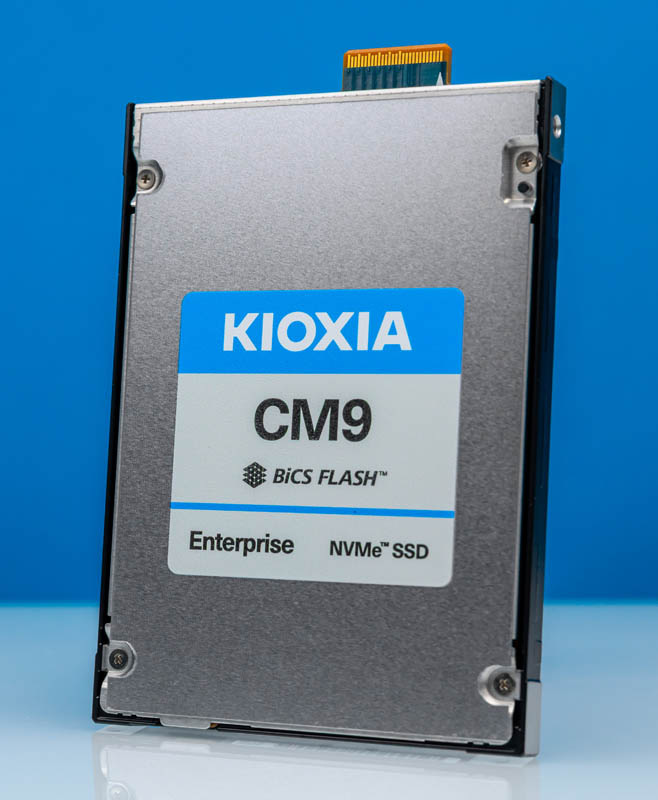
Kioxia CM9-R 15.36TB E3.S NVMe SSD
Kioxia CM9-R 15.36TB E3.S
- Must Have Editor's ChoiceTweakTown
- Best Low-Latency Enterprise SSDStorageReview
A PCIe 5.0 enterprise drive that combines record-setting low queue depth latency with excellent thermal efficiency
The Kioxia CM9-R 15.36TB E3.S is built for data center architects and enterprise infrastructure engineers running latency-sensitive read-heavy workloads, AI inferencing clusters, and large virtualization platforms. Its greatest strength is its eighth-generation BiCS8 TLC NAND with CBA architecture, delivering exceptional low-queue-depth latency and sustained throughput while pulling only 25W. The principal catch is that its 1 DWPD endurance rating is not suited for write-saturated logging tiers, which are better served by 3 DWPD drives like Kioxia's own CM9-V. Compared to rivals like the Micron 9550 MAX and Solidigm D7-PS1010, the CM9-R responds noticeably faster at shallow queue depths where real-world enterprise databases spend most of their time.
Buy it if
- AI model inferencing, GPU Direct Storage, and KV cache pipelines
- High-density 1U server racks requiring E3.S EDSFF form factors and 25W limits
- Read-intensive virtualization and transaction-heavy transactional databases
Skip it if
- Heavy write logging pipelines requiring 3 DWPD or higher endurance ratings
- Legacy server chassis without EDSFF E3.S backplanes or Gen5 host support
Where to buy
We may earn a commission from purchases or qualifying sign-ups through our links. Affiliate links explained
What reviewers liked
- Class-leading low queue depth read and write latency across tests
- Sustained sequential write throughput exceeding 11.3 GB/s
- High thermal and power efficiency with a 25W active ceiling
- Dual-port PCIe 5.0 support for high-availability enterprise arrays
What they didn’t
- Limited to 1 DWPD endurance compared to mixed-use alternatives
- Requires modern EDSFF E3.S server infrastructure for deployment
- Premium acquisition cost compared to QLC enterprise drives
Key specs
- Launch price
- Distributor pricing roughly $2,100 - $2,450 (OEM / B2B contract quoting)
- Reported price
- $2,100 - $2,350
- Form Factor
- EDSFF E3.S (7.5 mm thickness)
- Interface
- PCIe 5.0 x4 (single-port) / PCIe 5.0 x2+x2 (dual-port), NVMe 2.0
- Capacity
- 15.36 TB (15,360 GB)
- NAND Flash
- Kioxia BiCS FLASH generation 8 3D TLC (CBA architecture)
- Sequential Read / Write
- Up to 14,800 MB/s / 11,000 MB/s
- Random Read / Write
- Up to 3,400,000 IOPS / 540,000 IOPS
- Endurance
- 1 DWPD (28,032 TBW)
- Power Consumption
- 25 W typical active
- Warranty
- 5 years
In depth
Sequential and random speeds in tests
Across synthetic and steady-state evaluations, the CM9-R 15.36TB demonstrated unmatched responsiveness at low concurrency while maintaining high aggregate throughput. StorageReview found that at queue depth 1, the CM9-R led all tested Gen5 drives outright, posting 33.6K IOPS at 29.3 µs in 4K random reads and 115.8K IOPS at 8.2 µs in 4K random writes. In 64K random reads at QD1, StorageReview recorded 1,359.0 MB/s at 45.6 µs, reaching peak saturation at a fraction of the concurrency demanded by competing drives. In 64K random write sweeps, it reached 9,635.3 MB/s, trailing only the Micron 9550 MAX. TweakTown evaluated mixed enterprise workloads and measured 1.47 million IOPS at QD4096 in 4K 70/30 testing with a low QD1 latency of 36.7 µs. In balanced 4K 50/50 tests, TweakTown saw the drive cross 1.06 million IOPS, while in 8K 70/30 database patterns it leveled off at 763,000 IOPS, setting test records for a 1-DWPD SSD.
Real-world load and transfer times
In advanced server simulation pipelines, the drive proved equally capable under complex, multithreaded demands. Testing under GPU Direct Storage (GDS) protocols at StorageReview revealed that the CM9-R achieved 136.4K IOPS in small-block reads alongside an exceptionally flat write throughput line that peaked at 5.51 GiB/s, avoiding the thread-scaling volatility seen on earlier Gen5 designs. In multi-pass enterprise benchmarks, StorageReview logged average run times of 462.8 seconds on Pass 1 and 571.9 seconds on Pass 2, matching or beating rivals in its capacity class. ServeTheHome validated real-world host compatibility by testing the drive across diverse architectures, including AMD EPYC (Sorano), Intel Xeon 6, AmpereOne, NVIDIA Grace, and Xsight Labs E1 800Gbps DPU fabrics, concluding that the controller and firmware maintained consistent throughput regardless of platform.
Sustained writes and thermals
Sustained performance over extended runs remains a strong suit of Kioxia's BiCS8 architecture. ServeTheHome reported steady-state sequential write rates hovering just above 11.3 GB/s, surpassing the rated 11.0 GB/s specification and substantially improving upon the 7.23 GB/s delivered by the previous-generation CD9P-R. The drive transitions into steady state predictably during preconditioning without sharp performance drop-offs. Thermally, the EDSFF E3.S form factor provides superior airflow aerodynamics compared to older 2.5-inch U.2 enclosures. Both StorageReview and TweakTown pointed out that while competitors frequently push 28W or higher to achieve peak Gen5 speeds, Kioxia limits typical active draw to 25W, reducing cooling overhead in dense 1U and 2U chassis deployments.
Endurance and warranty
The CM9-R is designated as a read-intensive drive and carries a rating of 1 drive write per day (DWPD) supported by a 5-year manufacturer warranty. For this 15.36TB model, that translates to approximately 15.36 TB of host writes per day, or roughly 28,032 TBW over the warranty lifespan. Hardware-based Power Loss Protection (PLP) and end-to-end data protection are included across all models, with optional firmware support for Sanitize Instant Erase (SIE), Self-Encrypting Drive (SED), and FIPS 140-3 validation. Reviewers emphasize that organizations operating write-heavy transactional logging or heavy caching should step up to the CM9-V mixed-use series (rated at 3 DWPD), but for standard read-heavy web, AI, and database roles, the CM9-R provides ample longevity.
Price per terabyte
Because the CM9-R is an enterprise-class component, sales are handled through server OEMs, value-added resellers, and IT distributors such as Connection and SHI rather than consumer retail shelves. Retail distributor pricing for bare drives generally lands between $2,100 and $2,450 for the 15.36TB capacity, which works out to approximately $137 to $160 per terabyte. Enterprise buyers negotiating volume agreements through server partners like Dell, HPE, or Supermicro often see lower effective costs per terabyte. While high-density QLC storage offers lower initial acquisition cost per terabyte for static data, reviewers note that the CM9-R justifies its pricing by maximizing Gen5 bandwidth, shallow queue depth speed, and power efficiency per rack unit.
Is it worth the money?
Priced around $137 to $160 per terabyte through enterprise distributors, offering competitive value for tier-1 PCIe 5.0 TLC flash, though QLC remains cheaper for bulk storage.
Also consider
- Micron 9550 MAX
Offers faster high-queue-depth sustained sequential writes and 3 DWPD mixed-use endurance, though at higher typical power consumption.
- Solidigm D7-PS1010
A proven Gen5 read-intensive alternative with competitive bulk throughput, though it exhibits higher low-queue-depth latency.
- Kioxia CM9-V 15.36TB
The mixed-use sibling of the CM9-R, offering identical BiCS8 speed profiles with 3 DWPD endurance for write-heavy data pipelines.
Reviews we read
This roundup summarizes professional reviews and published specifications; Next Interrupt did not test the product. Roundup updated November 3, 2026. How we work
- ServeTheHome — Kioxia CM9-R 15.36TB E3.S NVMe SSD Review
- StorageReview — KIOXIA CM9-R 15.36TB Review: BiCS8 Flash Hits Full Speed at Low Queue Depths
- TweakTown — KIOXIA CM9-R 15.36TB E3.S Enterprise SSD Review - Performance King at 1-DWPD