Laptops & desktops / Review roundup
Khadas Mind Pro
Core Ultra X7 358H, 64GB RAM and 2TB SSD
- 4.5 / 5TechRadar
A pocketable mini PC with seamless session portability and a steep price tag
The Khadas Mind Pro is designed for hybrid creators and professionals who want to transport an active Windows workspace between offices without shutting down. Its standout feature is an integrated 7.98Wh standby battery packed into a 0.43-liter aluminum chassis, keeping running applications alive during your commute. The primary obstacle is the steep $2,599 price tag, which climbs even higher if you invest in official modular peripherals like external GPU docks. Compared to Apple's Mac mini M4, the Mind Pro offers unmatched session mobility and modular expandability, but it demands a substantial price premium.
Buy it if
- Hybrid workers who move between multi-monitor desks without closing active projects
- Creative professionals seeking 64GB of RAM in a pocket-sized 0.43-liter chassis
- Users planning to expand graphics performance via the proprietary Mind Link ecosystem
Skip it if
- Shoppers expecting laptop-like battery runtime away from a wall outlet
- Budget-conscious buyers who can get similar raw performance from traditional mini PCs
- Users who need extensive built-in connectivity without buying external docks
Where to buy
We may earn a commission from purchases or qualifying sign-ups through our links. Affiliate links explained
What reviewers liked
- Ultra-compact 0.43-liter CNC aluminum chassis weighing 562 grams
- Integrated 7.98Wh battery maintains active Windows sessions in transit
- Solid creative and multitasking performance with Intel Core Ultra X7 and 64GB RAM
- Tool-free magnetic hatch provides quick access to a second M.2 2230 SSD slot
- Mind Link connector offers high-bandwidth PCIe 5.0 x4 docking
What they didn’t
- Steep $2,599 retail price for the standalone unit
- Limited native ports require add-on docks for complex desk setups
- LPDDR5X system memory is permanently soldered
Key specs
- Launch price
- $1,799 (pre-order launch)
- Reported price
- $2,599
- Processor
- Intel Core Ultra X7 358H
- Graphics
- Intel Arc B390 integrated graphics
- Memory
- 64GB LPDDR5X-8533 (soldered)
- Storage
- 2TB PCIe 4.0 NVMe M.2 2230 SSD (plus one free M.2 2230 slot)
- Standby battery
- 7.98 Wh (rated for up to 48 hours in sleep mode)
- Ports
- 2x Thunderbolt 4 (40Gbps), 1x HDMI 2.1, 2x USB-A 3.2 Gen 2, Mind Link
- Dimensions
- 146 × 105 × 28 mm (0.43 L)
- Weight
- 562 g (1.24 lbs)
In depth
Design, build and portability
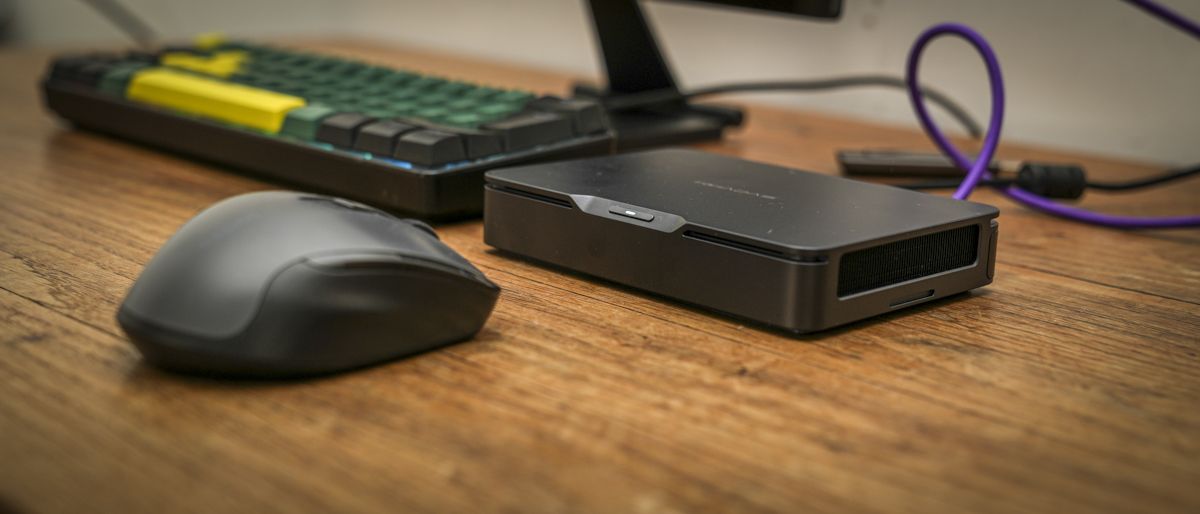
The Khadas Mind Pro measures 146 × 105 × 28 mm and weighs 562 grams, fitting a volume of roughly 0.43 liters. TechRadar praised its high-grade CNC-machined aluminum unibody, noting that it feels dense, rigid, and premium while easily slipping into a coat pocket or small sling bag. Because it functions as a headless mini PC core, it contains no integrated display, keyboard, or trackpad; instead, it is engineered to dock at stationary work areas or clip onto modular accessories like the Mind xPlay portable display. Reviewers highlighted the smooth finish and clean design, noting that it takes up negligible room on a workstation.
Performance in everyday and demanding work
Powered by Intel's Core Ultra X7 358H processor, integrated Arc B390 graphics, and 64GB of fast LPDDR5X memory, the Mind Pro performs well across heavy daily workflows. TechRadar found that it handled Adobe Photoshop, Lightroom, large multi-tab browsing sessions, and 4K video editing in Premiere Pro without hesitation. Benchmark reporting across outlets recorded Cinebench R23 multi-core scores around 19,830 and Geekbench 6 multi-core scores near 15,698, positioning it comfortably among high-end mobile workstations. ETA Prime noted that the Arc B390 integrated graphics can manage 1080p modern gaming when paired with Intel XeSS upscaling. Thermal control remains effective during normal office tasks, though cooling fan noise becomes audible when pushing sustained CPU render loads.
Battery life and standby session portability
Unlike a conventional laptop, the Mind Pro is not designed for untethered mobile computing. Instead, it features an internal 7.98Wh lithium battery dedicated exclusively to standby operation. TechRadar tested its party trick by leaving active editing projects and multiple productivity apps open, disconnecting the 100W USB-C power lead, commuting between office and home, and plugging back in. The Windows session remained fully intact without needing to save, shut down, or reopen files. Khadas rates sleep standby at up to 48 hours, and reviewers confirmed it reliably preserves work states during transit, provided users do not attempt to run demanding tasks while disconnected.
Ports and upgradeability
Onboard physical I/O includes two Thunderbolt 4 ports (40Gbps), two USB 3.2 Gen 2 Type-A ports (10Gbps), and a full-bandwidth HDMI 2.1 port capable of driving 4K at 240Hz or 8K at 60Hz. TechRadar observed that while the native selection is enough for a standard monitor and mouse, power users with extensive peripherals will quickly run short of connections. Expansion relies heavily on Khadas's proprietary Mind Link interface on the base, which delivers PCIe 5.0 x4 bandwidth (128 GT/s) for snapping directly onto the Mind Dock or Mind Graphics 2 external GPU module without reboots. Storage expansion is user-friendly thanks to a tool-free magnetic hatch concealing a second M.2 2230 NVMe slot, though the 64GB of RAM is soldered and cannot be changed.
Price and configurations
The Mind Pro is offered in a single high-tier configuration with the Core Ultra X7 358H, 64GB of LPDDR5X RAM, and a 2TB SSD. While it initially debuted for early pre-orders around $1,799, component costs pushed the official retail price up through 2026 to $2,599. TechRadar highlighted that this steep price tag represents a significant hurdle, especially given that unlocking its modular ecosystem—such as dedicated eGPU enclosures or portable screen docks—requires hundreds of dollars in optional accessories.
Is it worth the money?
Following several price adjustments driven by memory component expenses, the single 64GB/2TB configuration commands a steep $2,599 price, positioning it as an executive luxury compared to mainstream mini PCs.
Also consider
- Apple Mac mini (M4)
Starts at a fraction of the cost with quiet, efficient desktop performance, though it lacks session standby batteries and pocket portability.
- Minisforum AtomMan G7 PT
Offers standard mini PC utility and discrete graphics capability at a much lower price point, albeit in a bulkier chassis without modular docking.
- ASUS ROG NUC
Features built-in dedicated NVIDIA discrete graphics in a compact form factor without requiring an external proprietary eGPU dock.
Reviews we read
This roundup summarizes professional reviews and published specifications; Next Interrupt did not test the product. Roundup updated October 25, 2026. How we work