Phones & tablets / Review roundup
Apple iPhone Duo
iPhone Duo
- 4.5/5Tom's Guide
- 4/5TechRadar
- 4/5PCMag
- 4.5/5Mashable
- 8.8/10Engadget
- 8.7/10CNET
Apple's first foldable delivers refined hardware and a crease-taming display at a steep financial cost
The iPhone Duo is best suited for Apple loyalists and mobile workers who want a pocket phone that unfolds into an expansive 7.6-inch tablet canvas. Its biggest strength is its physical engineering, pairing a sturdy titanium frame and IP68 water resistance with an anti-reflective matte screen that conceals the hinge crease better than rival foldables. The biggest catches are the $1,999 starting price and the sacrifice of flagship perks like a telephoto camera and Face ID. Compared with Samsung's Galaxy Z Fold 8, the Duo delivers stronger battery endurance and a less reflective folding screen, but trails Samsung in multitasking flexibility and weight.
Buy it if
- Users who want a pocket-sized device that expands into a 7.6-inch tablet display
- Digital note-takers wanting Apple Pencil precision on an iPhone for the first time
- Media consumers who prioritize anti-reflective display coating and zero screen glare
Skip it if
- Mobile photographers who need a 5x dedicated optical telephoto zoom lens
- Power users demanding three or more simultaneous floating app windows
- Shoppers unwilling to pay a $2,000 premium for a first-generation foldable
Where to buy
We may earn a commission from purchases or qualifying sign-ups through our links. Affiliate links explained
What reviewers liked
- Nano-texture matte finish minimizes glare and disguises the center hinge crease
- Grade 5 titanium chassis feels sturdy and carries a certified IP68 rating
- A20 Pro chip delivers rapid performance with smooth sustained thermal stability
- Battery life lasted over 13 hours on the inner display in standardized testing
- Supports the Apple Pencil on the internal folding screen
What they didn’t
- Entry-level $1,999 price makes it one of the most expensive phones on the market
- Lacks a dedicated optical telephoto camera and ProRAW or ProRes video recording
- iOS restricts split-screen multitasking to only two applications side by side
- Replaces Face ID facial recognition with a side-mounted Touch ID sensor
Key specs
- Launch price
- $1,999 (256GB), $2,199 (512GB), $2,499 (1TB), $2,799 (2TB)
- Reported price
- $1,999 to $2,199
- Inner Display
- 7.6-inch Super Retina XDR OLED (2670 x 1878, 120Hz ProMotion, nano-texture)
- Cover Display
- 5.4-inch Super Retina XDR OLED (120Hz ProMotion, Ceramic Shield 2)
- Processor
- Apple A20 Pro (2nm, 6-core CPU, 7-core GPU)
- RAM
- 12GB
- Storage
- 256GB, 512GB, 1TB, 2TB
- Rear Cameras
- 48MP Main (f/1.6, sensor-shift OIS), 48MP Ultra Wide (f/2.2)
- Battery Capacity
- 4,883 mAh dual-cell system
- Charging
- Up to 50% in 20 min with 60W USB-C; 25W MagSafe/Qi2
- Dimensions
- Folded: 117.8 x 84.1 x 11.3 mm; Unfolded: 117.8 x 164.6 x 5.2 mm
- Weight
- 254 g (8.96 oz)
- Durability Rating
- IP68 water and dust resistance
In depth
Design and durability
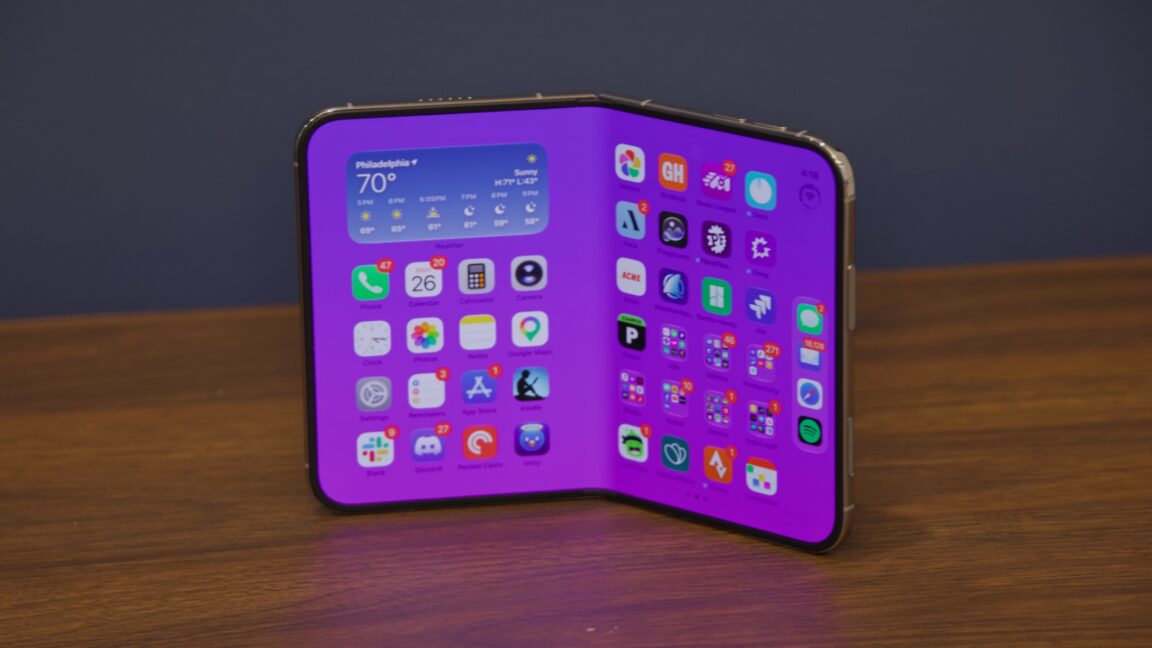
The iPhone Duo adopts a passport-style book folding format built around a Grade 5 titanium frame and a titanium hinge housing. Folded, it measures 117.8 by 84.1 mm with an 11.3 mm thickness, unfolding into a 5.2 mm slab that weighs 254 grams. Reviewers at Tom's Guide noted that the construction feels remarkably dense and rigid, comparing the feel to Apple's standard Pro phones rather than flimsy early foldables. It holds an IP68 certification against dust and water immersion up to 6 meters for 30 minutes, an uncommon rating for foldables. In lab stress tests, CNET folded the hinge more than 450,000 times before recording the first signs of mechanical friction. In teardown testing, however, iFixit discovered that microscopic dust particles can still work past the hinge gaskets into internal gear teeth. Longtime iPhone users will also notice that Apple omitted Face ID, relying instead on a Touch ID capacitive sensor integrated directly into the side power button.
Display
The front cover features a 5.4-inch OLED display protected by Ceramic Shield 2, while opening the device reveals a square 7.6-inch Super Retina XDR folding OLED panel running at a 2670 by 1878 resolution with 120Hz ProMotion. The headline development across professional reviews is the matte nano-texture glass layer applied to the flexible interior screen. Tom's Guide and TechRadar reported that this treatment virtually conceals the center crease when viewed straight on, eliminating the distracting reflections common to glossy polymer screens. While reviewers at TechRadar noted that the crease can still be felt lightly under deliberate finger pressure, Tom's Guide found it largely imperceptible during everyday swiping. The interior panel also supports Apple Pencil input, turning the device into an on-the-go sketching tablet.
Cameras (daylight, low light, zoom, video)
To fit the thin 5.2 mm halves, Apple limited the Duo to a dual-camera rear array consisting of a 48MP main camera and a 48MP ultra-wide sensor, paired with a 12MP external cover selfie camera and an interior under-display sensor. In testing across Tom's Guide and CNET, standard daylight images and 4K Dolby Vision video clips produced the sharp contrast, balanced color, and fast autofocus expected of modern iPhones. However, reviewers unanimously highlighted the lack of an optical telephoto lens as a substantial concession for a $1,999 phone. While 2x sensor-crop images remain clear, digital zoom beyond 3x quickly softens in dim lighting compared to the 5x periscope module on the iPhone 18 Pro Max. Furthermore, Macworld pointed out that pro-tier creative tools—such as ProRAW capture, Log 2 video gamma, and manual shutter settings—are absent from the Duo's camera software.
Performance and gaming
The iPhone Duo is driven by Apple's 2nm A20 Pro system-on-a-chip, paired with 12GB of RAM and Apple's in-house C2 modem. Across synthetic testing, the Duo proved to be the fastest foldable available. In Tom's Guide graphics benchmarking, the Duo posted a score of 16,496 at 62.3 frames per second in 3DMark Solar Bay Unlimited, matching the standard iPhone 18 Pro and outpacing competing Android foldables. To control thermals inside the thin chassis, Apple integrated an internal vapor chamber. In 3DMark Wild Life Extreme looping stress tests, Tom's Guide recorded a 75.9% stability score. While thermal scans showed the titanium frame runs warmer to the touch during extended 3D gaming sessions than thicker slab phones, reviewers experienced zero game hitching or frame rate drops during daily use.
Battery life and charging speed
Power is supplied by a split dual-battery array with a total capacity of 4,883 mAh. Endurance varies substantially depending on which panel is active. Macworld noted that heavy usage on the 7.6-inch interior screen drains the phone rapidly, whereas sticking predominantly to the cover display yields multi-day stamina. In Tom's Guide standardized battery test—which browses websites continuously at 150 nits over cellular on the unfolded display—the iPhone Duo lasted 13 hours and 20 minutes. That easily outlasted the Samsung Galaxy Z Fold 8 (10 hours and 6 minutes) and Google Pixel 11 Pro Fold (12 hours and 31 minutes), though it fell short of the 17 hours and 31 minutes logged by the iPhone 18 Pro Max. Wired fast-charging hits a 50% replenish in roughly 20 minutes with a 60W adapter, complemented by 25W wireless charging over MagSafe and Qi2.
Software and update promise
Running iOS 27, the Duo introduces foldable interface tweaks such as a persistent side dock and automatic app continuity when opening or closing the device. Apps smoothly adapt between full-screen tablet canvas and compact exterior views. However, professional reviewers at Engadget and Tom's Guide found the multitasking capabilities conservative. The software restricts side-by-side multitasking to two concurrent apps via Split View, missing the three-app grid, floating pop-up windows, and desktop external monitor mode provided by Samsung's software. On longevity, Apple maintains its typical industry support cadence, providing guaranteed major iOS platform updates and security patches for at least five to seven years.
Price and storage options
The iPhone Duo launched at $1,999 for the 256GB base model, increasing to $2,199 for 512GB, with 1TB and 2TB versions priced higher. It sells at full retail price across standard carrier and Apple Store channels. Reviewers broadly agree that the phone is a high-cost statement piece for early adopters rather than a pragmatic upgrade. Spending $2,000 asks buyers to pay an $800 premium over an iPhone 18 Pro while giving up telephoto camera reach, pro video tools, and Face ID in exchange for the foldable form factor.
Is it worth the money?
At an opening price of $1,999, the iPhone Duo is an expensive luxury purchase. Buyers pay a significant premium over traditional Pro iPhones while giving up dedicated zoom cameras and Face ID.
Benchmarks
PERFORMANCE
Benchmarks
Measurement coverage
- GPU: 3 tests
- Battery: 2 tests
- Display: 3 tests
Charts include only the measurements shown here, with settings and source links. Reviews may contain additional tests. Camera comparisons and subjective heat observations are discussed in the review findings.
Brightness Nits (SDR)
Higher is better · nitsTom’s Guide · full test results ↗Published 2026-10-21 · checked 2026-10-23
Brightness Nits (SDR) · iPhone Duo: iPhone Duo
Results apply to this publication’s tested models and settings. Check those details before comparing another review.
Test data and methodology
| Product | Result | Test scope |
|---|---|---|
| Apple iPhone Duo | 1986 | Reviewed model only |
Bars start at zero. Results apply to the tested configuration and settings. Missing products are never assigned zero.
Also consider
- Samsung Galaxy Z Fold 8
Offers three-app multitasking, a lighter chassis, and a dedicated 3x telephoto camera for roughly $100 less.
- Apple iPhone 18 Pro Max
Delivers longer battery endurance, Face ID, and a 5x periscope telephoto lens for hundreds of dollars less.
- Apple iPad mini
Provides a similar 8.3-inch tablet canvas with Apple Pencil support at a fraction of the Duo's price when paired with a standard phone.
Reviews we read
This roundup summarizes professional reviews and published specifications; Next Interrupt did not test the product. Roundup updated November 14, 2026. How we work
- Tom's Guide — Apple iPhone Duo review: My favorite foldable, but there's a catch
- TechRadar — Apple iPhone Duo review: this is the foldable Apple fans have been waiting for
- Engadget — iPhone Duo vs. iPad Mini: Which Apple device is right for you?
- Macworld — iPhone Duo guide: Release date, price, specs and first reviews
- Engadget — Apple iPhone Duo review: A first-class foldable
- WIRED — Apple iPhone Duo Review: Is It Worth It?
- Ars Technica — Apple iPhone Duo review: Two screens, two experiences, two thousand dollars
- Macworld — iPhone Duo guide: Price, specs, availability, problems and reviews
- Android Central — Apple iPhone Duo review: the greatest iPhone ever made
- Macworld — Macworld Podcast: iPhone Duo review
- The Verge — The iPhone Duo should have been an iPad
- Macworld — iPhone Duo review roundup: A little weird, a lot of fun, and a breath of fresh air
- 9to5Google — iPhone Duo review roundup: The same problems Android foldables face, but with Apple’s polish
- Notebookcheck — Apple iPhone Duo reviews are in: Plenty of criticism, but positive hinge stress test
- The Verge — I reviewed the iPhone Duo, ask me anything
- 9to5Mac — iPhone Duo review: The future is foldable
- The Verge — The iPhone Duo is a messy, expensive, good time