Storage & NAS / Review roundup
Goodram PX700
2TB
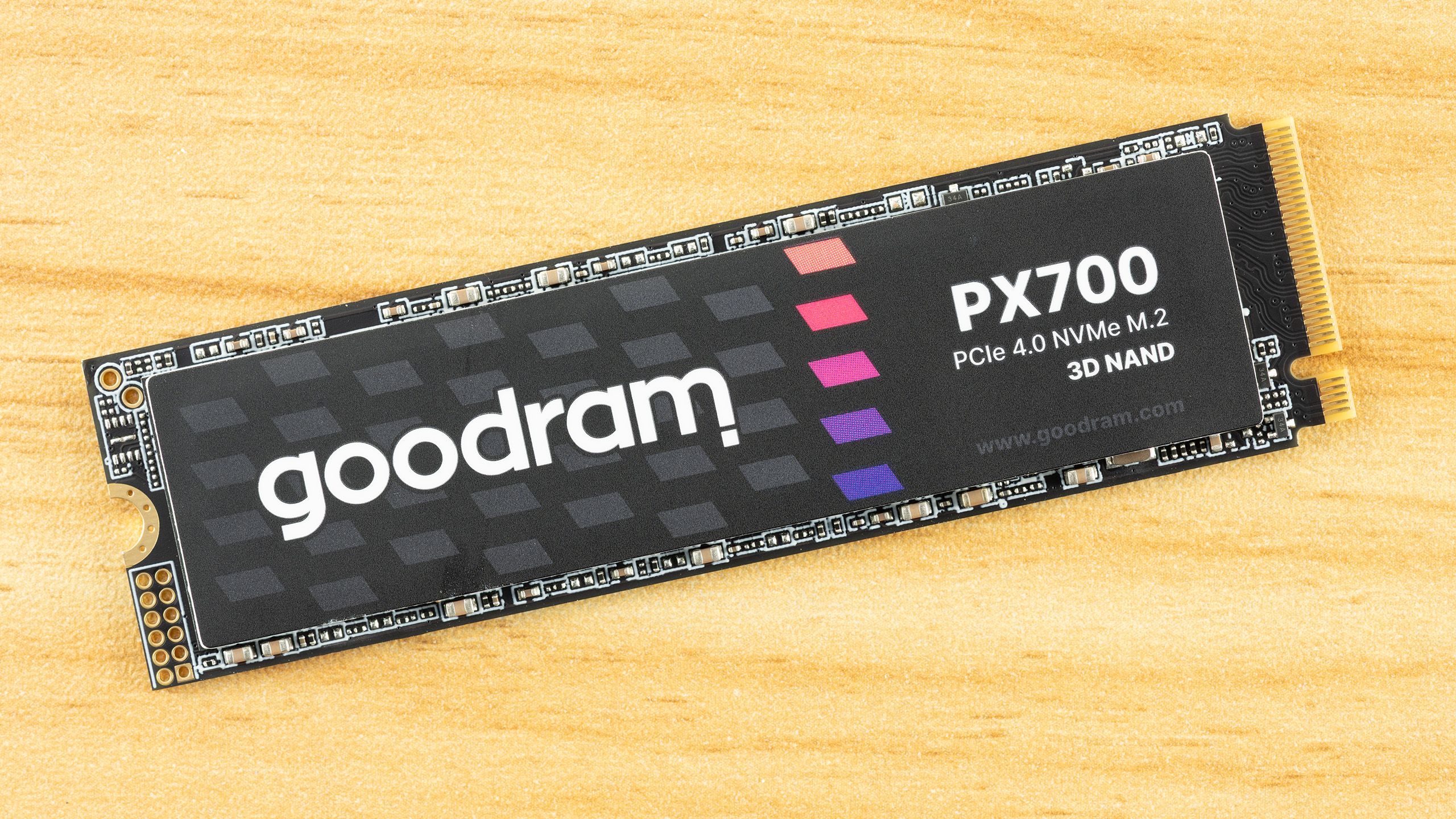
A cool, efficient PCIe 4.0 SSD for laptops and PS5 that is held back by slow folding and US pricing
The Goodram PX700 2TB is a solid choice for laptop owners and PlayStation 5 gamers in Europe seeking cool-running, responsive storage. Its biggest strength is snappy day-to-day burst performance combined with exceptional power efficiency from its DRAM-less Maxio controller and graphene label. However, the drive stumbles hard during massive continuous file writes, where post-cache folding speeds drop to just 163 MB/s. While it trades blows with mainstream rivals like the Crucial P310 and WD Blue SN5100 in app loading, inflated import pricing outside Europe severely dampens its value.
Buy it if
- Laptop users needing a slim, single-sided drive that runs exceptionally cool
- PlayStation 5 console owners looking for snappy game-loading speeds
- European PC builders who can buy Goodram hardware at standard local retail prices
Skip it if
- You frequently copy massive video files or perform heavy sustained write tasks
- You are shopping in the US, where scarce stock causes wildly inflated retail pricing
- You rely on a manufacturer-supplied software suite for drive health and cloning
Where to buy
We may earn a commission from purchases or qualifying sign-ups through our links. Affiliate links explained
What reviewers liked
- Snappy burst read and write performance across gaming and OS tasks
- Remarkably power-efficient and runs cool without requiring a thick heatsink
- Single-sided M.2 2280 form factor fits cramped laptop and console slots
- Generous 1,200 TBW endurance rating and five-year factory warranty
What they didn’t
- Severe post-cache write slowdown down to 163 MB/s during sustained workloads
- Heavily inflated pricing and poor availability in North American retail channels
- No manufacturer toolbox or disk-cloning utility provided
Key specs
- Launch price
- $160 / €160
- Reported price
- $130–$160 in Europe (severely inflated on US import listings)
- Form Factor
- M.2 2280 (Single-sided)
- Interface
- PCIe 4.0 x4, NVMe 2.0
- Controller
- Maxio MAP1602A (Quad-core, DRAM-less with HMB)
- NAND Flash
- 232-layer 3D NAND
- Sequential Read
- Up to 7,400 MB/s
- Sequential Write
- Up to 6,500 MB/s
- Random 4K IOPS
- Up to 1,000,000 read / 820,000 write
- Endurance (TBW)
- 1,200 TBW (2TB model)
- Warranty
- 5 years
In depth
Sequential and random speeds in tests
On paper, the Goodram PX700 2TB maxes out the PCIe 4.0 interface with ratings of 7,400 MB/s sequential read and 6,500 MB/s sequential write, alongside 1 million read IOPS. In synthetic testing by Tom's Hardware, the quad-channel Maxio MAP1602A controller delivers on these targets during burst workloads, taking full advantage of Host Memory Buffer (HMB) to offset the lack of dedicated DRAM. Random 4K read and write latency at low queue depths proved particularly competitive, matching or exceeding several pricier TLC drives.
Real-world load and transfer times
In 3DMark's Storage Benchmark, which simulates game installations, file saves, and gameplay streaming, Tom's Hardware measured latency around 40 microseconds and bandwidth above 700 MB/s. That places the PX700 right alongside top mainstream PCIe 4.0 drives like the Crucial P310 and WD Blue SN5100, while soundly outpacing entry-level options like the Kingston NV3. In PCMark 10 application traces, the drive mirrored premium competitors for everyday productivity. It also cleared Sony's 5,500 MB/s recommendation during PlayStation 5 console testing, keeping game transfers and level load times swift and consistent.
Sustained writes and thermals
Extended writing reveals the PX700's primary hardware limitation. Tom's Hardware observed that the 2TB drive relies on a massive dynamic pseudo-SLC write cache of roughly 500 GB when empty. Once this cache is exhausted during prolonged writes, the controller drops directly into a folding state, slowing write speeds to an average of just 163 MB/s. The trade-off is exceptional thermal and energy efficiency: the 12nm controller, paired with a slim graphene heatspreader label, consumed between 3.3W and 4.7W under load and stayed under 70°C without requiring a bulky aftermarket heatsink.
Endurance and warranty
Goodram covers the PX700 with a five-year limited warranty and a rated endurance of 1,200 TBW for the 2TB model (600 TBW per terabyte), paired with a 1.5-million-hour MTBF. While Tom's Hardware noted performance behavior indicative of high-layer QLC flash rather than TLC, the published TBW rating provides plenty of write tolerance for mainstream computing and gaming. Note that Goodram does not supply a custom SSD management suite, meaning users must turn to third-party tools for firmware updates, drive health tracking, and system cloning.
Price per terabyte
Value is the PX700's most volatile characteristic. Produced by Poland-based Wilk Elektronik, the drive is reasonably priced in European markets at around €160 for 2TB (approximately $85 to $90 per terabyte), placing it in direct competition with budget PCIe 4.0 options. In the US, however, limited distribution and memory shortages led to third-party seller listings hitting upwards of $613 during testing. Tom's Hardware emphasized that while the drive is compelling at standard budget pricing, any markup over $130 to $150 makes it impossible to recommend over established competitors.
Is it worth the money?
Competitive value at European retail prices, but severe US import markups make it unviable in North America.
Also consider
- Crucial P310
Offers similar burst PCIe 4.0 speeds and compact design with dependable US retail pricing and availability.
- Lexar NM790
Uses the same Maxio MAP1602 controller paired with TLC flash for far superior sustained write speeds.
- WD Blue SN5100
Delivers superior random read latency and robust proprietary software support at a mainstream price.
- Kingston NV3
A cheaper, widely distributed budget PCIe 4.0 drive suitable for non-critical secondary game storage.
Reviews we read
This roundup summarizes professional reviews and published specifications; Next Interrupt did not test the product. Roundup updated November 5, 2026. How we work