Graphics cards / Review roundup
GMKtec Neo-X1 Pro
Neo-X1 Pro (as tested)
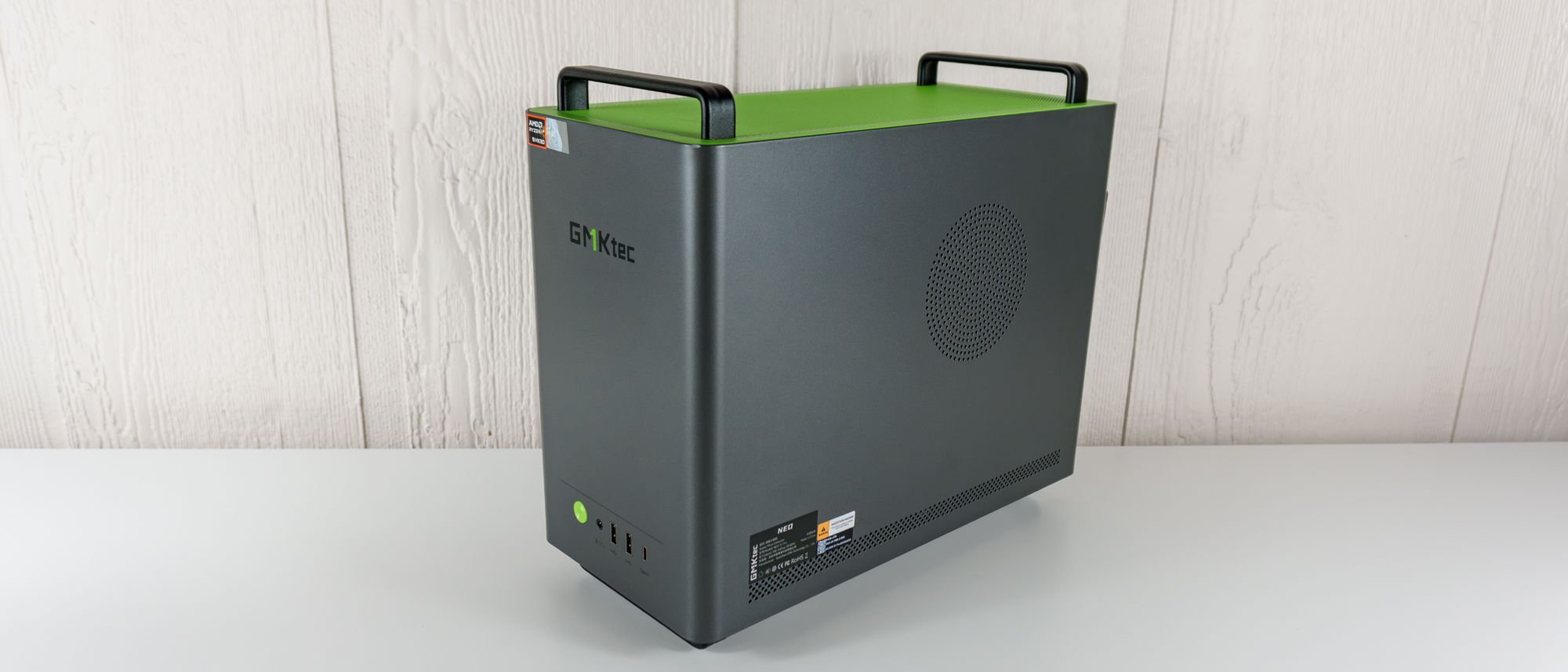
Desktop RTX 5070 gaming and whisper-quiet cooling packed into a portable 14.6-liter chassis
The GMKtec Neo-X1 Pro is built for gamers and creative professionals who want discrete RTX 5070 performance in a compact footprint without the loud fan noise typical of small-form-factor builds. Its primary strength is thermal management, keeping system acoustics to a faint hum even during demanding gaming sessions. The biggest drawback is the soldered mobile processor and a significant price premium over standard desktop towers. While custom mini-ITX builds offer better value and processor upgradability, the Neo-X1 Pro provides a turnkey, exceptionally quiet package.
Buy it if
- Gamers seeking small-form-factor performance without loud fan noise
- Living room or desk setups requiring a portable, handle-equipped rig
- Players targeting fluid 1440p and 4K gaming using DLSS upscaling
Skip it if
- You want full platform upgradeability, including the CPU socket
- You are shopping on a tight budget where a standard desktop mid-tower offers more value
- You require USB4 or Thunderbolt peripheral support
Where to buy
We may earn a commission from purchases or qualifying sign-ups through our links. Affiliate links explained
What reviewers liked
- Whisper-quiet acoustic profile even under sustained gaming workloads
- Desktop-grade NVIDIA RTX 5070 graphics card delivers strong 1440p and 4K performance
- Compact 14.6-liter chassis features sturdy integrated carrying handles
- Upgradable DDR5 memory slots and dual M.2 NVMe storage bays
What they didn’t
- Substantial price premium over standard DIY mid-tower systems
- Mobile AMD processor is permanently soldered to the motherboard
- No USB4 or Thunderbolt ports included on rear or front I/O
Key specs
- Launch price
- $2,899
- Reported price
- $3,099 to $3,199
- Graphics Card
- NVIDIA GeForce RTX 5070 (12GB GDDR7)
- Processor
- AMD Ryzen 9 9955HX3D (16 cores, 32 threads, 128MB 3D V-Cache)
- Memory
- 64GB DDR5-5600 (tested, expandable up to 96GB)
- Storage
- 2TB PCIe NVMe SSD (dual M.2 slots, supports up to 16TB)
- Chassis Volume
- 14.6 liters
- Dimensions
- 350 x 165 x 310 mm (with handles attached)
- Power Supply
- 850W SFX 80 Plus Gold internal PSU
- Display Connectivity
- 1x HDMI 2.1b, 3x DisplayPort 2.1b
In depth
Gaming performance at 1080p, 1440p and 4K (fps in named games)
In Tom's Guide lab testing, the Neo-X1 Pro easily maintained triple-digit frame rates at 1080p without relying on upscaling algorithms. Stepping up to 4K resolution, Forza Horizon 6 ran at a fluid 96 fps on High settings. Demanding AAA titles presented more of a test: in Black Myth: Wukong at 4K, native Cinematic settings dipped to 25 to 36 fps, but lowering the graphics preset to Medium raised performance to 51 fps. Across 1440p testing in heavy titles like Cyberpunk 2077 and DOOM: The Dark Ages, reviewers found the system comfortable delivering stable, high-refresh rates across ultra presets.
Ray tracing and upscaling (DLSS/FSR)
Equipped with a discrete desktop RTX 5070, the system supports hardware-accelerated ray tracing along with NVIDIA's DLSS feature set, including Super Resolution, Ray Reconstruction, and Frame Generation. Tom's Guide and other reviewers noted that while moderate ray tracing works smoothly at 1440p native, more demanding titles require DLSS to ensure smooth 60 fps output, especially at 4K. Engaging DLSS Quality mode allowed demanding scenes in games like Cyberpunk 2077 to transition from borderline 35 fps results into playable 60-plus fps experiences.
Power draw, heat and noise
Acoustics are the defining attribute highlighted by reviewers. Tom's Guide observed that from the moment the system powered on, it produced only a faint background hum, remaining near-silent even while running demanding games under full load. GMKtec accomplished this by pairing a custom 240mm all-in-one liquid CPU cooler with well-ventilated side panels, pulling cool air across the internal triple-fan graphics card and exhausting heat without high-pitched fan whine.
Memory (VRAM) and future-proofing
The installed RTX 5070 provides 12GB of GDDR7 VRAM, which reviewers noted is sufficient for modern 1440p gaming and well-optimized 4K titles. However, pushing native 4K with ray tracing and ultra textures in future releases will increasingly require upscaling to stay within the 12GB VRAM buffer. On the system side, the test unit provided 64GB of DDR5 memory and dual M.2 NVMe storage slots accommodating up to 16TB. The primary upgrade constraint is the motherboard: the AMD Ryzen 9 9955HX3D mobile chip is soldered directly to the board, meaning the CPU cannot be swapped in the future, though the desktop graphics card sits in a standard PCIe slot and can be replaced.
Size, power connector and PSU needs
The Neo-X1 Pro measures 350 x 165 x 310 mm with its top and bottom handles attached, resulting in an internal volume of 14.6 liters, roughly equivalent to two Xbox Series X consoles stacked together. Removing the handles cuts the height by 55 mm. Power delivery is handled by an internal 850W SFX 80 Plus Gold modular power supply, using standard internal PCIe cabling for the graphics card and an ordinary rear IEC AC power cord, eliminating the need for external power bricks.
Price versus competing cards
The Neo-X1 Pro launched at $2,899, with standard retail pricing hovering around $3,099 to $3,199 (and list prices reaching $3,699 during component supply fluctuations). This is noticeably more expensive than building an equivalent desktop mid-tower, where an RTX 5070 card and a desktop Ryzen chip can be purchased for far less. However, against other boutique prebuilt small-form-factor PCs, the pricing reflects the integrated liquid cooling, 64GB of RAM, and ultra-quiet tuning right out of the box.
Is it worth the money?
The Neo-X1 Pro carries a visible price premium over standard desktop towers, which reviewers attribute to the cost of high-density SFF engineering, liquid cooling, and 64GB of DDR5 memory.
Also consider
- Custom Mini-ITX PC (RTX 5070)
Allows an upgradeable socketed desktop CPU and customizable components at a lower total price if you are willing to build it yourself.
- HP Victus 15L
Offers an entry-level compact desktop chassis with desktop-class graphics at a far more budget-conscious price point.
- Steam Machine / Living Room Mini PC
Significantly smaller and cheaper for lightweight television gaming, though delivering only a fraction of the RTX 5070 graphical horsepower.
Reviews we read
This roundup summarizes professional reviews and published specifications; Next Interrupt did not test the product. Roundup updated November 10, 2026. How we work