Laptops & desktops / Review roundup
GMKtec EVO-X3
AMD Ryzen AI Max+ 395, 16C/32T (5.1GHz)
- 4 / 5TechRadar
A specialized compact AI workstation whose massive 128GB unified memory offsets a high price tag
The GMKtec EVO-X3 is designed specifically for AI researchers, developers, and power users who need to run large 70B parameter language models locally without recurring cloud compute bills. Its main asset is AMD's Ryzen AI Max+ 395 processor paired with 128GB of fast unified memory, allowing up to 96GB to be allocated directly to graphics tasks. The primary hurdles are its $3,799 price, non-upgradable soldered memory, and a Windows-based AI software stack that requires manual setup. Compared to an Apple Mac Studio, it offers native x86 Windows and Linux support plus an OCuLink expansion port, even if Apple provides a more polished plug-and-play workflow.
Buy it if
- Developers and homelab users needing to run large 70B parameter AI models offline
- Professionals seeking 16 full Zen 5 cores and up to 96GB assignable VRAM in a compact footprint
- Users who want a quiet desktop workstation with high-speed OCuLink eGPU expansion
Skip it if
- Shoppers looking for a general-purpose mini PC on a standard budget
- Users who require user-upgradable SO-DIMM memory slots
- Buyers expecting a turn-key, zero-configuration local AI experience out of the box
Where to buy
We may earn a commission from purchases or qualifying sign-ups through our links. Affiliate links explained
What reviewers liked
- 128GB of LPDDR5X-8000 unified memory allows allocating up to 96GB as VRAM for large LLMs
- Redesigned triple-fan cooling system sustains up to 140W power targets with low noise
- 16 Zen 5 cores deliver strong multi-threaded performance in heavy rendering and compilation
- Integrated 40 CU Radeon 8060S GPU delivers performance competitive with a mobile RTX 4060
- Built-in OCuLink port enables PCIe 4.0 x4 connectivity for external GPU enclosures
What they didn’t
- Steep $3,799 entry price limits appeal to specialized enterprise and developer workflows
- Soldered LPDDR5X memory cannot be upgraded after purchase
- Local AI deployment on Windows and DirectML requires technical configuration
- Requires a large external 300W power supply brick
Key specs
- Launch price
- $3,600 (pre-order) / $3,799 (MSRP)
- Reported price
- $3,799
- Processor
- AMD Ryzen AI Max+ 395 (16 cores, 32 threads, up to 5.1 GHz, TSMC 4nm)
- Graphics
- AMD Radeon 8060S (RDNA 3.5, 40 Compute Units, 2,560 stream processors)
- NPU
- AMD XDNA 2 (50 TOPS; 126 total platform TOPS)
- Memory
- 128GB LPDDR5X-8000 (soldered, 256-bit bus, up to 96GB allocatable VRAM)
- Storage
- 2TB or 4TB PCIe 4.0 NVMe SSD (2x M.2 2280 slots)
- Form Factor & Cooling
- 41 mm slim vertical blade tower; triple fans with 3 heat pipes (54W to 140W TDP modes)
- Ports
- 1x OCuLink (PCIe 4.0 x4), 1x USB4, 1x HDMI 2.1, USB-A ports, 1x 2.5 Gbps LAN, 3.5mm audio
- Wireless
- Wi-Fi 7, Bluetooth 5.4
- Power Supply
- External 300W DC power brick
In depth
Design, build and portability
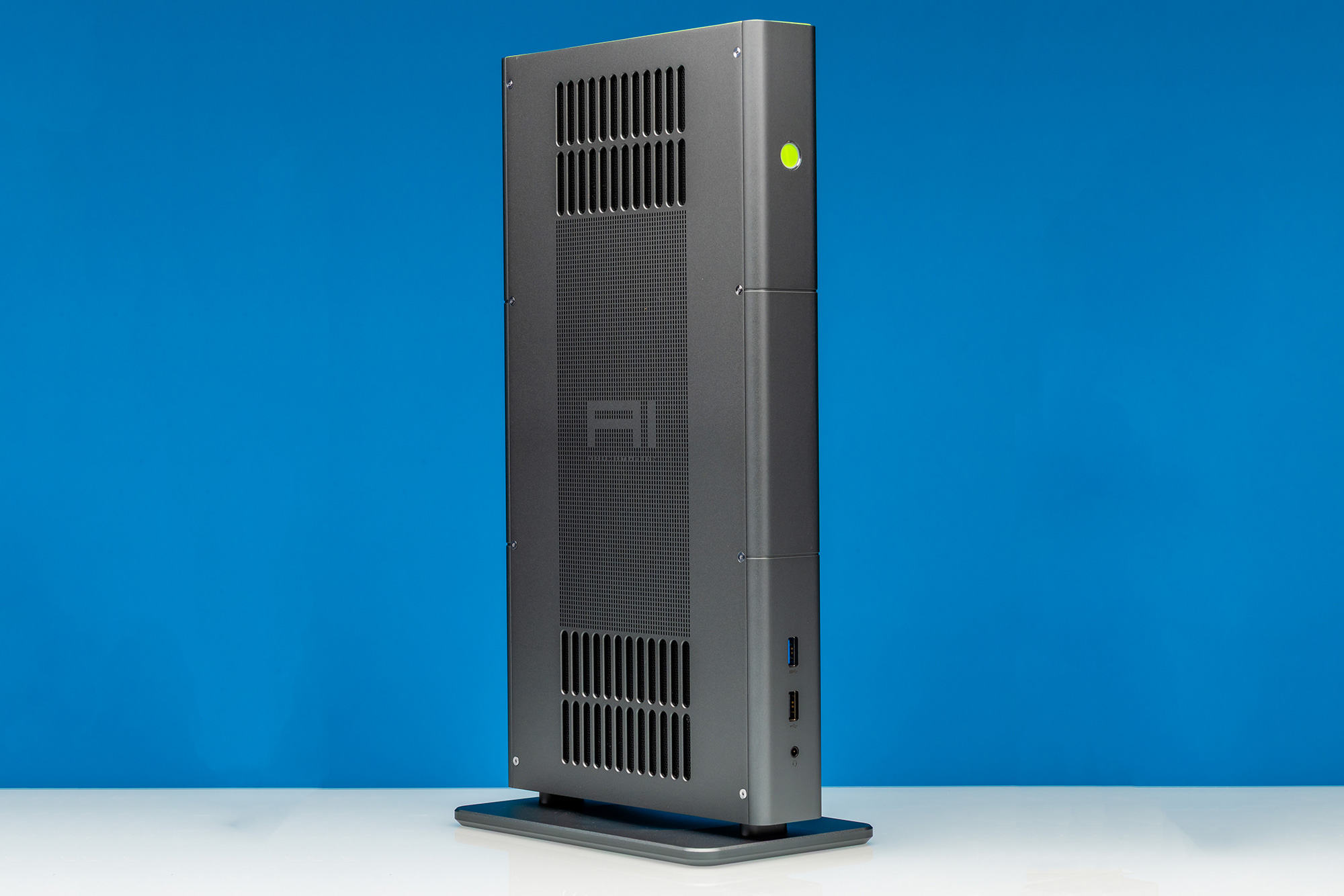
GMKtec departed from the standard horizontal square chassis used on the EVO-X2, shifting the EVO-X3 to a slim, vertical tower layout. The CNC-machined metal chassis measures roughly 41 mm wide and stands about 14 inches high, giving it a footprint reminiscent of an upright gaming console. ServeTheHome pointed out that the bolt-on base stand is required for everyday operation, as it stabilizes the upright chassis and holds mandatory regulatory information. Ventilation grilles wrap around both flanks and the rear heatsink assembly, while the top cover uses plastic to allow unobstructed Wi-Fi 7 and Bluetooth signal transmission. Wccftech noted that the internal thermal module features three cooling fans—two exhaust units at the rear and one intake unit at the front—cooling a triple-heat-pipe heatsink. The BIOS provides three configurable TDP profiles: Quiet at 54W, Balanced at 85W, and Performance at up to 140W. Reviewers found that even under sustained 140W loads, fan acoustics remained controlled and pleasant, though the device relies on a bulky external 300W power brick.
Performance in everyday and demanding work
The EVO-X3 is powered by AMD's flagship Strix Halo processor, the Ryzen AI Max+ 395, featuring 16 full Zen 5 CPU cores, 32 threads, and boost frequencies up to 5.1 GHz. In general compute benchmarks, Wccftech recorded 2,976 points in Geekbench 6 single-core and 20,245 points in multi-core, as well as 7,830 points in Cinebench 2026 multi-core. In local AI evaluations, ServeTheHome tested the EVO-X3 using MLPerf Client 1.6.1 with OrtGenAI and DirectML, reporting an average throughput of 24.7 tokens per second on the Phi 4 14B parameter reasoning model with a 1.46-second time-to-first-token. With the BIOS allowing up to 96GB of the 128GB LPDDR5X-8000 pool to be dedicated to VRAM, the system loaded and executed 70B parameter models entirely in memory without relying on slow system swapping. TechRadar noted, however, that local AI software on Windows still requires command-line familiarity and toolchain tuning, as bundled utilities are not entirely plug-and-play.
Graphics and gaming performance
Graphics duties are handled by the integrated AMD Radeon 8060S, built on RDNA 3.5 silicon with 40 Compute Units and 2,560 stream processors. In synthetic graphics testing, Wccftech logged a 3DMark Time Spy score of 11,150 points, aligning integrated graphics performance with mainstream discrete laptop GPUs like the mobile Nvidia GeForce RTX 4060. Tom's Hardware and independent testing confirmed that this integrated GPU comfortably manages modern AAA gaming titles at 1440p resolution. In Cyberpunk 2077 and Black Myth: Wukong, the system sustained playable frame rates at 1440p using high presets and FSR upscaling. For users needing professional CUDA support or higher 4K graphics rendering, the built-in OCuLink port provides direct PCIe 4.0 x4 lanes to attach an external discrete desktop GPU dock.
Ports and upgradeability
Port distribution is well-rounded for a compact workstation. The chassis incorporates an OCuLink port (PCIe 4.0 x4), one USB4 40 Gbps Type-C port, an HDMI 2.1 video output, multiple USB 3.2 Gen 2 Type-A ports, a 2.5 Gbps Ethernet port, and a 3.5mm combo audio jack. Multi-display configurations can output up to 8K resolution. Internally, upgrade options are restricted to storage. GMKtec includes two M.2 2280 PCIe 4.0 slots, allowing users to swap or add NVMe SSDs. However, the 128GB of LPDDR5X memory is soldered to the motherboard to maintain its high-speed 256-bit bus, meaning system memory cannot be increased or replaced down the road.
Price and configurations
The GMKtec EVO-X3 carries an official retail price of $3,799 for the 128GB RAM and 2TB NVMe SSD configuration, with promotional pre-order windows having briefly listed it around $3,600. A higher-end configuration equipped with 128GB of RAM and a 4TB SSD retails for approximately $3,999. TechRadar and Tom's Hardware highlighted that $3,799 is a steep entry point for a compact desktop. However, ServeTheHome noted that when compared against the current cost of high-density server RAM or multi-card desktop workstation builds necessary to run 70B local models with 128GB of unified memory, the EVO-X3 serves as a cost-effective compact AI node.
Is it worth the money?
While $3,799 is high for a mini PC, having 128GB of unified memory capable of loading large 70B local LLMs makes it significantly less expensive than comparable multi-GPU workstation towers or enterprise server memory kits.
Also consider
- Apple Mac Studio (M4 Max / M2 Ultra)
Provides unified memory configurations up to 128GB or 192GB with polished local AI toolchains and quiet operation, though at high workstation prices and without native x86 Windows support.
- GMKtec EVO-X2
Uses the same 16-core Ryzen AI Max+ 395 processor at a lower price point near $2,000, but in a horizontal chassis with louder cooling fans.
- Beelink GTR9 Pro
A competing AMD Strix Halo compact desktop offering 128GB unified memory and dual 10GbE network interfaces for homelab deployment.
Reviews we read
This roundup summarizes professional reviews and published specifications; Next Interrupt did not test the product. Roundup updated October 24, 2026. How we work
- ServeTheHome — GMKtec EVO-X3 Mini-PC Review Looking at a 128GB AMD Local AI Box
- Wccftech — GMKtec EVO-X3 “AMD Ryzen AI MAX+ 395” Mini PC Review: Enhanced Cooling In A Local AI Powerhouse
- TechRadar — GMKtec EVO-X3 mini PC review: For local AI, the hardware is impressive, but the software still needs work
- Tom's Hardware — GMKtec Evo-X3 review: Strix Halo in a brand new suit