Smart home & cameras / Review roundup
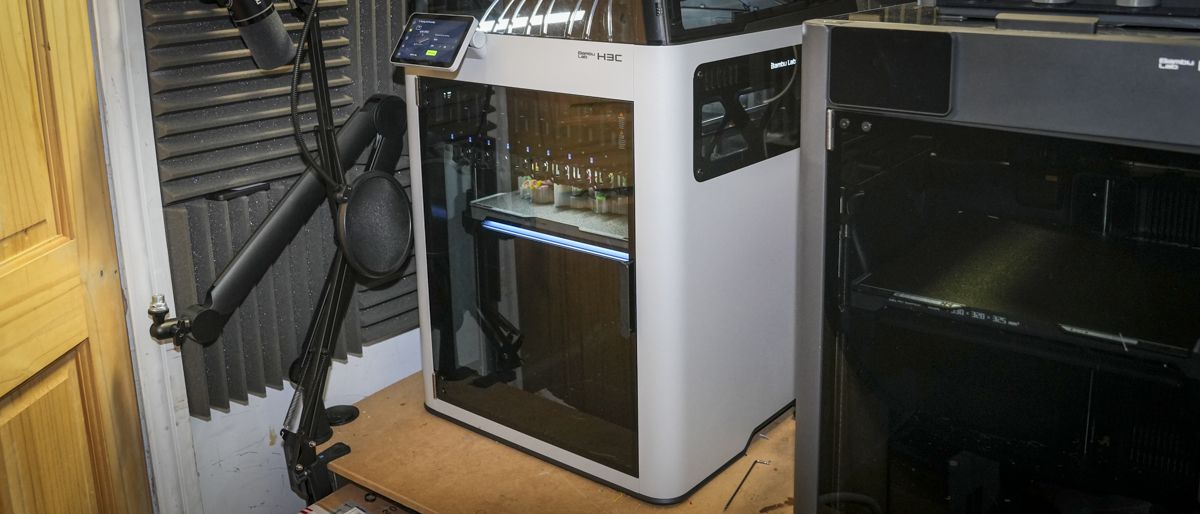
Bambu Lab H3C
with the AMS 3H and all nine PrintTools included
- 5 / 5TechRadar
- 4.5 / 5Tom's Hardware
- 9 / 10How-To Geek
A nine-tool 3D printer with six-second tool swaps and soft TPU support, offset by towering height and a steep price
The Bambu Lab H3C is designed for serious prototyping workshops and multi-color creators who regularly combine rigid and flexible materials. Its standout strength is the Swaptek nine-tool architecture, which switches loaded materials in roughly six seconds while enabling seamless mixing of rigid filaments, soft 75A TPU, and different nozzle sizes in one job. The primary catches are its steep $2,499 asking price and an imposing vertical footprint that exceeds four feet in height when paired with the AMS 3H. Compared with the eight-tool Prusa CORE One+ INDX, the H3C delivers a substantially larger 330 x 320 x 325 mm build envelope and dedicated 2.85 mm filament support, justifying the extra cost for high-volume makers.
Buy it if
- Workshops needing true multi-material prints that blend rigid plastics with flexible TPU
- High-volume multicolor makers looking to eliminate prolonged filament purge cycles
- Technical creators who want to combine multiple nozzle diameters in a single build
Skip it if
- Workspaces with standard overhead shelving that cannot fit a four-foot vertical tower
- Casual hobbyists whose occasional multi-color prints do not justify spending $2,499
- Users needing a compact, portable printer that can be easily repositioned by one person
Where to buy
We may earn a commission from purchases or qualifying sign-ups through our links. Affiliate links explained
What reviewers liked
- Swaptek nine-tool changer completes material handoffs in approximately six seconds
- Handles ultra-soft 75A TPU and 2.85 mm filament alongside standard 1.75 mm plastics
- Roomy 330 x 320 x 325 mm enclosed build volume accommodates large industrial parts
- AMS 3H integrates automated feeding, storage for nine spools, and two active drying bays
- Dramatically reduces filament waste compared to single-nozzle purge-and-wipe systems
What they didn’t
- Steep $2,499 launch price limits accessibility for typical hobbyists
- Towering total height exceeds four feet with the AMS 3H installed on top
- Still requires a priming purge tower, meaning filament waste is not fully eliminated
- Complex multi-diameter nozzle configurations create a steep learning curve in the slicer
Key specs
- Launch price
- $2,499
- Reported price
- $2,499
- Build Volume
- 330 x 320 x 325 mm
- Toolchanger System
- Bambu Lab Swaptek 9-tool switching (approx. 6-second swap time)
- Included PrintTools
- 8x 0.4 mm for 1.75 mm filament, 1x 0.4 mm for 2.85 mm filament
- Filament Management
- AMS 3H unit (9 spool slots, 2 active drying chambers)
- Extrusion System
- Direct-drive FlexFeed with hardened steel nozzles (HRC 55+)
- Max Nozzle Temp
- 300°C (supports PLA, PETG, ABS, PC, PA-CF, TPU 75A to 95A)
- Chamber & Bed
- Fully enclosed heated chamber, magnetic flexible build plate
- Printer Dimensions
- 493 x 571 x 587 mm (machine alone; over 1,200 mm tall with AMS 3H)
- Monitoring
- Integrated AI chamber camera with failure detection and timelapse
In depth
Setup and app
Setting up the Bambu Lab H3C is mechanically straightforward but physically demanding. CNET noted that while the machine arrives mostly assembled, lifting and positioning the heavy chassis requires two people. Its vertical scale is another factor: James Bricknell at CNET reported that once the AMS 3H unit is mounted to the top, the setup stands well over four feet tall, making filament loading difficult on a regular workbench unless placed on Bambu Lab's dedicated rolling cart, which brings the assembly to 63 inches. On the digital side, Tom's Hardware praised the built-in color touchscreen for displaying clear on-screen diagnostic and setup instructions directly on the machine without forcing users to scan external QR codes. TechRadar found that Bambu Studio software handles multi-tool slicing effectively, although configuring multi-diameter nozzles and different material profiles adds complexity that requires patience to dial in.
Core performance
Core performance centers on Bambu Lab's Swaptek architecture, which operates very differently from single-nozzle systems. Tom's Hardware and TechRadar verified that tool swaps take roughly six seconds because each PrintTool is independently wired, loaded, and pre-heated. In contrast to earlier single-nozzle setups that spend minutes retracting, cutting, and purging filament for every color change, the H3C swaps heads almost instantly. Tom's Hardware noted that while it does not eliminate purge waste entirely—requiring a small priming tower to stabilize nozzle pressure—filament waste is vastly reduced. Material versatility is equally strong: Tom's Hardware successfully printed complex items using soft 75A TPU via the dedicated 2.85 mm PrintTool, while TechRadar combined rigid PLA exterior walls with shock-absorbing TPU internal infill in a single test print. Printing speeds remain rapid, though reviewers observed noticeable mechanical clicks as tools dock and detach.
Privacy, local storage and subscriptions
The Bambu Lab H3C operates without mandatory cloud subscriptions, recurring software fees, or feature paywalls. Users can send jobs and monitor prints via the Bambu Handy mobile app and Bambu Studio using the encrypted Bambu Cloud. For privacy-sensitive commercial settings or environments without internet access, the printer supports full offline operation via micro-SD card and a local network LAN-only mode that keeps print files and camera streams strictly within the local firewall. The onboard chamber camera handles AI-driven print failure detection, such as spaghetti errors, entirely on the local processor rather than offloading image feeds to remote third-party servers for inspection.
Reliability
Reviewers found the Swaptek mechanical docking system remarkably consistent over hundreds of print hours. Tom's Hardware observed reliable repeatability across complex multi-tool jobs, noting that the hardwired PrintTools eliminate the mechanical contact wear that can degrade swappable hotend designs over time. The hardened steel nozzles (rated HRC 55+) handled abrasive carbon-fiber blends without premature degradation. However, reviewers pointed out thermal trade-offs in multi-material workflows: community testing indicated that when combining high-temperature engineering plastics like polycarbonate with standard PLA, docked PLA tools can soften if left inside the heated chamber, requiring users to manually unload heat-sensitive spools during extreme high-temperature chamber prints.
Price
At $2,499 for the launch combo—which includes the AMS 3H and all nine PrintTools—the Bambu Lab H3C represents a significant financial commitment. However, reviewers across outlets agreed that it provides exceptional value within the tool-changer category. Historically, nine-tool setups required expensive custom open-source builds or five-figure industrial equipment. Compared with its closest direct competitor, the Prusa CORE One+ INDX 8-Tool (roughly $2,082 assembled), the H3C provides a ninth toolhead, a substantially larger 330 x 320 x 325 mm build area, native 2.85 mm TPU support, and two integrated filament drying bays. For businesses and prototyping labs that lose hours to multi-color purge cycles, the time and material savings make the entry cost easily defensible.
Is it worth the money?
The $2,499 launch combo includes the AMS 3H and nine PrintTools. While a high barrier for casual hobbyists, reviewers consider it competitively priced against rival commercial tool changers.
Also consider
- Prusa CORE One+ INDX 8-Tool
An eight-tool enclosed changer priced around $2,082 assembled, offering open-source hardware but a much smaller print volume.
- Snapmaker U1
A $899 four-tool changer that provides an affordable entry into tool swapping for users who do not need nine heads.
- Bambu Lab H2C Combo
Bambu's previous multi-filament printer at $2,199, which uses a single-extruder hotend changer rather than fully independent toolheads.
Reviews we read
This roundup summarizes professional reviews and published specifications; Next Interrupt did not test the product. Roundup updated November 4, 2026. How we work