Laptops & desktops / Review roundup
Asus TUF Gaming A16
RTX 5050 115 W | Ryzen 7 260
- 88%PC Gamer
A well-balanced budget gaming rig with punchy audio and surprisingly stout 1080p performance
Budget-conscious gamers looking for a dependable 1080p machine with good battery life should place the Asus TUF Gaming A16 near the top of their list. Its biggest strength is its balanced component selection, coupling an uncapped 115 W RTX 5050 with an eight-core Ryzen 7 260 and unusually punchy laptop speakers. The main compromise is long-term futureproofing, as the entry-level GPU and 16 GB of system memory will strain in future demanding titles. Compared to rivals like the Lenovo Legion 5 and MSI Katana 15 HX, the TUF A16 delivers far better battery stamina and a sturdier, cleaner chassis for the money.
Buy it if
- Gamers seeking smooth 60+ fps performance in modern AAA titles at 1080p and 1200p.
- Users who want solid battery life from a gaming laptop without carrying a charger everywhere.
- Shoppers prioritizing user-upgradeable memory and storage over soldered components.
Skip it if
- You intend to run games with heavy ray tracing at native 1440p resolutions.
- You dislike cleaning fingerprint smudges off matte plastic and aluminum surfaces.
Where to buy
We may earn a commission from purchases or qualifying sign-ups through our links. Affiliate links explained
What reviewers liked
- Stout 115 W TGP RTX 5050 matches or beats lower-wattage RTX 5060 laptops
- Class-leading 90 Wh battery ran for 112 minutes in PCMark 10 gaming tests
- Impressive speaker output with audible bass and low distortion at maximum volume
- Accessible dual SO-DIMM memory slots and two M.2 PCIe 4.0 SSD slots
- Clean, understated Jaeger Gray chassis with military-grade drop resistance
What they didn’t
- Satin finish attracts oily fingerprints quickly
- Asus Armoury Crate management software remains clunky
- Modest 8 GB GPU VRAM may limit high-settings gaming three to four years out
Key specs
- Launch price
- $1,099
- Reported price
- $950 - $1,050
- Starting price
- $1,099
- Processor
- AMD Ryzen 7 260 (8 cores, 16 threads, up to 5.1 GHz boost)
- Graphics
- Nvidia GeForce RTX 5050 Laptop GPU (8 GB GDDR7, up to 115 W TGP)
- Memory
- 16 GB DDR5-5600 MT/s (2x 8 GB SO-DIMM, dual-channel, upgradeable)
- Storage
- 512 GB or 1 TB PCIe 4.0 NVMe SSD (2x M.2 slots)
- Display
- 16.0-inch IPS-level, 1920 x 1200, 16:10, 165 Hz, G-Sync
- Battery capacity
- 90 Wh (240 W power brick included, supports 100 W USB-C PD)
- Weight
- 2.20 kg (4.85 lbs)
- Dimensions
- 354 x 269 x 17.9–25.7 mm (13.94 x 10.59 x 0.70–1.01 in)
In depth
Design, build and portability
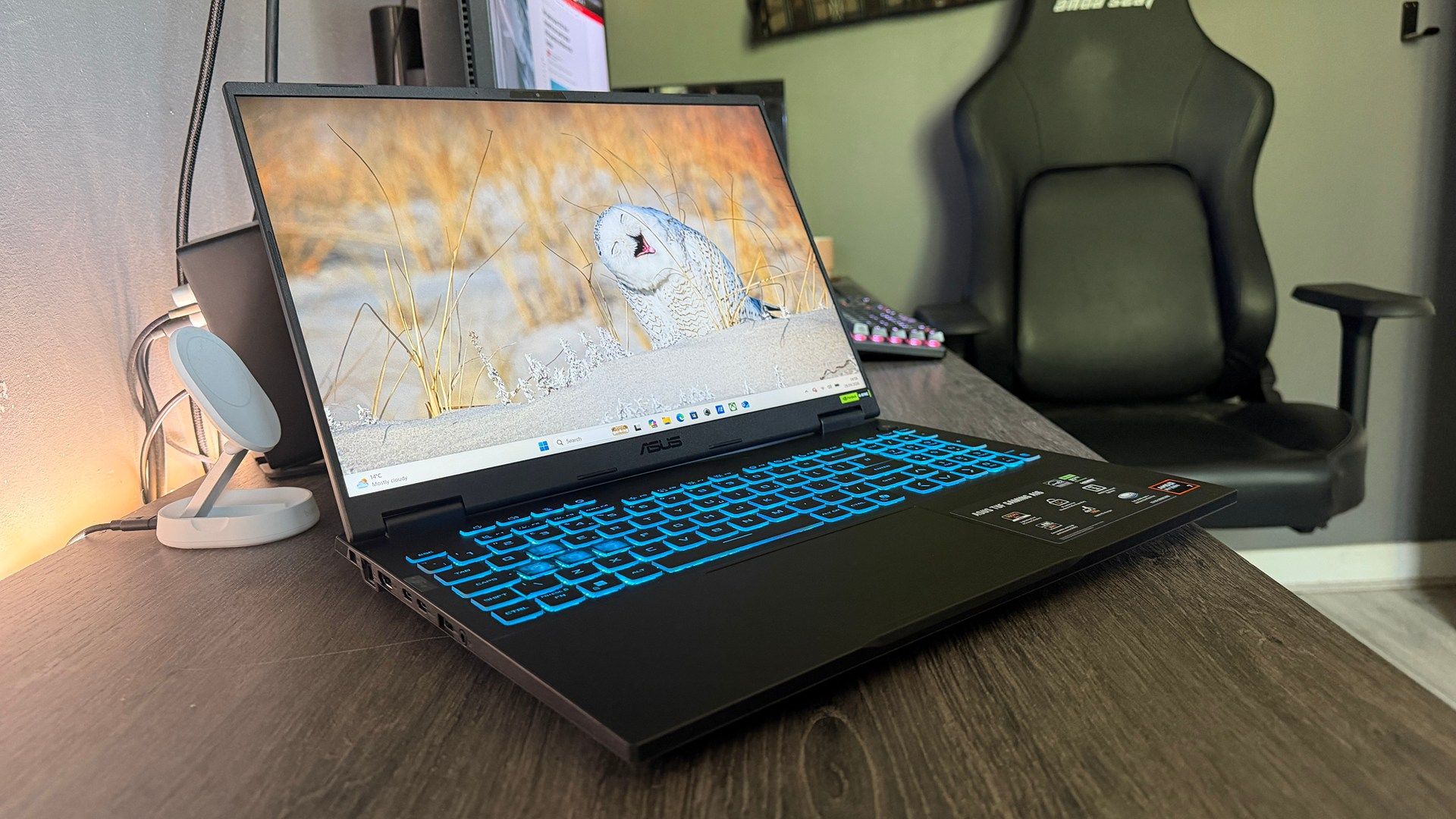
The Asus TUF Gaming A16 moves away from aggressive gamer aesthetics, adopting a subdued Jaeger Gray exterior with a satin-touch texture and an embossed TUF logo on its aluminum lid. It measures between 17.9 mm and 25.7 mm thick and weighs 2.20 kg (4.85 lbs), making it reasonably portable for a 16-inch gaming notebook. The chassis feels rigid and meets MIL-STD-810H durability standards. Reviewers at PC Gamer praised the thin display bezels and understated profile, though they noted the satin surfaces collect noticeable fingerprint oils during daily use.
Display
The evaluated configuration features a 16.0-inch 16:10 IPS-level screen with a 1920 x 1200 resolution and a 165 Hz refresh rate. PC Gamer reported that brightness is strong, color reproduction pops, and ghosting or panel latency is minimal. Nvidia G-Sync integration prevents tearing in games where frame rates fluctuate. While Asus offers higher-resolution 2560 x 1600 options on premium trims, reviewers considered the 1200p panel the ideal match for an RTX 5050, allowing games to run comfortably without dragging frame rates down.
Performance in everyday and demanding work
Under the hood sits an AMD Ryzen 7 260 processor boasting eight Zen 4 cores and 16 threads with a 5.1 GHz boost clock, paired with Nvidia's GeForce RTX 5050. While the RTX 5050 is an entry-level GPU, Asus tuned it to draw up to 115 W of total graphics power. In PC Gamer's testing, this elevated wattage allowed the TUF A16 to outscore laptops equipped with lower-wattage (85 W) RTX 5060 GPUs in synthetic 3DMark benchmarks and match them in titles like Cyberpunk 2077. General multitasking and CPU-intensive duties rival Intel Core i7 and Ultra 7 laptops, though PC Gamer cautioned that 16 GB of system memory and 8 GB of VRAM will require setting adjustments as games evolve over the next three to four years.
Battery life
Battery longevity is an area where the TUF Gaming A16 separated itself from its direct competitors. Armed with a 90 Wh internal battery, it logged 112 minutes in PCMark 10's gaming battery benchmark in PC Gamer's lab. That nearly doubled the 64 minutes recorded by the Lenovo Legion 5 and easily cleared the MSI Katana 15 HX at 71 minutes. When dialed into eco mode for web browsing and text editing, reviewers found it provides over eight hours of typical office productivity. Recharging is handled by an included 240 W barrel-plug adapter, with supplemental support for 100 W over USB Type-C Power Delivery.
Keyboard, trackpad, speakers and webcam
The single-zone RGB chiclet keyboard offers dependable key travel for typing and gaming, though PC Gamer characterized it as functional rather than exceptional. The sizable touchpad provides smooth glide and accurate tracking for everyday desktop tasks. The 1080p webcam delivers acceptable clarity for video meetings. Speakers were a standout surprise: PC Gamer reported unusually high performance for this class, producing clear mids, smooth treble, and palpable bass with minimal distortion even at top volume.
Ports and upgradeability
Port selection is thorough: the chassis features three USB Type-A ports (two USB 3.2 Gen 2 and one USB 2.0), two USB Type-C ports (one USB4 with DisplayPort and 100 W Power Delivery, plus one USB 3.2 Gen 2), an HDMI 2.1 video output, an RJ45 Gigabit Ethernet port, and a 3.5 mm combo audio jack. Internal upgradeability is another high point. Asus avoided soldered RAM, fitting two standard SO-DIMM slots in a dual-channel configuration alongside two M.2 PCIe 4.0 SSD slots for straightforward future storage additions.
Price and configurations
In the United States, the Asus TUF Gaming A16 in this base hardware trim (model FA608UHI) launched at $1,099 with a 512 GB SSD, while European and UK variants with a 1 TB SSD arrived around £1,260. Retail discounts frequently see it drop under $1,000 during major sales events. Higher configurations step up to an RTX 5060 or RTX 5070 and a 2560 x 1600 panel, but reviewers noted the RTX 5050 version at around $1,000 delivers the most compelling value of the line.
Is it worth the money?
Delivers strong value around $1,000 thanks to its uncapped 115 W GPU wattage, generous 90 Wh battery, and fully upgradeable memory and storage slots.
Benchmarks
PERFORMANCE
Benchmarks
Baldur's Gate 3 (1080p Ultra)
Higher is better · FPSPC Gamer · full test results ↗Published 2026-09-30 · checked 2026-10-09
Baldur's Gate 3 (1080p Ultra) · Asus TUF Gaming A16: RTX 5050 115 W | Ryzen 7 260
Results apply to this publication’s tested models and settings. Check those details before comparing another review.
Test data and methodology
| Product | Result | Test scope |
|---|---|---|
| Asus TUF Gaming A16 | 63 | Reviewed model only |
Bars start at zero. Results apply to the tested configuration and settings. A suite average is not the frame rate of every game. Missing products are never assigned zero.
Also consider
- Lenovo Legion 5
Provides a slightly sleeker chassis and optional sharper display, but lags behind with roughly half the gaming battery life.
- MSI Katana 15 HX
Offers aggressive pricing for mid-range gaming, but comes with a smaller battery, shorter endurance, and heavier gaming styling.
- Acer Nitro 16
Delivers comparable 16-inch 16:10 gaming performance with good cooling, though in a slightly heavier and bulkier package.
Reviews we read
This roundup summarizes professional reviews and published specifications; Next Interrupt did not test the product. Roundup updated November 10, 2026. How we work